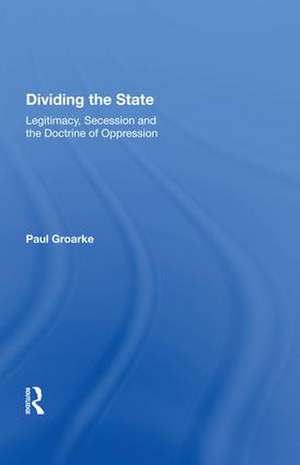
Dividing the State: Legitimacy, Secession and the Doctrine of Oppression
Autor Paul Groarkeen Limba Engleză Hardback – 18 dec 2017
Preț: 1112.48 lei
Preț vechi: 1356.68 lei
-18%
Puncte Express: 1669
Carte tipărită la comandă
Livrare economică 01-15 decembrie
Livrare prin curier în România Termenul estimat este afișat lângă disponibilitate.
Transport gratuit pentru acest produs Plată online sau ramburs, în funcție de opțiunile comenzii.
Retur gratuit în 14 zile Comandă securizată și suport în română.
Specificații
ISBN-13: 9780815388616
ISBN-10: 0815388616
Pagini: 220
Dimensiuni: 156 x 234 x 14 mm
Greutate: 0.45 kg
Ediția:1
Editura: Taylor & Francis
Colecția Routledge
Locul publicării:Oxford, United Kingdom
ISBN-10: 0815388616
Pagini: 220
Dimensiuni: 156 x 234 x 14 mm
Greutate: 0.45 kg
Ediția:1
Editura: Taylor & Francis
Colecția Routledge
Locul publicării:Oxford, United Kingdom
V-ar putea interesa
-
 Yearbook on International Investment Law & Policy 2012-2013Andrea Bjorklund-38%Preț: 1389.32 lei2231.60 lei
 -
 Preț: 404.23 lei
 -
 Preț: 412.99 lei
 -
 On the Essence of Legal ConsciousnessIvan Il'In-15%Preț: 576.58 lei678.33 lei
 -
 -18%Preț: 1117.96 lei1363.36 lei
 -
 Employment LawUK) Sargeant, Malcolm (Middlesex UniversityPreț: 295.05 lei
 -
 Law and Fair Work in ChinaSean Cooney-15%Preț: 431.60 lei507.77 lei
 -
 -18%Preț: 1100.24 lei1341.76 lei
 -
 Indivisible: Indigenous Human RightsJoyce Green-23%Preț: 174.76 lei227.39 lei
 -
 Evolution Of The United Nations SystemAmos Yoder-9%Preț: 1129.40 lei1241.10 lei
 -
 -23%Preț: 561.55 lei729.28 lei
 -
 La justice juvénile réparatrice à la lumière des droits de l'enfantRadoslava KarabashevaPreț: 257.64 lei
 -
 Le concept d'indérogeabilité en droit international Tome IDelphine Olivia Hayim-19%Preț: 620.76 lei766.37 lei
 -
 Preț: 308.52 lei
Cuprins
Contents: Introduction; Legitimacy; The legal concept of legitimacy; The historical problem of sovereignty; Solving the historical problem; Existing theories of secession; Institutional and legal issues; Philosophical framework; A legal theory of secession; Practice issues; Conclusion: institutional reform; Select Bibliography; Index.
Descriere
This book accordingly argues for a global system of justice based on a domestic model of compulsory law.