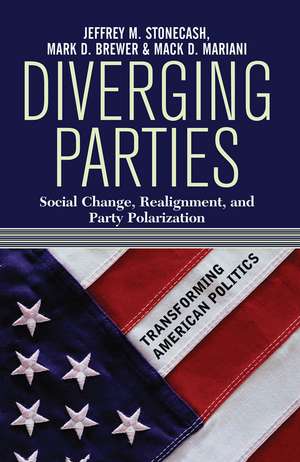
Diverging Parties: Social Change, Realignment, and Party Polarization
Autor Jeffrey M. Stonecash, Mark D. Brewer, Mack Marianien Limba Engleză Hardback – 28 aug 2019
Preț: 1112.48 lei
Preț vechi: 1356.68 lei
-18%
Puncte Express: 1669
Carte tipărită la comandă
Livrare economică 02-16 decembrie
Livrare prin curier în România Termenul estimat este afișat lângă disponibilitate.
Transport gratuit pentru acest produs Plată online sau ramburs, în funcție de opțiunile comenzii.
Retur gratuit în 14 zile Comandă securizată și suport în română.
Specificații
ISBN-13: 9780367315412
ISBN-10: 0367315416
Pagini: 208
Dimensiuni: 152 x 229 mm
Greutate: 0.45 kg
Ediția:1
Editura: Taylor & Francis
Colecția Routledge
Locul publicării:Oxford, United Kingdom
ISBN-10: 0367315416
Pagini: 208
Dimensiuni: 152 x 229 mm
Greutate: 0.45 kg
Ediția:1
Editura: Taylor & Francis
Colecția Routledge
Locul publicării:Oxford, United Kingdom
V-ar putea interesa
-
 Political Order and Political DecayFrancis FukuyamaPreț: 136.06 lei
 -
 Turkish AwakeningAlev ScottPreț: 93.91 lei
 -
 On Power and IdeologyNoam Chomsky-8%Preț: 660.97 lei718.45 lei
 -
 Public OpinionCarroll J. Glynn-15%Preț: 459.76 lei540.89 lei
 -
 -15%Preț: 437.03 lei514.15 lei
 -
 -25%Preț: 181.35 lei240.36 lei
 -
 Private IslandJames MeekPreț: 166.22 lei
 -
 -21%Preț: 42.80 lei54.20 lei
Cuprins
1 The Reemergence of Party Polarization -- 2 Explaining Increasing Conflict -- 3 The Origins of Increased Party Polarization -- 4 Social Change and Political Implications -- 5 Social Change, Realignment, and Party Polarization -- 6 Constituencies and Party Conflict -- 7 Interpreting Congressional Elections: The Limits of the Candidate-Centered Framework
Notă biografică
Jeff Stonecash is professor and chair of the Department of Political Science at Syracuse University's Maxwell School. He is the author of Diverging Parties and Class and Party in American Politics. Mark D. Brewer is a visiting assistant professor in the Department of Government at Colby College. Mack Mariani is Director of Special Projects for the Monroe County Department of Communications and a Ph.D. candidate in Political Science at the Maxwell School of Citizenship and Public Affairs at Syracuse University. Previously, he served as an aide to U.S. Representative Bill Paxon and a staff member for the Monroe County Legislature.
Descriere
Explores how redistricting, demographic shifts, and political polarization are impacting legislation and voting behavior in the US Congress. . Party polarization in the House of Representatives has increased in recent decades. Explaining this development has been difficult, given current interpretations of American elections. The dominant framework for interpreting elections has been to see them as candidate-centered, or individualistic. This framework may have seemed appropriate as a way to see elections during the 1970s and 1980s, when identification with parties declined and split-ticket voting increased. With increasing party differences, however, the presumptions that campaigns focus on candidates separate from parties, and that voters are less partisan in their voting, do not provide a satisfactory framework for understanding our current situation. This proposed book explains the emergence of party polarization by focusing on how the constituencies of House districts affect partisan outcomes and the subsequent voting behavior of House members. This proposed analysis is premised on the simple argument that members are elected from districts, and an explanation of polarization must begin with districts. The origins of polarization lie in the realignment of the electoral bases of the parties, and the shifting demographic composition of America. Liberal voting is more likely among members from urban, lower-income, largely non-white districts. Conservative voting is more likely among members from higher-income, largely white districts. Realignment has resulted in Democrats representing urban, lower-income, heavily non-white districts, while Republicans are more likely to come from suburban-rural, more affluent, white districts. Perhaps most important, the percentage of districts with a substantial proportion of non-whites is steadily increasing in the United States. The analysis will focus primarily on changes since the 1960s.