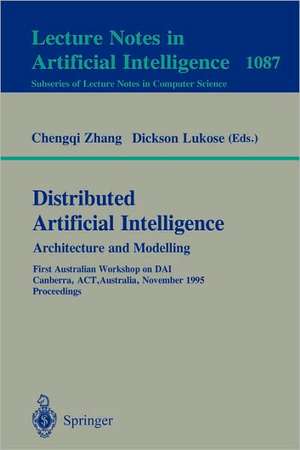
Distributed Artificial Intelligence: Architecture and Modelling
Editat de Chengqi Zhang, Dickson Lukoseen Limba Engleză Paperback – 12 iun 1996
The 16 full papers included in the book are revised versions of the contributions accepted for presentation at the workshop; they cover a wide range of current issues in the field of DAI, such as formal frameworks, methodology, theory, and architecture; various aspects of agents and multi-agent systems are addressed.
Preț: 332.26 lei
Preț vechi: 415.32 lei
-20%
Puncte Express: 498
Carte tipărită la comandă
Livrare economică 28 noiembrie-12 decembrie
Livrare prin curier în România Termenul estimat este afișat lângă disponibilitate.
Transport gratuit de la 400.00 lei Plată online sau ramburs, în funcție de opțiunile comenzii.
Retur gratuit în 14 zile Comandă securizată și suport în română.
Specificații
ISBN-13: 9783540613145
ISBN-10: 3540613145
Pagini: 248
Ilustrații: X, 238 p.
Dimensiuni: 155 x 235 x 14 mm
Greutate: 0.38 kg
Ediția:1996
Editura: Springer
Locul publicării:Berlin, Heidelberg, Germany
ISBN-10: 3540613145
Pagini: 248
Ilustrații: X, 238 p.
Dimensiuni: 155 x 235 x 14 mm
Greutate: 0.38 kg
Ediția:1996
Editura: Springer
Locul publicării:Berlin, Heidelberg, Germany
V-ar putea interesa
-
 -20%Preț: 89.95 lei112.23 lei
 -
 Computer VisionSimon J. D. Prince-20%Preț: 582.72 lei728.39 lei
 -
 Machine LearningPeter Flach-20%Preț: 386.84 lei483.55 lei
 -
 Multi-Agent Machine LearningSchwartz-20%Preț: 675.81 lei844.77 lei
 -
 Wavelet Neural NetworksAntonis K Alexandridis-20%Preț: 634.18 lei792.72 lei
 -
 Practical Introduction to CompDawson-Howe-20%Preț: 518.21 lei647.76 lei
 -
 Machine Learning: An Algorithmic Perspective, Second EditionStephen Marsland-20%Preț: 625.22 lei781.53 lei
 -
 Domain Driven Data MiningLongbing Cao-20%Preț: 647.06 lei808.83 lei
 -
 -9%Preț: 987.33 lei1084.98 lei
 -
 Intelligent Strategies for Pathway MiningQingfeng Chen-31%Preț: 276.95 lei402.40 lei
 -
 Data ScienceChengqi Zhang-20%Preț: 329.93 lei412.41 lei
 -
 -20%Preț: 656.02 lei820.02 lei
 -
 Secure Transaction Protocol AnalysisQingfeng Chen-20%Preț: 332.26 lei415.32 lei
 -
 Multi-Agent Systems for SocietyDickson Lukose-20%Preț: 328.72 lei410.89 lei
 -
 -20%Preț: 317.05 lei396.31 lei
 -
 Believable BotsPhilip Hingston-20%Preț: 676.70 lei845.88 lei
 -
 Modelling and Control of Dialysis SystemsAhmad Taher Azar-20%Preț: 1252.93 lei1566.17 lei
 -
 Hybrid MetaheuristicsEl-Ghazali Talbi-28%Preț: 1041.08 lei1455.95 lei
 -
 Computational Intelligence in Intelligent Data AnalysisChristian Moewes-20%Preț: 1277.72 lei1597.15 lei
 -
 -20%Preț: 950.17 lei1187.71 lei
 -
 Modeling Users' Experiences with Interactive SystemsEvangelos Karapanos-20%Preț: 617.54 lei771.93 lei
 -
 Intelligent Distributed Computing VIGiancarlo Fortino-20%Preț: 993.16 lei1241.45 lei
 -
 Metaheuristics for Dynamic OptimizationEnrique Alba-20%Preț: 959.82 lei1199.77 lei
 -
 -20%Preț: 615.30 lei769.12 lei
Public țintă
ResearchCuprins
Definition and application of a comprehensive framework for distributed problem solving.- A logical framework for multi-agent systems and joint attitudes.- A kernel-oriented model for autonomous-agent coalition-formation in general environments.- A knowledge-level model of co-ordination.- An evolutionary model of multi-agent systems.- Engagement and cooperation in motivated agent modelling.- A methodology for developing agent based systems.- Plans and the revision of intentions.- A formal view of social dependence networks.- From practice to theory in designing autonomous agents.- Motivation and perception mechanisms in mobile agents for electronic commerce.- Integrated agent architecture: Execution and recognition of mental-states.- Neural network strategies for solving synthesis problems in non-conflict cases in distributed expert systems.- A linearly quasi-anticipatory autonomous agent architecture: Some preliminary experiments.- Cooperation among opportunistic agents on a distributed environment.- A scenario-based design method and an environment for the development of multiagent systems.