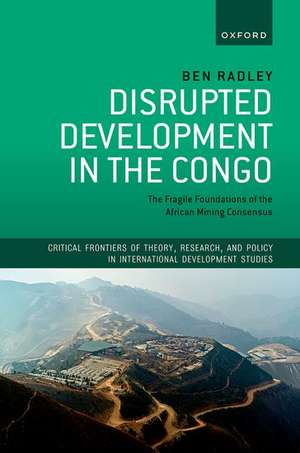
Disrupted Development in the Congo: The Fragile Foundations of the African Mining Consensus: Critical Frontiers of Theory, Research, and Policy in International Development Studies
Autor Ben Radleyen Limba Engleză Hardback – 16 noi 2023
Din seria Critical Frontiers of Theory, Research, and Policy in International Development Studies
- 10%
 Preț: 332.57 lei
 - 19%
 Preț: 590.62 lei
 - 14%
 Preț: 256.34 lei
 - 16%
 Preț: 162.34 lei
 - 19%
 Preț: 679.26 lei
 - 19%
 Preț: 258.79 lei
 - 32%
 Preț: 656.92 lei
 - 31%
 Preț: 589.58 lei
 - 30%
 Preț: 557.45 lei
 - 28%
 Preț: 382.21 lei
 - 13%
 Preț: 279.74 lei
 - 30%
 Preț: 563.24 lei
 - 23%
 Preț: 591.84 lei
 - 29%
 Preț: 575.41 lei
 - 32%
 Preț: 654.70 lei
 - 19%
 Preț: 592.20 lei
 - 32%
 Preț: 633.22 lei
 - 32%
 Preț: 616.84 lei
 - 31%
 Preț: 558.33 lei
 - nou
 Preț: 628.66 lei
 - nou
 Preț: 631.02 lei
Preț: 558.21 lei
Preț vechi: 820.85 lei
-32%
Puncte Express: 837
Carte disponibilă
Livrare economică 13-24 noiembrie
Livrare prin curier în România Termenul estimat este afișat lângă disponibilitate.
Transport gratuit pentru acest produs Plată online sau ramburs, în funcție de opțiunile comenzii.
Retur gratuit în 14 zile Comandă securizată și suport în română.
Specificații
ISBN-13: 9780192849052
ISBN-10: 0192849050
Pagini: 214
Dimensiuni: 160 x 240 x 17 mm
Greutate: 0.47 kg
Editura: OUP OXFORD
Colecția OUP Oxford
Seria Critical Frontiers of Theory, Research, and Policy in International Development Studies
Locul publicării:Oxford, United Kingdom
ISBN-10: 0192849050
Pagini: 214
Dimensiuni: 160 x 240 x 17 mm
Greutate: 0.47 kg
Editura: OUP OXFORD
Colecția OUP Oxford
Seria Critical Frontiers of Theory, Research, and Policy in International Development Studies
Locul publicării:Oxford, United Kingdom
Recenzii
This book is a major contribution to scholarship on economic development in low-income countries by its brilliant analysis of theories of development from Raul Prebisch and the CEPAL structuralists in Latin America to Samir Amin and his followers in Africa. It ought to be read by all those interested in economic development in mineral-rich countries in Africa and in other countries of the South.
The analysis in this book should inspire policy makers in African countries who hope to chart a new course towards resource-based industrialization that is transformative, inclusive, and sustainable.
In this hard-headed and systematic critique, Radley reveals how domestic forces in and around mining create more favourable opportunities for developing national sovereign projects in Africa. A must read for anyone looking for radical policy alternatives.
Disrupted Development in the Congo is a meticulous, essential and dystopian study tracing how one such foreign-led enterprise - now defunct Banro Corp. - established an ambitious project to industrially source gold from two major mining areas in eastern DRC (Twangiza in South Kivu province and Namoya in Maniema province).
This book is an essential resource for policymakers, development economists, scholars, and students interested in the dynamics of mining-based economies and their broader socio-economic implications. It also serves as an invaluable reference for NGOs and international bodies involved in formulating and implementing development policies in Africa. The insights provided are crucial for anyone committed to fostering sustainable development in resource-rich, low-income countries, making it a cornerstone text for understanding and improving economic development frameworks in similar contexts.
Disrupted Development in the Congo is a harrowing tale of how positivist theory and corporate practice go hand in hand not only in devastating indigenous development in the periphery, but also in creating - as Polanyi (1944) remarked and the case of Banro corroborates - an ultimately self-destructive machine.
The analysis in this book should inspire policy makers in African countries who hope to chart a new course towards resource-based industrialization that is transformative, inclusive, and sustainable.
In this hard-headed and systematic critique, Radley reveals how domestic forces in and around mining create more favourable opportunities for developing national sovereign projects in Africa. A must read for anyone looking for radical policy alternatives.
Disrupted Development in the Congo is a meticulous, essential and dystopian study tracing how one such foreign-led enterprise - now defunct Banro Corp. - established an ambitious project to industrially source gold from two major mining areas in eastern DRC (Twangiza in South Kivu province and Namoya in Maniema province).
This book is an essential resource for policymakers, development economists, scholars, and students interested in the dynamics of mining-based economies and their broader socio-economic implications. It also serves as an invaluable reference for NGOs and international bodies involved in formulating and implementing development policies in Africa. The insights provided are crucial for anyone committed to fostering sustainable development in resource-rich, low-income countries, making it a cornerstone text for understanding and improving economic development frameworks in similar contexts.
Disrupted Development in the Congo is a harrowing tale of how positivist theory and corporate practice go hand in hand not only in devastating indigenous development in the periphery, but also in creating - as Polanyi (1944) remarked and the case of Banro corroborates - an ultimately self-destructive machine.
Notă biografică
Ben Radley is a Lecturer in International Development at the University of Bath. He earned a PhD (cum laude) in Development Studies at the International Institute of Social Studies (ISS) in The Hague. His research centres on processes of economic transformation in Central Africa, with a focus on labour dynamics and the role played by Northern corporations. He is an affiliated member of Centre d'Expertise en Gestion Minière at the Catholic University of Bukavu, and sits on the editorial board of Review of African Political Economy.