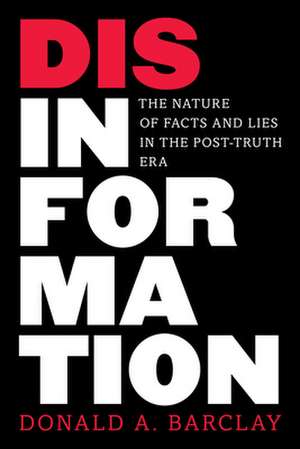
Disinformation: The Nature of Facts and Lies in the Post-Truth Era
Autor Donald A. Barclayen Limba Engleză Hardback – 15 apr 2022
Disinformation explains:
How human psychology-the very way our brains work-can leave us vulnerable to disinformation.How the early visions of what a global computer network would and should be unintentionally laid the groundwork for the current post-truth culture.The ways in which truth is twisted and misrepresented via propaganda and conspiracy theories. How new technology not only spreads disinformation but may also be changing the way we think.The ways in which the economics of information and the powerful influence of popular culture have contributed to the creation of the post-truth culture.Unlike the far-too-numerous one-sided, politically ideological treatments of the post-truth culture, Disinformation does not seek to point the finger of blame at any individuals or groups; instead, its focus is on how a number of disparate forces have influenced human behaviors during a time when all of humanity is struggling to better understand and more effectively control (for better or worse) challenging new technologies that are straining the limits of human intellectual and emotional capacity.
Preț: 195.30 lei
Preț vechi: 241.55 lei
-19%
Carte tipărită la comandă
Livrare economică 30 noiembrie-14 decembrie
Specificații
ISBN-10: 1538144085
Pagini: 312
Ilustrații: 6 b/w photos; 11 textboxes
Dimensiuni: 160 x 232 x 24 mm
Greutate: 0.88 kg
Editura: Bloomsbury Publishing
Colecția Rowman & Littlefield
Locul publicării:New York, United States
V-ar putea interesa
-
 Serving Online Customers: Lessons for Libraries from the Business WorldDonald A. Barclay-29%Preț: 708.65 lei1004.07 lei
 -
 Investigative JournalismWilliam Gaines-23%Preț: 461.96 lei599.94 lei
 -
 Transdisciplinary Ethnography in India: Women in the FieldRosa Maria PerezPreț: 430.50 lei
 -
 Social Media Theory and Communications PracticeWhitney Lehmann-18%Preț: 1150.00 lei1402.44 lei
 -
 Technologies and Trends in the Halal IndustryNor Aida Abdul Rahman-18%Preț: 1126.68 lei1374.00 lei
 -
 -24%Preț: 145.23 lei190.50 lei
 -
 What Went Wrong With BrexitPeter FosterPreț: 106.07 lei
 -
 Preț: 86.22 lei
 -
 Preț: 161.62 lei
 -
 Preț: 145.92 lei
 -
 Le poëte déchu, fragment inéditAlfred De MussetPreț: 78.83 lei
 -
 Voyage du tour du monde. Traduit de l'italien. Tome 1Giovanni Francesco Gemelli CareriPreț: 246.11 lei
 -
 Voyage du tour du monde. Traduit de l'italien. Tome 4Giovanni Francesco Gemelli CareriPreț: 253.50 lei
 -
 Voyage du tour du monde. Traduit de l'italien. Tome 6Giovanni Francesco Gemelli CareriPreț: 253.77 lei
 -
 Preț: 253.30 lei
 -
 Preț: 176.92 lei
 -
 Le Cocq ou MémoiresHippocratePreț: 123.45 lei
 -
 Preț: 124.46 lei
 -
 Journaux départementauxEdgard PourcellePreț: 208.54 lei
 -
 Preț: 86.49 lei
 -
 Preț: 116.05 lei
 -
 Comunicação Intersubjetiva na Negociação Integrativa: CRIAÇÃO DE VALORMurilo Furtado de Mendonça JuniorPreț: 319.69 lei
 -
 Future Book(s)Pia PolPreț: 194.86 lei
Cuprins
Acknowledgements
Preface
Chapter 1: The Meaning of Truth in the Post-Truth Culture
Chapter 2: The Science of the Mind and the Post-Truth Culture
Chapter 3: Digital Utopias Lost: Conflicting How the Dreams from the Dawn of Cyberspace Diverged
Chapter 4: As We May Come to Think: How Technology Changes Way We Think
Chapter 5: Propaganda: The Good, the Bad, and the Persuasive
Chapter 6: Information Wants to Be Free-And Why It Is Not
Chapter 7: Conspiracy Theories in the Post-Truth Culture
Chapter 8: The Powerful Influence of Popular Culture-Amplified by Digital Technology-On the Post-Truth Culture.
About the Author
Recenzii
In this bold philosophical examination, Barclay looks at how humans and technology combine when it comes to presenting facts and lies in a post-truth culture. The expression post-truth was widely used during the 2016 presidential election, and that contest serves as case-study material later in the book. Barclay sets out to demonstrate how history, technology, the economy, and the human psyche influence the post-truth culture. The first several chapters explore the philosophical nature of truth, methodologies for examining arguments for truth, and the histories of technology and propaganda. Subsequent chapters examine the economics of information in cyberspace and the allure of conspiracy theories. A concluding chapter establishes that humans control popular culture and thus control influences on truth. Barclay's is an unbiased and thorough treatment of this important and expanding conversation. Recommended. Upper-division undergraduates through faculty and professionals.
Donald Barclay beautifully adds a strong voice to the much-needed discourse on disinformation and living in a post-truth era. By combining solid, academic research with a clear and concise writing style, Barclay delivers a great, accessible book that is an absolute must-read for everyone.
Barclay approaches the post-truth landscape by looking deeply across the humanities, technology, and popular culture. He offers a clear-eyed, practical perspective to clearing out the confusion about the epistemic crisis we face today. This book is a refreshing and optimistic antidote to the surfeit of superficiality and fear-mongering that is capitalizing our public fascination with the disinformation industry.
Barclay's latest book defines and examines post-truth culture with an unwavering eye,
addressing the dangers of these unprecedented times while simultaneously holding out
hope. It is both an effective textbook on the topic of disinformation and an engaging and
thought-provoking look at the world we have created and is a most relevant addition to
any public or academic library.
Notă biografică
Donald A. Barclay worked as an academic librarian from 1990 until his retirement in 2022, during his library career holding positions at New Mexico State University, the University of Houston, the Texas Medical Center, and the University of California, Merced. Barclay began working at the University of California, Merced in 2002, before ground was broken on what would become the first (and thus far only) new U.S. research university of the twenty-first century. The unique opportunity of creating an academic research library from the ground up at a time when digital technology was expanding into every aspect of human life and radically transforming scholarly communication allowed him to both closely observe and actively participate in the biggest technological change to hit libraries since the advent of printing from moveable type.
Barclay has authored numerous articles and books over the course of his career on topics ranging from the literature of the American West to children's literature to library and information science. His book, Fake News, Propaganda, and Plain Old Lies: How to Find Trustworthy Information in the Digital Age, was published by Rowman and Littlefield in June 2018 and spent two months as an Amazon #1 New Release. His follow up book, Disinformation: The Nature of Facts and Lies in the Post-Truth Era, was published by Rowman and Littlefield in 2022.
Barclay earned his bachelor's degree from Boise State University and holds masters' degrees in both English and Library and Information Science from the University of California, Berkeley. Prior to working as a librarian, he spent four years teaching college writing as well as ten seasons working as a wildland fire fighter, mostly as a member of a U.S. Forest Service Hotshot Crew. He lives in Merced, California with his wife Caroline Dawson and their three daughters, Tess, Emily, and Alexandra.