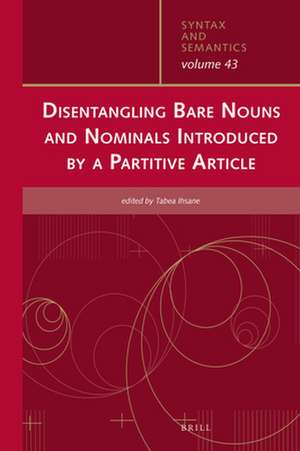
Disentangling Bare Nouns and Nominals Introduced by a Partitive Article: Syntax and Semantics, cartea 43
Tabea Ihsaneen Limba Engleză Hardback – 28 oct 2020
The outcome is a snapshot of current research into “partitive articles” and the way they relate to bare nouns, in a cross-linguistic perspective and on new data: the research covers noteworthy data (fieldwork data and corpora) from Standard languages - like French and Italian, but also German - to dialectal and regional varieties, including endangered ones like Francoprovençal.


Preț: 1038.68 lei
Preț vechi: 1207.77 lei
-14% Nou
Puncte Express: 1558
Preț estimativ în valută:
183.80€ • 215.53$ • 161.41£
183.80€ • 215.53$ • 161.41£
Carte tipărită la comandă
Livrare economică 02-16 februarie 26
Preluare comenzi: 021 569.72.76
Specificații
ISBN-13: 9789004431126
ISBN-10: 9004431128
Pagini: 344
Dimensiuni: 155 x 235 mm
Greutate: 0.67 kg
Editura: Brill
Colecția Brill
Seria Syntax and Semantics
ISBN-10: 9004431128
Pagini: 344
Dimensiuni: 155 x 235 mm
Greutate: 0.67 kg
Editura: Brill
Colecția Brill
Seria Syntax and Semantics
Notă biografică
Tabea Ihsane, Ph.D. (2006), University of Geneva, is a lecturer and researcher at the Universities of Geneva and Zurich. She has several publications on partitive elements (pronouns, also L2 joint work; articles), including a monograph (Benjamins 2008, Syntax 2013, Linguistics 2020).
Cuprins
List of Figures and Tables
Glosses and Abbreviations
1 Introduction
Tabea Ihsane
2 The Rise and Fall of Partitive Markers in Some Germanic Varieties
Thomas Strobel and Elvira Glaser
3 Bound To Be? Bare and Partitive-Marked Noun Phrases in Romance Languages and the Emergence of Prominence-Conditioned Patterns
Hagay Schurr
4 Why “Partitive Articles” Do Not Exist in (Old) Spanish
David Paul Gerards and Elisabeth Stark
5 Predicates of Personal Taste and Pancake Sentences in Brazilian Portuguese and French
Fabienne Martin, Janayna Carvalho and Artemis Alexiadou
6 Negation, des-Indefinites in French and Bare Nouns across Languages
Carmen Dobrovie-Sorin
7 Telicity, Specificity, and Complements with a Plural “Partitive Article” in French
Tabea Ihsane
8 A Protocol for Indefinite Determiners in Italian and Italo-Romance
Giuliana Giusti
9 “Partitive Articles” in Aosta Valley Francoprovençal—Old Questions and New Data
Elisabeth Stark and David Paul Gerards
Index
Glosses and Abbreviations
1 Introduction
Tabea Ihsane
2 The Rise and Fall of Partitive Markers in Some Germanic Varieties
Thomas Strobel and Elvira Glaser
3 Bound To Be? Bare and Partitive-Marked Noun Phrases in Romance Languages and the Emergence of Prominence-Conditioned Patterns
Hagay Schurr
4 Why “Partitive Articles” Do Not Exist in (Old) Spanish
David Paul Gerards and Elisabeth Stark
5 Predicates of Personal Taste and Pancake Sentences in Brazilian Portuguese and French
Fabienne Martin, Janayna Carvalho and Artemis Alexiadou
6 Negation, des-Indefinites in French and Bare Nouns across Languages
Carmen Dobrovie-Sorin
7 Telicity, Specificity, and Complements with a Plural “Partitive Article” in French
Tabea Ihsane
8 A Protocol for Indefinite Determiners in Italian and Italo-Romance
Giuliana Giusti
9 “Partitive Articles” in Aosta Valley Francoprovençal—Old Questions and New Data
Elisabeth Stark and David Paul Gerards
Index