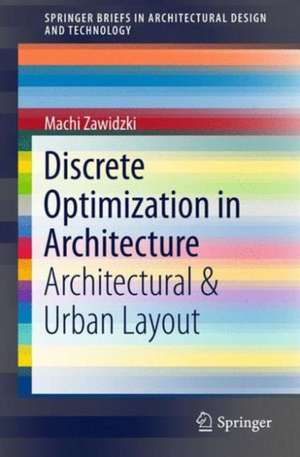
Discrete Optimization in Architecture: SpringerBriefs in Architectural Design and Technology
Autor Machi Zawidzkien Limba Engleză Paperback – 18 iul 2016
The algorithm for the functional layout design is based onbacktracking using a constraint satisfaction approach combined with coarse griddiscretization. The algorithm for the town square evaluation is based ongeometrical properties derived directly from its plan.
Part II introduces a crowd-simulation application for theanalysis of escape routes on floor plans, and optimization of a floor plan forsmooth crowd flow. The algorithms presented employ agent-based modeling andcellular automata.
Din seria SpringerBriefs in Architectural Design and Technology
-
 Preț: 378.77 lei
 -
 Preț: 397.34 lei
 -
 Preț: 327.88 lei
 -
 Preț: 409.06 lei
 -
 Preț: 403.31 lei
 -
 Preț: 365.31 lei
 -
 Preț: 414.91 lei
 -
 Preț: 363.87 lei
 - 15%
 Preț: 444.14 lei
 -
 Preț: 445.65 lei
 - 15%
 Preț: 462.66 lei
 - 15%
 Preț: 494.76 lei
 -
 Preț: 410.11 lei
 -
 Preț: 248.44 lei
 -
 Preț: 249.64 lei
 -
 Preț: 364.57 lei
 -
 Preț: 265.57 lei
 -
 Preț: 391.62 lei
 -
 Preț: 408.25 lei
 -
 Preț: 421.49 lei
 -
 Preț: 380.97 lei
 -
 Preț: 380.09 lei
Preț: 366.64 lei
Puncte Express: 550
Carte tipărită la comandă
Livrare economică 08-22 decembrie
Livrare prin curier în România Termenul estimat este afișat lângă disponibilitate.
Transport gratuit de la 400.00 lei Plată online sau ramburs, în funcție de opțiunile comenzii.
Retur gratuit în 14 zile Comandă securizată și suport în română.
Specificații
ISBN-13: 9789811011054
ISBN-10: 9811011052
Pagini: 120
Ilustrații: XIV, 105 p. 96 illus., 82 illus. in color.
Dimensiuni: 155 x 235 x 7 mm
Greutate: 0.22 kg
Ediția:1st edition 2016
Editura: Springer
Colecția SpringerBriefs in Architectural Design and Technology
Seria SpringerBriefs in Architectural Design and Technology
Locul publicării:Singapore, Singapore
ISBN-10: 9811011052
Pagini: 120
Ilustrații: XIV, 105 p. 96 illus., 82 illus. in color.
Dimensiuni: 155 x 235 x 7 mm
Greutate: 0.22 kg
Ediția:1st edition 2016
Editura: Springer
Colecția SpringerBriefs in Architectural Design and Technology
Seria SpringerBriefs in Architectural Design and Technology
Locul publicării:Singapore, Singapore
V-ar putea interesa
-
 Complete Book of Home Inspection 4/ENorman BeckerPreț: 149.10 lei
 -
 Temporary Structures in Construction, Third EditionRobert Ratay-32%Preț: 600.95 lei889.54 lei
 -
 -32%Preț: 438.39 lei642.65 lei
 -
 Measurement of Building ServicesGeorge Murray-11%Preț: 467.55 lei525.34 lei
 -
 Why Buildings Stand UpMario SalvadoriPreț: 119.77 lei
 -
 -20%Preț: 1207.48 lei1509.34 lei
 -
 Urban and Environmental Economics: An IntroductionGraham Squires-15%Preț: 420.47 lei494.67 lei
 -
 Reinforced and Prestressed Concrete DesignEugene O'Brien-29%Preț: 442.99 lei620.93 lei
 -
 Circular Work in Carpentry and JoineryGeorge CollingsPreț: 127.94 lei
 -
 Carpentry and Joinery IllustratedPaul N. HasluckPreț: 322.21 lei
 -
 Construction Technology 1: House ConstructionAlison Cotgrave-24%Preț: 367.28 lei485.15 lei
 -
 How to Build Dry-Stacked Stone WallsJohn Shaw-RimmingtonPreț: 193.88 lei
 -
 Miss Savidge Moves Her HouseChristine Adams-18%Preț: 71.47 lei87.08 lei
 -
 ThatchingNicolas HallPreț: 180.59 lei
 -
 Preț: 148.74 lei
 -
 Fundamentals of Sustainable NeighbourhoodsAvi Friedman-15%Preț: 663.90 lei781.06 lei
Notă biografică
Dr. Machi Zawidzki’s doctoral research focused on various optimization methods based on CI for the fundamental problems of the architectural design: Functionality, Structure and Aesthetics. His research interests are in
designing built environment, especially in ergonomics and architectural design.
Cuprins
Quantization in Architecture & Urban Design:
1. Tessellation of space
1.1 Traditional grid/guideline systems (before the computer era)
1.1.1 Architecture
1.1.2 Urban Design
1.2 Modern (of the computer era) grid systems
1.2.1 "Collateral" systems, that is, derived from existing image pixelation
1.2.2. Space discretization serving optimization
1.2.3 Novel architectonic grid systems
1.2.3.1 Fine grid ("one cell = one agent")
1.2.3.1.1 Agent based modeling for crowd simulation
1.2.3.1.2 Simulation in regular tessellations: Square, Triangular
& Hexagonal
1.2.3.2 Coarse grid ("cell side = minimal corridor width" )
2. Discretization of Time
2.1 The role of time in architectural (and urban design?)
2.1.1 Crowd simulations
2.1.2 Daylight simulations
3. Module as a building component
3.1 Definition of a modular system and an overview of existing modular systems
3.2. Principles of two novel modular systems: Pipe-Z (PZ) & Truss-Z (TZ)
3.2.1 Deployability of PZ & TZ
4. Bringing it all together: Overview of the cellular automaton (CA) shading as a system with discrete time
& space and realized with congruent modules.
4.1 Building Envelope and Daylighting
4.2 Why cellular automata (CA) to drive shading of building envelopes?
4.3 One-dimensional CA applied on surfaces
4.3.1 Various CA in square grid
4.3.2 Other regular tessellations: hexagonal and triangular
4.3.3 Rotating polarized film shading system
4.4 Two-dimensional CA on surfaces
4.4.1 Triangular CA
4.4.2 CA on triangulated free-form surfaces
4.5 Application of evolutionary algorithms for optimization of CA shading
4.6 Prototypes
1. Tessellation of space
1.1 Traditional grid/guideline systems (before the computer era)
1.1.1 Architecture
1.1.2 Urban Design
1.2 Modern (of the computer era) grid systems
1.2.1 "Collateral" systems, that is, derived from existing image pixelation
1.2.2. Space discretization serving optimization
1.2.3 Novel architectonic grid systems
1.2.3.1 Fine grid ("one cell = one agent")
1.2.3.1.1 Agent based modeling for crowd simulation
1.2.3.1.2 Simulation in regular tessellations: Square, Triangular
& Hexagonal
1.2.3.2 Coarse grid ("cell side = minimal corridor width" )
2. Discretization of Time
2.1 The role of time in architectural (and urban design?)
2.1.1 Crowd simulations
2.1.2 Daylight simulations
3. Module as a building component
3.1 Definition of a modular system and an overview of existing modular systems
3.2. Principles of two novel modular systems: Pipe-Z (PZ) & Truss-Z (TZ)
3.2.1 Deployability of PZ & TZ
4. Bringing it all together: Overview of the cellular automaton (CA) shading as a system with discrete time
& space and realized with congruent modules.
4.1 Building Envelope and Daylighting
4.2 Why cellular automata (CA) to drive shading of building envelopes?
4.3 One-dimensional CA applied on surfaces
4.3.1 Various CA in square grid
4.3.2 Other regular tessellations: hexagonal and triangular
4.3.3 Rotating polarized film shading system
4.4 Two-dimensional CA on surfaces
4.4.1 Triangular CA
4.4.2 CA on triangulated free-form surfaces
4.5 Application of evolutionary algorithms for optimization of CA shading
4.6 Prototypes