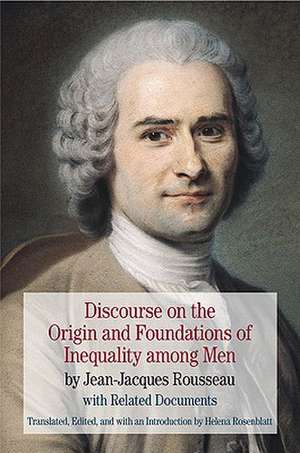
Discourse on the Origin and Foundations of Inequality Among Men
Autor Jean Jacques Rousseau, Helena Rosenblatten Limba Engleză Paperback – 13 oct 2010
Preț: 229.44 lei
Preț vechi: 335.84 lei
-32% Nou
Puncte Express: 344
Preț estimativ în valută:
40.60€ • 47.67$ • 35.64£
40.60€ • 47.67$ • 35.64£
Carte disponibilă
Livrare economică 06-20 ianuarie 26
Preluare comenzi: 021 569.72.76
Specificații
ISBN-13: 9780312468422
ISBN-10: 0312468423
Pagini: 176
Dimensiuni: 136 x 208 x 12 mm
Greutate: 0.21 kg
Editura: BEDFORD BOOKS
Locul publicării:New York, United States
ISBN-10: 0312468423
Pagini: 176
Dimensiuni: 136 x 208 x 12 mm
Greutate: 0.21 kg
Editura: BEDFORD BOOKS
Locul publicării:New York, United States
V-ar putea interesa
-
 WellingtonRichard HolmesPreț: 102.99 lei
 -
 Preț: 80.80 lei
 -
 Voice of the Past: Oral HistoryPaul Thompson-14%Preț: 249.92 lei291.44 lei
 -
 Captain James CookRichard Hough-27%Preț: 75.66 lei103.69 lei
 -
 The Age Of CapitalEric Hobsbawm-28%Preț: 74.13 lei102.75 lei
 -
 The Age Of EmpireEric Hobsbawm-27%Preț: 75.11 lei103.35 lei
 -
 White RajahNigel Barley-28%Preț: 54.17 lei75.22 lei
 -
 Second Chance: Three Presidents and the Crisis of American SuperpowerZbigniew BrzezinskiPreț: 150.01 lei
 -
 Salafi Ritual Purity: In the Presence of GodRichard Gauvain-18%Preț: 1179.64 lei1438.58 lei
 -
 Florence Nightingale At First Hand: Vision, Power, LegacyProfessor Lynn McDonald-18%Preț: 130.51 lei158.30 lei
 -
 Westwell, I: Illustrated History of World War OneIan WestwellPreț: 82.64 lei
 -
 -17%Preț: 395.07 lei474.23 lei
 -
 Wisnewski, G: One Small Step?Gerhard WisnewskiPreț: 122.84 lei
Descriere
A provocative essay that challenged the superiority of civilized society and modern government, Jean-Jacques Rousseau's Discourse on the Origin and Foundations of Inequality made him an outcast among fellow Enlightenment thinkers but stands today as one of the most important political texts in Western history. Helena Rosenblatt's new translation, introduction, and selection of related documents help students comprehend why Rousseau's criticisms of human nature, political hierarchy, and private property were so controversial in his time yet later were hailed as a foundation of democracy. The introduction explores life experiences that shaped Rousseau's philosophy, explains contemporary ideas about political authority and social order, and guides students through Rousseau's thought, including explanations of how his work anticipated theories about evolution and inspired leaders of the French Revolution. Related primary documents - including a selection from Rousseau's Social Contract - situate Rousseau's ideas in contemporary political and social thought. Questions for consideration, a chronology of Rousseau's life and work, and a selected bibliography enrich students' understanding of the man and his times.
Cuprins
Foreword
Preface
PART ONE. INTRODUCTION: The Life and Thought of Jean-Jacques Rousseau
Rousseau's Beginnings: The Road to the Second Discourse
The Origins of Political Authority Before Rousseau
Rousseau's Bombshell: The Discourse on the Origin and Foundations of Inequality
The State of Nature
The Steps to Society
The Invention of Property
Anthropology, Psychology, and Evolutionary Biology
Rousseau and Gender
Reception of the Second Discourse
“Citizen of Geneva”: The Dedication
Rousseau's Later Life and Legacy
Rousseau and the French Revolution
The Social Contract and Its Paradoxes
Rousseau's Beginnings: The Road to the Second Discourse
The Origins of Political Authority Before Rousseau
Rousseau's Bombshell: The Discourse on the Origin and Foundations of Inequality
The State of Nature
The Steps to Society
The Invention of Property
Anthropology, Psychology, and Evolutionary Biology
Rousseau and Gender
Reception of the Second Discourse
“Citizen of Geneva”: The Dedication
Rousseau's Later Life and Legacy
Rousseau and the French Revolution
The Social Contract and Its Paradoxes
PART TWO: Discourse on the Origin and Foundations of Inequality Among Men by Jean-Jacques Rousseau, Citizen of Geneva
Dedication
Preface
Notice about the Notes
First Part
Second Part
Rousseau's Notes
Dedication
Preface
Notice about the Notes
First Part
Second Part
Rousseau's Notes
PART THREE. RELATED DOCUMENTS
1. Jacques-Bénigne Bossuet, Politics Drawn from Holy Scripture, 1709
2. Thomas Hobbes, Leviathan, 1651
3. Samuel Pufendorf, On the Duty of Man and Citizen, 1673
4. John Locke, Two Treatises of Government, 1690
5. George-Louis Leclerc Buffon, Discourse on the Nature of Animals, 1753
6. Jean-Jacques Rousseau, Of the Social Contract, 1762
7. Maximilien Robespierre, Eulogies to Rousseau, 1790s
8. Benjamin Constant, Principles of Politics, 1810
1. Jacques-Bénigne Bossuet, Politics Drawn from Holy Scripture, 1709
2. Thomas Hobbes, Leviathan, 1651
3. Samuel Pufendorf, On the Duty of Man and Citizen, 1673
4. John Locke, Two Treatises of Government, 1690
5. George-Louis Leclerc Buffon, Discourse on the Nature of Animals, 1753
6. Jean-Jacques Rousseau, Of the Social Contract, 1762
7. Maximilien Robespierre, Eulogies to Rousseau, 1790s
8. Benjamin Constant, Principles of Politics, 1810
Appendixes
A Jean-Jacques Rousseau Chronology (1712-1794)
Questions for Consideration
Selected Bibliography
A Jean-Jacques Rousseau Chronology (1712-1794)
Questions for Consideration
Selected Bibliography
Index
Notă biografică
HELENA ROSENBLATT is a professor of history at the Graduate Center of the City University of New York.
Caracteristici
- The introduction explores life experiences that shaped Rousseau's philosophy, explains contemporary ideas about political authority and social order, and guides students through Rousseau's thought
- Related primary documents - including a selection from Rousseau's Social Contract - situate Rousseau's ideas in contemporary political and social thought
- Questions for consideration, a chronology of Rousseau's life and work, and a selected bibliography enrich students' understanding of the man and his times