
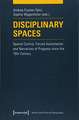
Disciplinary Spaces: Spatial Control, Forced Assimilation and Narratives of Progress since the 19th Century: Sozial- und Kulturgeographie, cartea 14
Editat de Andrea Fischer-Tahir, Sophie Wagenhoferen Limba Engleză Electronic book text – 30 apr 2017
| Toate formatele și edițiile | Preț | Express |
|---|---|---|
| Paperback (1) | 306.03 lei 3-5 săpt. | |
| Transcript Verlag – 31 mar 2017 | 306.03 lei 3-5 săpt. | |
| Electronic book text (1) | 358.50 lei Precomandă | |
| Transcript Verlag – 30 apr 2017 | 358.50 lei Precomandă |
Din seria Sozial- und Kulturgeographie
- 19%
 Preț: 306.03 lei
 -
 Preț: 209.27 lei
 -
 Preț: 209.27 lei
 -
 Preț: 210.59 lei
 -
 Preț: 273.23 lei
 -
 Preț: 259.24 lei
 -
 Preț: 243.88 lei
 -
 Preț: 207.97 lei
 -
 Preț: 188.83 lei
 -
 Preț: 275.02 lei
 -
 Preț: 237.87 lei
 -
 Preț: 218.70 lei
 -
 Preț: 324.22 lei
 -
 Preț: 236.57 lei
 -
 Preț: 306.98 lei
Preț: 358.50 lei
Precomandă
Puncte Express: 538
Preț estimativ în valută:
63.40€ • 75.03$ • 55.28£
63.40€ • 75.03$ • 55.28£
Nepublicat încă
Doresc să fiu notificat când acest titlu va fi disponibil:
Se trimite...
Specificații
ISBN-13: 9783839434871
ISBN-10: 3839434874
Pagini: 304
Editura: Transcript Verlag
Colecția Transcript Verlag
Seria Sozial- und Kulturgeographie
Locul publicării:Bielefeld
ISBN-10: 3839434874
Pagini: 304
Editura: Transcript Verlag
Colecția Transcript Verlag
Seria Sozial- und Kulturgeographie
Locul publicării:Bielefeld
V-ar putea interesa
-
 -11%Preț: 430.79 lei484.04 lei
 -
 The Economics of Clusters: Lessons from the French ExperienceGilles Duranton-34%Preț: 570.58 lei862.56 lei
 -
 Rocky Mountain Divide: Selling and Saving the WestJohn B. WrightPreț: 223.74 lei
 -
 Preț: 189.19 lei
 -
 The Security ArchipelagoPaul AmarPreț: 242.31 lei
 -
 Preț: 216.81 lei
 -
 Preț: 368.41 lei
 -
 GeopiracyJoel WainwrightPreț: 368.09 lei
 -
 Global ShiftPeter Dicken-23%Preț: 443.41 lei575.86 lei
 -
 Preț: 372.15 lei
 -
 Handbook of Regional ScienceManfred M. Fischer-18%Preț: 5492.68 lei6698.38 lei
Notă biografică
Andrea Fischer-Tahir (PhD) is an anthropologist with regional focus on the Middle East and Kurdistan. Sophie Wagenhofer (PhD) is a historian specialized in entangled history with a focus on Europe and North Africa.
Descriere
This volume looks at territories such as reservations, model villages and collective towns as the spatial materialization of forced assimilation and "progress". These disciplinary spaces were created in order to disempower and alter radically the behavior of people who were perceived as ill-suited "to fit" into hegemonic imaginations of "the nation" since the 19th century. Comparing examples from the Americas, Australia, North and East Africa, Central Europe as well as West and Central Asia, the book not only considers the acts and legitimizing narrations of ruling actors, but highlights the agency of the subaltern who are often misrepresented as passive victims of violent assimilation strategies.