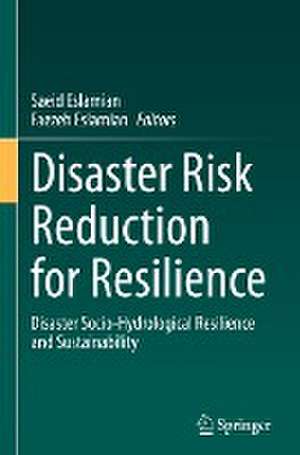
Disaster Risk Reduction for Resilience: Disaster Socio-Hydrological Resilience and Sustainability
Editat de Saeid Eslamian, Faezeh Eslamianen Limba Engleză Hardback – 16 noi 2023
This volume discusses the implementation of socio-hydrological resilience measures to curb the impacts on vulnerable communities of hydrologic diasters such as coastal floods, drought, water scarcity, and thunderstorms. The book provides a framework for sustainable hydrology-community interactions to inform local communities about the best practices to achieve hydrological resilience, and to implement resilient water infrastructure. Hydrological influences on the resilience of a region are comprehensively surveyed, and a "green economy strategy" is described and recommended for achieving climatic and hydrological sustainability.
| Toate formatele și edițiile | Preț | Express |
|---|---|---|
| Paperback (3) | 618.50 lei 6-8 săpt. | |
| Springer International Publishing – 3 oct 2023 | 618.50 lei 6-8 săpt. | |
| Springer International Publishing – 10 apr 2023 | 916.33 lei 6-8 săpt. | |
| Springer International Publishing – 6 iun 2023 | 916.49 lei 6-8 săpt. | |
| Hardback (5) | 626.36 lei 3-5 săpt. | |
| Springer International Publishing – 2 oct 2022 | 626.36 lei 3-5 săpt. | |
| Springer International Publishing – 16 noi 2023 | 912.09 lei 3-5 săpt. | |
| Springer International Publishing – 6 iun 2022 | 924.22 lei 3-5 săpt. | |
| Springer International Publishing – 30 mar 2023 | 977.30 lei 3-5 săpt. | |
| Springer International Publishing – 9 apr 2022 | 883.15 lei 39-44 zile |
Preț: 912.09 lei
Preț vechi: 1112.30 lei
-18%
Puncte Express: 1368
Preț estimativ în valută:
161.26€ • 190.07$ • 140.85£
161.26€ • 190.07$ • 140.85£
Carte disponibilă
Livrare economică 19 martie-02 aprilie
Specificații
ISBN-13: 9783031431760
ISBN-10: 3031431766
Pagini: 218
Ilustrații: XIV, 218 p. 61 illus., 56 illus. in color.
Dimensiuni: 155 x 235 mm
Greutate: 0.54 kg
Ediția:1st ed. 2023
Editura: Springer International Publishing
Colecția Springer
Locul publicării:Cham, Switzerland
ISBN-10: 3031431766
Pagini: 218
Ilustrații: XIV, 218 p. 61 illus., 56 illus. in color.
Dimensiuni: 155 x 235 mm
Greutate: 0.54 kg
Ediția:1st ed. 2023
Editura: Springer International Publishing
Colecția Springer
Locul publicării:Cham, Switzerland
Cuprins
Chapter 1. Modeling Human Dimensions to Reduce the Disaster Risk: A Socio-Hydrological Approach.- Chapter 2. Improvement of Urban Socio-Hydrologic Resilience in Extreme Hydro-climatic Conditions.- Chapter 3. Fluvio-Geomorphic Hazard and Its Impact on Socio-Economy, A Study on Resilience and Sustainability in Assam.- Chapter 4. Effect of Climate Change on the Agricultural System of Hirakud Command Area.- Chapter 5. Mitigating the Negative Effects of Plastic Pollution For Sustainable Economic Growth In Nigeria.- Chapter 6. Teaching of Climate Change in the Official Documentation: An International Review For Improving the Resilience.- Chapter 7. Hydrologic Disasters: Assessing Hazard and Risks.- Chapter 8. Floods in Tutong District, Brunei Darussalam and the Role of Tutong River: Approaches for Mitigation Measures.- Chapter 9. Adaptation and Resilience Measures in The Face of Extreme Events in Algeria.- Chapter 10. Socio-Hydrological Role of North Africa's Traditional Water Management Systems Under.
Notă biografică
Saeid Eslamian received his PhD in Civil and Environmental Engineering from University of New South Wales, Australia in 1998. Saeid was Visiting Professor in Princeton University and ETH Zurich in 2005 and 2008 respectively. He has contributed to more than 1K publications in journals, conferences, books. Eslamian has been appointed as 2-Percent Top Researcher by Stanford University for several years. Currently, he is full professor of Hydrology and Water Resources and Director of Excellence Center in Risk Management and Natural Hazards. Isfahan University of Technology, His scientific interests are Floods, Droughts, Water Reuse, Climate Change Adaptation, Sustainability and Resilience. He is a founding chief editor of International Journal of Hydrology Science and Technology (WoS, Scopus, Q2).in Switzerland.
Faezeh Eslamian is a PhD Holder of Bioresource Engineering in McGill University. Her research focuses on the development of a novel lime-based product to mitigate phosphorus loss from agricultural fields. Faezeh completed her bachelor and master’s degrees in Civil and Environmental Engineering from Isfahan University of Technology, Iran where she evaluated natural and low-cost absorbents for the removal of pollutants such as textile dyes and heavy metals. Furthermore, she has conducted research on the worldwide water quality standards and wastewater reuse guidelines. Faezeh is an experienced multidisciplinary researcher with interest in soil and water quality, environmental remediation, water reuse and drought management.
Faezeh Eslamian is a PhD Holder of Bioresource Engineering in McGill University. Her research focuses on the development of a novel lime-based product to mitigate phosphorus loss from agricultural fields. Faezeh completed her bachelor and master’s degrees in Civil and Environmental Engineering from Isfahan University of Technology, Iran where she evaluated natural and low-cost absorbents for the removal of pollutants such as textile dyes and heavy metals. Furthermore, she has conducted research on the worldwide water quality standards and wastewater reuse guidelines. Faezeh is an experienced multidisciplinary researcher with interest in soil and water quality, environmental remediation, water reuse and drought management.
Textul de pe ultima copertă
This book is part of a six-volume series on Disaster Risk Reduction and Resilience. The series aims to fill in gaps in theory and practice in the Sendai Framework, and provides additional resources, methodologies and communication strategies to enhance the plan for action and targets proposed by the Sendai Framework. The series will appeal to a broad range of researchers, academics, students, policy makers and practitioners in engineering, environmental science and geography, geoscience, emergency management, finance, community adaptation, atmospheric science and information technology.
This volume discusses the implementation of socio-hydrological resilience measures to curb the impacts on vulnerable communities of hydrologic diasters such as coastal floods, drought, water scarcity, and thunderstorms. The book provides a framework for sustainable hydrology-community interactions to inform local communities about the best practices to achieve hydrological resilience, and to implement resilient water infrastructure. Hydrological influences on the resilience of a region are comprehensively surveyed, and a "green economy strategy" is described and recommended for achieving climatic and hydrological sustainability.
This volume discusses the implementation of socio-hydrological resilience measures to curb the impacts on vulnerable communities of hydrologic diasters such as coastal floods, drought, water scarcity, and thunderstorms. The book provides a framework for sustainable hydrology-community interactions to inform local communities about the best practices to achieve hydrological resilience, and to implement resilient water infrastructure. Hydrological influences on the resilience of a region are comprehensively surveyed, and a "green economy strategy" is described and recommended for achieving climatic and hydrological sustainability.
Caracteristici
Discusses building socio-hydrological resilience under climate change Evaluates sustainability and resilience strategies for water infrastructure Assesses hazards and risks for hydrologic disasters