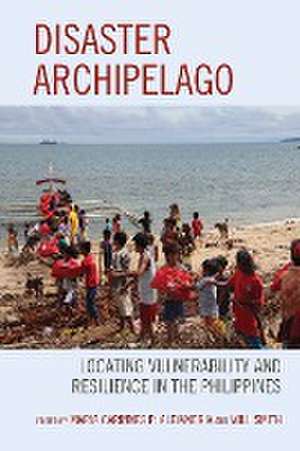
Disaster Archipelago: Locating Vulnerability and Resilience in the Philippines
Editat de Maria Carinnes P. Alejandria, Will Smith Contribuţii de Mark Anthony Alindogan, Arlen A. Ancheta, Dan Angelo B. Balita, Clarence M. Batan, Oliver M. Belarga, Pamela Gloria Cajilig, Fernanda Claudio, Kathryn B Francis, M Adil Khan, Emmanuel M. Luna, Ladylyn L Mangada, Melissa Theodora U. Macasaet, Diego S Maranan, Zosimo O. Membrebe, Nelly Mendoza, Victor G. Obedicen, Zbigniew Piepora, Frederick G. Precillas, Rosalie Quilicol, Patrick A. Regoniel, Liezl Riosa, Alain Jomarie G Santos, Irma R Tan, Dr Noah Theriault, John Christian C. Valeroso, Sarah Webb, Gintare Zaksaiteen Limba Engleză Paperback – 5 apr 2023
Preț: 258.00 lei
Preț vechi: 351.27 lei
-27%
Puncte Express: 387
Carte tipărită la comandă
Livrare economică 30 noiembrie-14 decembrie
Livrare prin curier în România Termenul estimat este afișat lângă disponibilitate.
Transport gratuit de la 400.00 lei Plată online sau ramburs, în funcție de opțiunile comenzii.
Retur gratuit în 14 zile Comandă securizată și suport în română.
Specificații
ISBN-13: 9781498569958
ISBN-10: 1498569951
Pagini: 306
Ilustrații: 3 b/w illustrations; 10 b/w photos; 3 tables;
Dimensiuni: 154 x 223 x 18 mm
Greutate: 0.41 kg
Editura: Bloomsbury Publishing
Colecția Lexington Books
Locul publicării:New York, United States
ISBN-10: 1498569951
Pagini: 306
Ilustrații: 3 b/w illustrations; 10 b/w photos; 3 tables;
Dimensiuni: 154 x 223 x 18 mm
Greutate: 0.41 kg
Editura: Bloomsbury Publishing
Colecția Lexington Books
Locul publicării:New York, United States
V-ar putea interesa
-
 Flood Forecasting: A Global PerspectiveThomas E. Adams-28%Preț: 576.91 lei800.99 lei
 -
 Disasters and Public Health: Planning and ResponseBruce W. Clements-29%Preț: 519.26 lei732.61 lei
 -
 -22%Preț: 322.59 lei416.23 lei
 -
 Disaster Volunteers: Recruiting and Managing People Who Want to HelpBrenda D. Phillips-31%Preț: 402.64 lei579.69 lei
 -
 The Fukushima and Tohoku Disaster: A Review of the Five-Year Reconstruction EffortsSchool of Societal Safety Sciences-30%Preț: 775.65 lei1110.30 lei
 -
 Secular and Religious Dynamics in Humanitarian ResponseOlivia J. Wilkinson-15%Preț: 434.24 lei510.88 lei
 -
 -11%Preț: 553.51 lei621.92 lei
 -
 Disaster LawKristian Cedervall Lauta-15%Preț: 428.00 lei503.53 lei
 -
 -33%Preț: 642.28 lei960.06 lei
 -
 -26%Preț: 1278.79 lei1739.36 lei
 -
 Natural Disasters: Response, Recovery and AssistanceSonja Torres-27%Preț: 1274.35 lei1736.45 lei
 -
 -18%Preț: 1279.95 lei1560.92 lei
 -
 TsunamiEdward Bryant-15%Preț: 625.09 lei735.40 lei
 -
 Physics of TsunamisBoris W. Levin-15%Preț: 620.68 lei730.21 lei
 -
 Natural Disaster Risk ManagementUlrich Ranke-15%Preț: 543.13 lei638.98 lei
 -
 Preț: 367.49 lei
 -
 Advancing Culture of Living with LandslidesKyoji SassaPreț: 527.16 lei
 -
 Volcanic UnrestJoachim GottsmannPreț: 401.24 lei
 -
 Avoidable DeathsNibedita S. Ray-BennettPreț: 424.77 lei
 -
 -15%Preț: 648.13 lei762.50 lei
 -
 -15%Preț: 661.84 lei778.63 lei
 -
 Landslide Science and PracticeClaudio Margottini-24%Preț: 962.34 lei1266.23 lei
 -
 Natural Disasters in ChinaPeijun Shi-15%Preț: 619.69 lei729.05 lei
 -
 Disaster Education and ManagementRajendra Kumar Bhandari-15%Preț: 677.99 lei797.63 lei
Cuprins
Introduction: Place, Politics, and Disaster in the Philippines, Will Smith
Chapter 1: At a Glance: Disaster in the Philippines and the Philippine Disaster Management System, Zbigniew Piepora, Oliver Belarga, and Anthony Alindogan
Chapter 2: Aid Effectiveness and the Role of Evaluation in the Design and Implementation of Disaster-Oriented Programs in the Philippines, Anthony Alindogan
Chapter 3: Children in Post-Disaster Conditions: The Case of Humanitarian Intervention of Save the Children in Post-Typhoon Haiyan in Leyte, Philippines, Liezl Riosa, Fernanda Claudio, M. Adil Khan
Chapter 4: Post-Disaster Accountability in the Haiyan Shelter Response: Who had the Greater Say? Ladylyn L. Mangada, Irma R. Tan, Margarita T. dela Cruz
Chapter 5: Sanay Kami sa Bagyo (We are Used to Storms): Unpacking "irrational" Evacuation Decision-making within the Sentient Ecology during Typhoon Haiyan (Yolanda), Pamela Gloria Cajilig, Diego S. Maranan, Kathryn B. Francis, Gintare Zaksaite
Chapter 6: Surviving the Old Tides: Disaster Resilience Among Food-Insecure Older Adults in an Urban Poor Settlement in Manila, Maria Carinnes P. Alejandria
Chapter 7: "Baha at mga bata" (flood and children): Exploring selected filipino children's flood experiences, vulnerable contexts & resilience, Arlen Ancheta, Clarence Batan, Dan Angelo Balita, Maria Carinnes Alejandria
Chapter 8: Drought, Food Insecurity, and Cultures of Hunger in the Philippines, Will SmithChapter 9: Ethnographic Approaches to Locating Disaster: Honey Harvesting, Livelihoods and Everyday Uncertainty on Palawan Island, Sarah Webb
Chapter 10: Community Engaged Resilience in an Island Community: Case of Fisherfolks in Pamarawan Island, Malolos, Bulacan, Philippines, Alain Jomarie G. Santos, Zosimo O. Membrebe Jr, John Christian C. Valeroso, Dr. Arlen A. Ancheta
Chapter 11: Harnessing Participatory and Community-Based Approach in Disaster Recovery Planning in Areas Affected by the Earthquake in Bohol, Emmanuel M. Luna, Rosalie Quilicol and Victor G. Obedicen
Chapter 12: Climate Hazard Effects on Socio-Environmental Health and Adaptation Strategies in Two Coastal Communities in Palawan Island, Philippines, Patrick A. Regoniel, Frederick A. Precillas, Melissa Theodora U. Macasaet, Nelly Mendoza
Conclusion: Reframing "Disaster", Noah Theriault
Chapter 1: At a Glance: Disaster in the Philippines and the Philippine Disaster Management System, Zbigniew Piepora, Oliver Belarga, and Anthony Alindogan
Chapter 2: Aid Effectiveness and the Role of Evaluation in the Design and Implementation of Disaster-Oriented Programs in the Philippines, Anthony Alindogan
Chapter 3: Children in Post-Disaster Conditions: The Case of Humanitarian Intervention of Save the Children in Post-Typhoon Haiyan in Leyte, Philippines, Liezl Riosa, Fernanda Claudio, M. Adil Khan
Chapter 4: Post-Disaster Accountability in the Haiyan Shelter Response: Who had the Greater Say? Ladylyn L. Mangada, Irma R. Tan, Margarita T. dela Cruz
Chapter 5: Sanay Kami sa Bagyo (We are Used to Storms): Unpacking "irrational" Evacuation Decision-making within the Sentient Ecology during Typhoon Haiyan (Yolanda), Pamela Gloria Cajilig, Diego S. Maranan, Kathryn B. Francis, Gintare Zaksaite
Chapter 6: Surviving the Old Tides: Disaster Resilience Among Food-Insecure Older Adults in an Urban Poor Settlement in Manila, Maria Carinnes P. Alejandria
Chapter 7: "Baha at mga bata" (flood and children): Exploring selected filipino children's flood experiences, vulnerable contexts & resilience, Arlen Ancheta, Clarence Batan, Dan Angelo Balita, Maria Carinnes Alejandria
Chapter 8: Drought, Food Insecurity, and Cultures of Hunger in the Philippines, Will SmithChapter 9: Ethnographic Approaches to Locating Disaster: Honey Harvesting, Livelihoods and Everyday Uncertainty on Palawan Island, Sarah Webb
Chapter 10: Community Engaged Resilience in an Island Community: Case of Fisherfolks in Pamarawan Island, Malolos, Bulacan, Philippines, Alain Jomarie G. Santos, Zosimo O. Membrebe Jr, John Christian C. Valeroso, Dr. Arlen A. Ancheta
Chapter 11: Harnessing Participatory and Community-Based Approach in Disaster Recovery Planning in Areas Affected by the Earthquake in Bohol, Emmanuel M. Luna, Rosalie Quilicol and Victor G. Obedicen
Chapter 12: Climate Hazard Effects on Socio-Environmental Health and Adaptation Strategies in Two Coastal Communities in Palawan Island, Philippines, Patrick A. Regoniel, Frederick A. Precillas, Melissa Theodora U. Macasaet, Nelly Mendoza
Conclusion: Reframing "Disaster", Noah Theriault
Recenzii
The Philippines is one of the most disaster-prone countries in the world, and this edited collection brings together several anthropological studies examining disaster management in the island nation. Each chapter is a separate study focusing on a different disaster management issue or on a community or population that was devastated by disasters such as typhoons or earthquakes. The studies investigate disaster coping strategies, including humanitarian intervention, protection of vulnerable populations, post-disaster accountability, disaster resilience, insecurity and inequality of livelihood supplies, community-engaged aid programs, and implementation and evaluation of aid programs, among others. Chapters also examine social and cultural factors that impact and are impacted by coping strategies, such as local and federal governance, political-economic constraints, disaster preparedness by communities and the government, and the role of sociocultural traditions in coping with disasters. Importantly, disasters are not only viewed as natural phenomena but also as social justice issues. Overall, the anthropologists and scholars who contribute to this volume provide a panoramic view of disaster management in the Philippines as well as useful insights for global disaster studies. Summing Up: Recommended. Upper-division undergraduates through faculty; professionals.
Disaster Archipelago: Locating Vulnerability and Resilience in the Philippines provides a rich diversity of perspectives and lived experiences of disaster in the Philippines. The accounts in this volume are deeply rooted in the multifaceted impacts of colonialism in the Philippines-physical, historical, political, economic, and social-and the subsequent ways this history has been experienced by a diversity of communities across the country. This book offers an accessible and important exploration into the diverse ways in which communities grapple with disaster.
In this collection, Maria Carinnes P. Alejandria and Will Smith demonstrate that all humanitarian emergencies, regardless of their proximal causes, are culturally constructed. By grounding the experience of disaster in the Philippines in the lives of a diverse range of communities, the contributors clarify the various forces-social, economic, political, cultural, demographic, and public health-that shape the complex interactions between natural hazards on the one hand and the two-sided coin of human vulnerability and resilience on the other. A natural hazard may toss that coin, but humans have always determined what is engraved on either side, and, therefore, the potential outcomes of the coin toss.
Critically reframing reified and essentialized notions of disaster in the Philippines, this edited volume offers a fresh interdisciplinary perspective on the scaled challenges of comprehending, responding to, and overcoming the discursive and material manifestations of disaster across the archipelago. From locally situated ethnographic study to critical policy-practice analysis, Disaster Archipelago: Locating Vulnerability and Resilience in the Philippines offers us a diverse and exciting range of critical scholarship that successfully reframes long-standing understandings and responses to disasters.
Disaster Archipelago: Locating Vulnerability and Resilience in the Philippines provides a rich diversity of perspectives and lived experiences of disaster in the Philippines. The accounts in this volume are deeply rooted in the multifaceted impacts of colonialism in the Philippines-physical, historical, political, economic, and social-and the subsequent ways this history has been experienced by a diversity of communities across the country. This book offers an accessible and important exploration into the diverse ways in which communities grapple with disaster.
In this collection, Maria Carinnes P. Alejandria and Will Smith demonstrate that all humanitarian emergencies, regardless of their proximal causes, are culturally constructed. By grounding the experience of disaster in the Philippines in the lives of a diverse range of communities, the contributors clarify the various forces-social, economic, political, cultural, demographic, and public health-that shape the complex interactions between natural hazards on the one hand and the two-sided coin of human vulnerability and resilience on the other. A natural hazard may toss that coin, but humans have always determined what is engraved on either side, and, therefore, the potential outcomes of the coin toss.
Critically reframing reified and essentialized notions of disaster in the Philippines, this edited volume offers a fresh interdisciplinary perspective on the scaled challenges of comprehending, responding to, and overcoming the discursive and material manifestations of disaster across the archipelago. From locally situated ethnographic study to critical policy-practice analysis, Disaster Archipelago: Locating Vulnerability and Resilience in the Philippines offers us a diverse and exciting range of critical scholarship that successfully reframes long-standing understandings and responses to disasters.