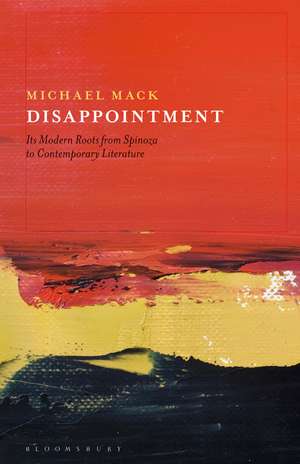
Disappointment: Its Modern Roots from Spinoza to Contemporary Literature
Autor Dr Michael Macken Limba Engleză Paperback – 14 ian 2021
Through this innovative approach, Spinoza emerges less as a single isolated figure and more as a sign for an intellectual constellation of thinkers and writers who - from the romantics to contemporary theory and literature - have introduced various shifts in the way we see humanity as being limited and prone to disappointment.
Combining intellectual history with literary and scientific theory, the book traces the collapse of traditional values and orders from Spinoza to Nietzsche and then to the literary modernism of Joseph Conrad and postmodernism of Philip Roth and Thomas Pynchon.
Preț: 178.59 lei
Preț vechi: 234.31 lei
-24%
Puncte Express: 268
Carte tipărită la comandă
Livrare economică 07-21 decembrie
Livrare prin curier în România Termenul estimat este afișat lângă disponibilitate.
Transport gratuit de la 400.00 lei Plată online sau ramburs, în funcție de opțiunile comenzii.
Retur gratuit în 14 zile Comandă securizată și suport în română.
Specificații
ISBN-13: 9781501366871
ISBN-10: 1501366874
Pagini: 296
Dimensiuni: 138 x 212 x 18 mm
Greutate: 0.36 kg
Editura: Bloomsbury Publishing
Colecția Bloomsbury Academic
Locul publicării:New York, United States
ISBN-10: 1501366874
Pagini: 296
Dimensiuni: 138 x 212 x 18 mm
Greutate: 0.36 kg
Editura: Bloomsbury Publishing
Colecția Bloomsbury Academic
Locul publicării:New York, United States
Cuprins
Introduction
1. Spinoza and F. H. Jacobi's idealist disavowal of disappointment or how Romanticism questions Idealisations of the Anthropocene
2. Rendering Dialectics Disappointing: Spinoza's spectre haunting the Anthropocene from Romanticism to Postmodernism in literature and science
3. The Destructive element: Keats & Conrad or How Romanticism avows idealism's disavowed disappointment
4. Modernity's promise and its disavowed disappointment: Hannah Arendt's Analysis of Totalitarianism out of the Sources of Conrad's Heart of Darkness
5. The trajectory of Conrad's novel of Disavowed Disappointment: Hegel's dialectics, Scott Fitzgerald's The Great Gatsby and Saul Bellow's Ravelstein
6. Political Promises and History's Disappointments: Leo Strauss as the esoteric centre of Bellow's Ravelstein and the critique of grand political promises
7. Disappointment in the age of the Anthropocene: how D H Lawrence and Kafka render dialectics inoperative
8. Disappointing expectations of Redemption: Modern Jewish Writing and Thought
9. Conclusion: Expecting Disappointment, or, from Pynchon's Roth's, Strauss's and Vonnegut's postmodernism to Anna Burn's Milkman and D. F. Wallace The Pale King
Bibliography
Acknowledgments
Index
1. Spinoza and F. H. Jacobi's idealist disavowal of disappointment or how Romanticism questions Idealisations of the Anthropocene
2. Rendering Dialectics Disappointing: Spinoza's spectre haunting the Anthropocene from Romanticism to Postmodernism in literature and science
3. The Destructive element: Keats & Conrad or How Romanticism avows idealism's disavowed disappointment
4. Modernity's promise and its disavowed disappointment: Hannah Arendt's Analysis of Totalitarianism out of the Sources of Conrad's Heart of Darkness
5. The trajectory of Conrad's novel of Disavowed Disappointment: Hegel's dialectics, Scott Fitzgerald's The Great Gatsby and Saul Bellow's Ravelstein
6. Political Promises and History's Disappointments: Leo Strauss as the esoteric centre of Bellow's Ravelstein and the critique of grand political promises
7. Disappointment in the age of the Anthropocene: how D H Lawrence and Kafka render dialectics inoperative
8. Disappointing expectations of Redemption: Modern Jewish Writing and Thought
9. Conclusion: Expecting Disappointment, or, from Pynchon's Roth's, Strauss's and Vonnegut's postmodernism to Anna Burn's Milkman and D. F. Wallace The Pale King
Bibliography
Acknowledgments
Index
Recenzii
A masterful weave of intellectual history and literary criticism, Disappointment is magisterial in scope and in the depth and originality of its analysis of the ambiguous fortunes of the modern project.
In an age of constant disappointments, in health care, political leadership, interpersonal relationships (at least virtual ones), Michael Mack strikes an engaging and readable note in examining what philosophers, writers, and thinkers have imagined disappointment to be over millennia. His view is that our modern sense of being disappointed with the world is a reflex of the Enlightenment notion of the self and its options. That may well mean that our 21st century worldview rests in the very notion of the failure of those claims. Disappointment is reality of the clash between our need for improvement and our ever compromised and compromising life experience. Read it, you won't be disappointed.
Mack's focus on the current sense of disappointment with our ecological, economic, and political state of affairs is most timely. This provocative, rigorous study blends disciplinary boundaries to open space for an exciting investigation of Spinoza's modernity and how it shaped romantic, modernist, and post-modern writing and thought.
In an age of constant disappointments, in health care, political leadership, interpersonal relationships (at least virtual ones), Michael Mack strikes an engaging and readable note in examining what philosophers, writers, and thinkers have imagined disappointment to be over millennia. His view is that our modern sense of being disappointed with the world is a reflex of the Enlightenment notion of the self and its options. That may well mean that our 21st century worldview rests in the very notion of the failure of those claims. Disappointment is reality of the clash between our need for improvement and our ever compromised and compromising life experience. Read it, you won't be disappointed.
Mack's focus on the current sense of disappointment with our ecological, economic, and political state of affairs is most timely. This provocative, rigorous study blends disciplinary boundaries to open space for an exciting investigation of Spinoza's modernity and how it shaped romantic, modernist, and post-modern writing and thought.