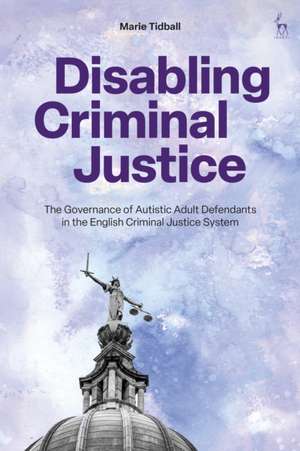
Disabling Criminal Justice
Autor Marie Tidballen Limba Engleză Paperback – 21 aug 2025
Utilising the social model of disability, it considers the dominant strategies of governance, including 'vulnerability', which the author argues obscures the rights of disabled people in the criminal justice system. In doing so it sheds light on how this group should be governed.
Drawing on rigorously-researched case studies of autistic adult defendants through the court process, the book brings together relevant legal and policy literature, criminological and criminal justice theory and disability studies to provide insight into the 'dividing practices' that affect the governance of disabled defendants' conduct.
Using interviews with elites and practitioners, textual analysis, and court observation of eight autistic adult defendants through their court process, the book investigates why the status of autistic defendants as disabled under the Equality Act 2010 has been overlooked in criminal justice policy and criminal court decision-making.
It explores the impact of the 'collateral' effects and 'symbiotic harm' of the criminal justice process on family members who support these defendants through the criminal justice process.
Preț: 331.26 lei
Preț vechi: 417.94 lei
-21%
Puncte Express: 497
Carte tipărită la comandă
Livrare economică 20-25 noiembrie
Livrare prin curier în România Termenul estimat este afișat lângă disponibilitate.
Transport gratuit de la 400.00 lei Plată online sau ramburs, în funcție de opțiunile comenzii.
Retur gratuit în 14 zile Comandă securizată și suport în română.
Specificații
ISBN-13: 9781509956982
ISBN-10: 1509956980
Pagini: 290
Dimensiuni: 152 x 232 x 18 mm
Greutate: 0.45 kg
Editura: Hart Publishing
Locul publicării:London, United Kingdom
ISBN-10: 1509956980
Pagini: 290
Dimensiuni: 152 x 232 x 18 mm
Greutate: 0.45 kg
Editura: Hart Publishing
Locul publicării:London, United Kingdom
Cuprins
Foreword, Professor Lucia Zedner (University of Oxford, UK)
Foreword, Professor Anna Lawson (University of Leeds, UK)
1. Introduction: Autism, Criminality and the Criminal Justice System
2. Qualitative Methods and Inclusive Research Participation
Part 1: How Should Autistic Adult Defendants be Governed?
3. Disabling Criminal Justice: Developing a Theoretical Toolkit
Part 2: Strategies of Governance: Autistic Adult Defendants and Autism-Specific Policy
4. Disability vs Vulnerability in Liaison and Diversion
5. Mapping the Legislative Landscape: The Autism Act 2009, Autism Strategies and Statutory Guidance
Part 3: Technologies of Governance: Criminal Court Practice
6: Pre-trial Shaping: The Police, the Crown Prosecution Service and Decision to Prosecute
7. To What Ends are they Governed? Negotiating the Courtroom, Remand and Plea
8. Dividing Practices in Case Disposal: Aggravating and Mitigating Factors and Sentencing
9. Governance Through the Family: Collateral Impact and 'Symbiotic Harm' for Defendants' Families
Part 4: 'The Creation of Other Possible Ways of Living'
10. Conclusion: The Normative Case for Disabling Criminal Justice
Foreword, Professor Anna Lawson (University of Leeds, UK)
1. Introduction: Autism, Criminality and the Criminal Justice System
2. Qualitative Methods and Inclusive Research Participation
Part 1: How Should Autistic Adult Defendants be Governed?
3. Disabling Criminal Justice: Developing a Theoretical Toolkit
Part 2: Strategies of Governance: Autistic Adult Defendants and Autism-Specific Policy
4. Disability vs Vulnerability in Liaison and Diversion
5. Mapping the Legislative Landscape: The Autism Act 2009, Autism Strategies and Statutory Guidance
Part 3: Technologies of Governance: Criminal Court Practice
6: Pre-trial Shaping: The Police, the Crown Prosecution Service and Decision to Prosecute
7. To What Ends are they Governed? Negotiating the Courtroom, Remand and Plea
8. Dividing Practices in Case Disposal: Aggravating and Mitigating Factors and Sentencing
9. Governance Through the Family: Collateral Impact and 'Symbiotic Harm' for Defendants' Families
Part 4: 'The Creation of Other Possible Ways of Living'
10. Conclusion: The Normative Case for Disabling Criminal Justice