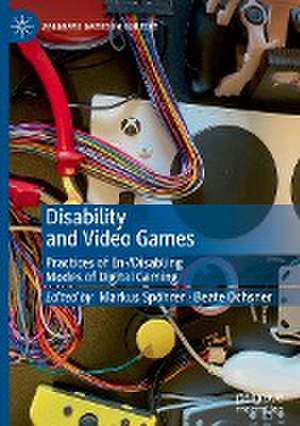
Disability and Video Games: Palgrave Games in Context
Editat de Markus Spöhrer, Beate Ochsneren Limba Engleză Hardback – 19 dec 2023







Preț: 985.01 lei
Preț vechi: 1201.23 lei
-18%
Puncte Express: 1478
Carte tipărită la comandă
Livrare economică 08-22 decembrie
Livrare prin curier în România Termenul estimat este afișat lângă disponibilitate.
Transport gratuit pentru acest produs Plată online sau ramburs, în funcție de opțiunile comenzii.
Retur gratuit în 14 zile Comandă securizată și suport în română.
Specificații
ISBN-13: 9783031343735
ISBN-10: 3031343735
Pagini: 380
Ilustrații: XIX, 357 p. 35 illus.
Dimensiuni: 153 x 216 x 25 mm
Greutate: 0.56 kg
Ediția:1st ed. 2024
Editura: Springer
Colecția Palgrave Games in Context
Seria Palgrave Games in Context
Locul publicării:Cham, Switzerland
ISBN-10: 3031343735
Pagini: 380
Ilustrații: XIX, 357 p. 35 illus.
Dimensiuni: 153 x 216 x 25 mm
Greutate: 0.56 kg
Ediția:1st ed. 2024
Editura: Springer
Colecția Palgrave Games in Context
Seria Palgrave Games in Context
Locul publicării:Cham, Switzerland
Cuprins
1.Dis-/Ability, Accessibility and Video Games: Chapters in the Context of a Research Overview._ Part I En-/Disabling Interfaces: History and Present._ 2 Game Interfaces as Disabling Infrastructures.- 3 Who Can Play? Rethinking Video Game Controllers and Accessibility.- 4 A History of Disability and Voice-Enabled Gaming from the 1970s to Intelligent Personal Assistants.- 5 Playing with the Eyes. A Media History of Eye Tracking.- 6 Interview with Mark Barlet (AbleGamers).- Part II Problematic Aprioris and Ableist Ideologies: (De) Constructing Dis/Ability.- 7 Dis/Enabled Playing: Ableist Ideologies and Abledness Consolidation in Video Games’ Mechanics and Infrastructures.- 8 The Mediality of Dis/Ability: Producing ‘Disability’ and ‘Ability’ in the Realm of Digital Games.- 9 Intersections Between Gaming and Dis/Abilities (Roundtable).- Part III Accessibility: Guidelines, Practice and Legal Issues.- 10 Accessibility by Numbers: A Critical Review of Game Accessibility Guidelines._ 11 Providing Access.- 12 Interview with Sandra Uhling: “Against Homogenization and on Becoming Aware and More Sensitive Towards Human Diversity”.-
Textul de pe ultima copertă
This collection intends to fill a long overdue research gap on the praxeological aspects of the relationships between disabilities, accessibility, and digital gaming. It will focus on the question of how Game Studies can profit from a Disability Studies perspective of en-/disabling gaming and issues of disability, (in)accessibility and ableism, and vice versa. Instead of departing from the medical model of disability that informs a wide range of publications on “disabled” gaming and that preconceives users as either “able-bodied,” “normal” or as “disabled,” “deficit,” or “unable to play,” our central premise is that dis/ability is not an essential characteristic of the playing subject. We rather intend to analyze the complex infrastructures of playing, i.e., the complex interplay of heterogeneous human and non-human actors, that are en- or disabling.
Dr. Markus Spöhrer is a Postdoc research associate in the project “The Interactive Gaze: On the Status and Ethics of Surveillance Images in Digital Games” at the International Center for Ethics in the Sciences and Humanities (IZEW, University of Tübingen,Germany). He studied American Studies, German and English literature (University of Tübingen), and Media Studies (University of Miami). He has a doctorate in Media Studies from the University of Konstanz, Germany. His main research areas are dis/ability and digital Media, digital games, and Science and Technology Studies (STS).
Prof. Dr. Beate Ochsner is a Professor of Media Studies at the University of Konstanz. Before, she was an assistant professor at the University of Mannheim and a guest professor at the Universities of Innsbruck, Basel, and St. Gallen. In 2002, she habilitated with the thesis DeMONSTRAtion. Zur Repräsentation des Monsters und des Monströsen in Literatur, Fotographie und Film. Also she is spokesperson of the research unit “Media and Participation” and principal investigator of subproject 2 “Techno-sensory processes of participation: App-practices and dis/ability.”
Prof. Dr. Beate Ochsner is a Professor of Media Studies at the University of Konstanz. Before, she was an assistant professor at the University of Mannheim and a guest professor at the Universities of Innsbruck, Basel, and St. Gallen. In 2002, she habilitated with the thesis DeMONSTRAtion. Zur Repräsentation des Monsters und des Monströsen in Literatur, Fotographie und Film. Also she is spokesperson of the research unit “Media and Participation” and principal investigator of subproject 2 “Techno-sensory processes of participation: App-practices and dis/ability.”
Caracteristici
Offers practical & critical perspectives, overviews, applications on accessibility technologies, practices, & histories Provides suggestions for academics, educators, teachers, digital game designers, and developers as well as gamers Functions as an introduction to the field of disability and digital games, and features in-depth analyses & case studies