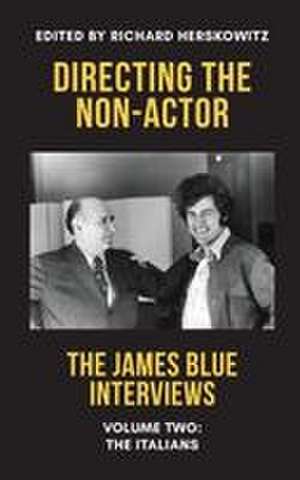
Directing the Non-Actor, Volume Two
Autor James Blue Editat de Richard Herskowitzen Limba Engleză Paperback – 2 noi 2026
Volume Two of Directing the Non-Actor is an indispensable document of a golden era in world cinema. The book opens with the revelatory, behind-the-scenes orientation to neorealism's origins, achievements, and aftermath conducted for Blue early in his visit by the well-connected screenwriter and critic Tullio Kezich.
Film directors and screenwriters Interviewed: Bernardo Bertolucci, Renato Castellani, Gianfranco De Bosio, Vittorio De Seta, Vittorio De Sica, Federico Fellini, Tullio Kezich, Ermanno Olmi, Pier Paolo Pasolini, Francesco Rosi, Roberto Rossellini and Cesare Zavattini.
Preț: 148.65 lei
Precomandă
Puncte Express: 223
Carte nepublicată încă
Livrare prin curier în România Precomanda se expediază când titlul devine disponibil.
Transport gratuit de la 400.00 lei Plată online sau ramburs, în funcție de opțiunile comenzii.
Retur gratuit în 14 zile Comandă securizată și suport în română.
Doresc să fiu notificat când acest titlu va fi disponibil:
Se trimite...
Specificații
ISBN-13: 9798899760952
Pagini: 232
Dimensiuni: 127 x 203 x 12 mm
Greutate: 0.23 kg
Editura: Sticking Place Books
Pagini: 232
Dimensiuni: 127 x 203 x 12 mm
Greutate: 0.23 kg
Editura: Sticking Place Books
Notă biografică
James Blue (1930-1980) was a groundbreaking filmmaker, educator, and advocate for public, accessible media. Born in Oklahoma, he studied at the University of Oregon before earning a scholarship to Paris's prestigious IDHEC, where his classmates included Costa-Gavras and Johan van der Keuken. His debut feature, Les Oliviers de la Justice, received the Critics' Prize at the 1962 Cannes Film Festival. His USIA documentary The March (1963-64), documenting the Civil Rights March on Washington, was later added to the National Film Registry. A Few Notes on Our Food Problem (1968) earned him an Academy Award nomination. As an educator, Blue taught at UCLA, the American Film Institute, Rice University, and SUNY Buffalo, where his students included Paul Schrader, Joan Churchill, and Jim Morrison. With initial support from a Ford Foundation grant, he conducted and recorded over 75 interviews with major international filmmakers, considered one of the most important film history archives of the 20th century. He died of cancer in 1980, just before turning 50.