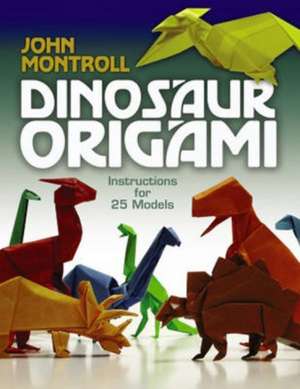
Dinosaur Origami
Autor John Montrollen Limba Engleză Paperback – 30 iul 2010
Începem călătoria noastră în era mezozoică prin plierea unui Pteranodon, un proiect care exemplifică perfect echilibrul dintre anatomia complexă și eleganța hârtiei. Notăm cu interes modul în care John Montroll reușește să transforme o simplă coală pătrată în 25 de modele distincte, capturând esența unor giganți care au stăpânit pământul acum 65 de milioane de ani. Remarcăm o selecție curajoasă de subiecte: pe lângă clasicii Triceratops sau Tyrannosaurus, găsim specii fascinante și mai rar abordate în arta plierii, precum Tanystropheus sau Dimetrodon. Găsim în această carte o metodologie de lucru riguroasă, specifică stilului lui Montroll, unde fiecare pas este documentat prin ilustrații tehnice precise, eliminând ambiguitatea din procesul de creație. Deși volumul este accesibil și începătorilor ambițioși, complexitatea structurală a modelelor va satisface în special practicanții de nivel intermediar care doresc să își perfecționeze tehnica de modelare a volumelor organice. Complementar lui Origami Dinosaurs de Mari Ono: unde acela se concentrează pe proiecte colorate și jucăușe destinate mai degrabă copiilor, oferind și hârtie gata imprimată, Dinosaur Origami explorează rigoarea geometrică și realismul formei, fiind un manual de referință pentru cei care văd origami ca pe o disciplină a preciziei. Totodată, față de Easy Origami Animals, lucrarea de față crește gradul de dificultate, trecând de la forme stilizate la reprezentări detaliate ale dinozaurilor.
Preț: 74.46 lei
Preț vechi: 120.86 lei
-38%
Carte disponibilă
Livrare economică 07-14 octombrie
Livrare express 23-29 septembrie pentru 74.47 lei
Specificații
ISBN-10: 0486477800
Pagini: 128
Ilustrații: Illustrations
Dimensiuni: 215 x 280 x 17 mm
Greutate: 0.39 kg
Editura: Dover Publications Inc.
V-ar putea interesa
-
 Lost in the CityEdward P. JonesPreț: 87.67 lei
 -
 Inside Out and Back AgainThanhhà LaiPreț: 106.65 lei
 -
 Domestic Violets: A NovelMatthew NormanPreț: 94.08 lei
 -
 The Westing Game (Puffin Modern Classics)Ellen RaskinPreț: 54.77 lei
 -
 Figgs & PhantomsEllen RaskinPreț: 47.84 lei
 -
 The Invisible CircusJennifer EganPreț: 98.62 lei
 -
 Power of the Dog, TheThomas SavagePreț: 69.34 lei
 -
 Maniac MageeJerry SpinelliPreț: 49.99 lei
 -
 PlainsongKent HarufPreț: 96.79 lei
 -
 EventideKent HarufPreț: 96.37 lei
 -
 Mary and O'NeilJustin CroninPreț: 101.80 lei
 -
 Walk Through DarknessDavid Anthony DurhamPreț: 111.21 lei
 -
 Where the Red Fern GrowsWilson Rawls-18%Preț: 46.74 lei57.13 lei
 -
 Bent RoadLori RoyPreț: 134.17 lei
 -
 The Best American Short Stories 2010Richard RussoPreț: 142.08 lei
 -
 The Lies of Locke LamoraScott LynchPreț: 60.24 lei
 -
 Red Seas Under Red SkiesScott LynchPreț: 68.05 lei
 -
 DispatchesMichael HerrPreț: 103.42 lei
 -
 Midnight in the Garden of Good and EvilJohn BerendtPreț: 114.40 lei
 -
 Preț: 87.06 lei
 -
 Last Exit to BrooklynHubert SelbyPreț: 96.97 lei
 -
 Train DreamsDenis JohnsonPreț: 84.77 lei
 -
 Paco's Story (National Book Award Winner)Larry HeinemannPreț: 108.16 lei
 -
 HatchetGary PaulsenPreț: 58.42 lei
 -
 Requiem for a DreamJr. Hubert SelbyPreț: 119.70 lei
 -
 The Beautiful Things That Heaven BearsDinaw MengestuPreț: 94.93 lei
De ce să citești această carte
Pentru pasionații de paleontologie și arte manuale, această carte oferă satisfacția de a recrea lumea preistorică prin tehnici de pliere de înaltă calitate. Cititorul câștigă acces la expertiza lui John Montroll, învățând cum să obțină detalii anatomice surprinzătoare fără a folosi foarfeca sau lipiciul. Este un exercițiu de răbdare și viziune spațială care transformă o pasiune într-o colecție de exponate de hârtie.
Despre autor
John Montroll este recunoscut la nivel mondial ca unul dintre maeștrii contemporani ai artei origami, fiind celebru pentru introducerea conceptului de pliere complexă dintr-o singură foaie de hârtie, fără tăieturi. Cu o carieră dedicată publicării de manuale tehnice, el a revoluționat disciplina prin diagramele sale extrem de clare și prin capacitatea de a crea modele care sunt în același timp realiste și pliabile. Opera sa acoperă o gamă vastă, de la animale și creaturi mitologice la forme matematice complexe, consolidându-i poziția de autoritate în comunitatea internațională de origami.
Notă biografică
We sat down with Mr. Montroll to discuss his influences, the impact of math on origami, and what he sees for the future of the artform.
How did you first get interested in origami and what were your influences?
"I was four when a Japanese neighbor taught me origami. At six, I had some books, showing the Japanese style."
Where do you find the inspiration for your original models?
"The models in the books were made by folding, cutting, using multiple sheets, and sometimes from non-square paper. I wanted to make origami where each model could be folded from a single uncut square so I had to make them up. Since I started as a child, "creating" was natural. Whatever I wanted to fold, I would make up. There was nothing great about my models, but I enjoyed exploring and found there was no end. In time, my work evolved as I discovered more techniques, and also philosophies, in the quality of origami. Now I can say that developing new, theme-related ideas and writing books gives me inspiration."
Do you think that there is a strong relationship between origami and mathematics?
"Yes. There is much math -- geometry, algebra, trigonometry, etc. -- in the structure of folding which can be used to develop and control the folding methods and designs. Math is especially used in my Dover books "Origami and Math" and "Classic Polyhedra Origami." Still, math is not essential and there are many aspects of origami that do not use math. Even if math was used in the design of a model, the folder need not understand it."
As a teacher, do you integrate origami into your lesson plans?
"As a math teacher, I can say students love doing origami! Sometimes, if my students finish their class work early, I let them fold from my books. Or we have some days, such as before vacations, where we do origami. But I will admit that I do not use origami as part of the math lesson!"
What new directions do you think the art of origami will be taking in the future?
"In the past few decades, origami has made huge developments in many directions. More people are involved, more ideas have been explored, all with more styles and techniques. The future will reveal newer directions for more people to explore and find their particular interest."
Bonus Question!
Do you have a favorite Dover book?
"I actually have two favorites, both by Beethoven: "Complete Piano Sonatas, Volume I"and "Complete Piano Sonatas, Volume. II." I enjoy playing his work and these books are well tattered!"