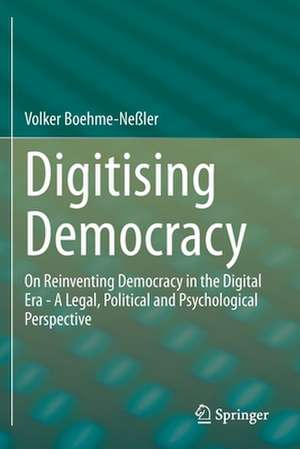
Digitising Democracy
Autor Volker Boehme-Neßleren Limba Engleză Paperback – 30 ian 2021
This book argues that in the digital era, a reinvention of democracy is urgently necessary. It discusses the mounting evidence showing that digitalisation is pushing classical parliamentary democracy to its limits, offering examples such as how living in a filter bubble and debating with political bots is profoundly changing democratic communication, making it more emotional, hysterical even, and less rational. It also explores how classical democracy involves long, slow thinking and decision processes, which don’t fit to the ever-increasing speed of the digital world, and examines the technical developments some fear will lead to governance by algorithms.
In the digitalised world, democracy no longer functions as it has in the past. This does not mean waving goodbye to democracy – instead we need to reinvent it. How this could work is the central theme of this book.
Preț: 695.81 lei
Preț vechi: 848.55 lei
-18%
Puncte Express: 1044
Carte tipărită la comandă
Livrare economică 21 noiembrie-05 decembrie
Livrare prin curier în România Termenul estimat este afișat lângă disponibilitate.
Transport gratuit pentru acest produs Plată online sau ramburs, în funcție de opțiunile comenzii.
Retur gratuit în 14 zile Comandă securizată și suport în română.
Specificații
ISBN-13: 9783030345587
ISBN-10: 3030345580
Pagini: 160
Ilustrații: X, 149 p. 1 illus.
Dimensiuni: 155 x 235 x 9 mm
Greutate: 0.25 kg
Ediția:1st ed. 2020
Editura: Springer
Locul publicării:Cham, Switzerland
ISBN-10: 3030345580
Pagini: 160
Ilustrații: X, 149 p. 1 illus.
Dimensiuni: 155 x 235 x 9 mm
Greutate: 0.25 kg
Ediția:1st ed. 2020
Editura: Springer
Locul publicării:Cham, Switzerland
Cuprins
Digitalisation: The End of Democracy?.- Boundary-Free. The Core of Digitalisation.- Fragmentation. Many Worlds, One Democracy?.- Algo-democracy. Power of Technology, Powerlessness of Democracy?.- Overloaded. Classical Democracy.- Complexity Management: Reinventing Democracy.
Notă biografică
Prof. Dr. Dr. Volker Boehme-Neßler is Chair for Public Law, Legal Theory, European Law, Information and Telecommunication Law at Carl von Ossietzky University Oldenburg.
Textul de pe ultima copertă
This book argues that in the digital era, a reinvention of democracy is urgently necessary. It discusses the mounting evidence showing that digitalisation is pushing classical parliamentary democracy to its limits, offering examples such as how living in a filter bubble and debating with political bots is profoundly changing democratic communication, making it more emotional, hysterical even, and less rational. It also explores how classical democracy involves long, slow thinking and decision processes, which don’t fit to the ever-increasing speed of the digital world, and examines the technical developments some fear will lead to governance by algorithms.
In the digitalised world, democracy no longer functions as it has in the past. This does not mean waving goodbye to democracy – instead we need to reinvent it. How this could work is the central theme of this book.
Caracteristici
Provides a multidisciplinary approach Deals with a highly topical theme Combines high level research and written in clear language