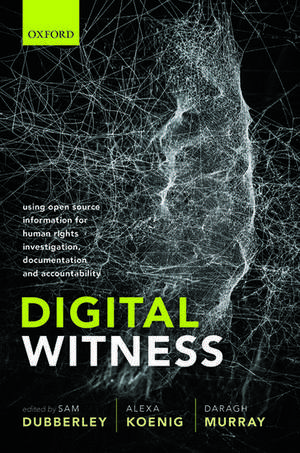
Digital Witness: Using Open Source Information for Human Rights Investigation, Documentation, and Accountability
Editat de Sam Dubberley, Alexa Koenig, Daragh Murrayen Limba Engleză Paperback – 17 ian 2020
Preț: 360.35 lei
Preț vechi: 425.83 lei
-15%
Puncte Express: 541
Carte tipărită la comandă
Livrare economică 04-15 decembrie
Livrare prin curier în România Termenul estimat este afișat lângă disponibilitate.
Transport gratuit de la 400.00 lei Plată online sau ramburs, în funcție de opțiunile comenzii.
Retur gratuit în 14 zile Comandă securizată și suport în română.
Specificații
ISBN-13: 9780198836070
ISBN-10: 0198836074
Pagini: 384
Dimensiuni: 169 x 243 x 19 mm
Greutate: 0.76 kg
Editura: OUP OXFORD
Colecția OUP Oxford
Locul publicării:Oxford, United Kingdom
ISBN-10: 0198836074
Pagini: 384
Dimensiuni: 169 x 243 x 19 mm
Greutate: 0.76 kg
Editura: OUP OXFORD
Colecția OUP Oxford
Locul publicării:Oxford, United Kingdom
V-ar putea interesa
-
 Preț: 89.50 lei
 -
 Preț: 249.00 lei
 -
 Business Result 2e Advanced Class Audio CD (2 Discs)Rebecca TurnerPreț: 457.62 lei
 -
 Preț: 409.23 lei
 -
 Religion and the Politics of Identity in KosovoGerlachus DuijzingsPreț: 251.95 lei
 -
 ExtremismJ. M. Berger-17%Preț: 89.49 lei107.85 lei
 -
 Essential Grammar in Use with AnswersRaymond MurphyPreț: 109.00 lei
 -
 -18%Preț: 953.86 lei1163.24 lei
 -
 Digital SociologyDeborah Lupton-15%Preț: 533.33 lei627.45 lei
 -
 Ted Talks StorytellingAkash KariaPreț: 43.80 lei
 -
 Intelligence OperationsErik Kleinsmith-23%Preț: 752.21 lei976.90 lei
 -
 The Decline of Empires in South AsiaHeather A CampbellPreț: 143.55 lei
 -
 Talk Like TEDCarmine Gallo-39%Preț: 52.51 lei86.09 lei
 -
 Preț: 78.37 lei
 -
 Preț: 248.11 lei
 -
 Coridorul îngust: State, societăți și soarta libertățiiDaron AcemogluPreț: 85.00 lei
Recenzii
In this compelling volume, beautifully edited by Sam Dubberley, Alexa Koenig, and Daragh Murray - and featuring the contributions of leading scholars, experts, journalists and lawyers - the role technology can now play in sharpening our investigations into gross human rights abuses is examined in commendable detail. The contributors to Digital Witness have, much to their credit, analyzed meticulously all significant and relevant angles. It is a volume that will fast become the standard text for anyone interested in human rights, the collection of evidence in the digital age, and the prosecution of those who perpetrate gross human rights violations.
Digital Witness demonstrates, as no other volume has done, how the digital age has opened up vast new opportunities for accountability. It shows how journalists and human rights researchers are solving mysteries that once seemed unsolvable, from responsibility for terrorism to the identity of perpetrators and victims of international crimes. Fact-finders no longer only travel to the front-lines of battle or trudge through dusty archives; they can learn, verify, preserve and explain using openly available digital tools. With expert input from around the world, Digital Witness is bound to become a key source for open source investigators -- and for students and professionals aiming to make visible what previously has only been hidden.
Digital Witness is an essential piece of guidance/reading, as it captures what anyone who believes in the truth as a tool for justice, must know. In a world rife with disinformation and overwhelmed with large volumes of videos documenting human rights abuses, this book pragmatically and effectively provides us with roadmap to make it possible for a "cameras everywhere" world to lead to/become a just world. For anyone who is a civic witness, an investigator, an activist, or a lawyer, or an ordinary person who has ever seen or shared an eye witness account capturing a human rights abuse, Digital Witness is essential reading. What the authors have done is make us understand the very concrete ways that open source information can deliver justice - it is both an essential roadmap and a much needed guide. So that, when the world witnesses human rights crimes, the promise of technology in service of human rights, can be realized.
The acceleration of armed conflict has also amplified the information it generates. […] in near real time, as events unfold and on the terms of those producing them. This creates and embroils them in a secondary conflict […]. When attempting to analyse and investigate events, noise, propaganda, disinformation and bias get dangerously entangled with valuable first-hand testimonies. Human rights investigators and conflict monitors must therefore match the speed of contemporary conflict and the agility of information technologies. They can no longer afford to only engage with the gathering of testimonies well after the fact, but must develop skills in real time analysis […]. How great it is, then, that the editors of this book have gathered a group of pioneering practitioners and scholars, to produce what is a guide book for both activists and investigators and for all students of our saturated visual cultures.
Digital Witness demonstrates, as no other volume has done, how the digital age has opened up vast new opportunities for accountability. It shows how journalists and human rights researchers are solving mysteries that once seemed unsolvable, from responsibility for terrorism to the identity of perpetrators and victims of international crimes. Fact-finders no longer only travel to the front-lines of battle or trudge through dusty archives; they can learn, verify, preserve and explain using openly available digital tools. With expert input from around the world, Digital Witness is bound to become a key source for open source investigators -- and for students and professionals aiming to make visible what previously has only been hidden.
Digital Witness is an essential piece of guidance/reading, as it captures what anyone who believes in the truth as a tool for justice, must know. In a world rife with disinformation and overwhelmed with large volumes of videos documenting human rights abuses, this book pragmatically and effectively provides us with roadmap to make it possible for a "cameras everywhere" world to lead to/become a just world. For anyone who is a civic witness, an investigator, an activist, or a lawyer, or an ordinary person who has ever seen or shared an eye witness account capturing a human rights abuse, Digital Witness is essential reading. What the authors have done is make us understand the very concrete ways that open source information can deliver justice - it is both an essential roadmap and a much needed guide. So that, when the world witnesses human rights crimes, the promise of technology in service of human rights, can be realized.
The acceleration of armed conflict has also amplified the information it generates. […] in near real time, as events unfold and on the terms of those producing them. This creates and embroils them in a secondary conflict […]. When attempting to analyse and investigate events, noise, propaganda, disinformation and bias get dangerously entangled with valuable first-hand testimonies. Human rights investigators and conflict monitors must therefore match the speed of contemporary conflict and the agility of information technologies. They can no longer afford to only engage with the gathering of testimonies well after the fact, but must develop skills in real time analysis […]. How great it is, then, that the editors of this book have gathered a group of pioneering practitioners and scholars, to produce what is a guide book for both activists and investigators and for all students of our saturated visual cultures.
Notă biografică
Sam Dubberley is a research consultant with the Human Rights Big Data and Technology project at the University of Essex, and Special Adviser in the Crisis Response team at Amnesty International. Sam worked for more than a decade in broadcast journalism, and was head of News Exchange at the European Broadcasting Union between 2010 and 2013. He is a fellow of the Tow Center for Digital Journalism at Columbia University, a founding partner of First Draft News, which gives practical and ethical guidance in how to find, verify and publish content sourced from the social web. He is also a part of the Open Source for Human Rights project team at Swansea University.Alexa Koenig is the executive director of the Human Rights Center (winner of the 2015 MacArthur Award for Creative and Effective Institutions), and a lecturer at UC, Berkeley. She co-founded the Human Rights Investigations Lab which trains students to use open source methods to advance human rights. She is a member of the American Association for the Advancement of Science's Committee on Scientific Freedom and Responsibility, co-chair of the World Economic Forum's Global Future Council on Technology and Human Rights, and a member of the Technology Advisory Board of the International Criminal Court's Office of the Prosecutor. She has a JD from the University of San Francisco and an MA and a PhD from UC Berkeley.Daragh Murray is Senior Lecturer at the University of Essex School of Law and Human Rights Centre, and the Director of the Digital Verification Unit based at the Human Rights Centre Clinic. His research focuses on issues relating to conflict and counter-terrorism, as regulated by the law of armed conflict and international human rights law. He has a particular interest in the regulation and engagement of non-State armed groups, and in the use of technology, particularly in an intelligence agency and law enforcement context. He is a former Government of Ireland IRCHSS Research Scholar, and has a PhD in Law from the University of Essex, an LLM in International Human Rights Law from the Irish Centre for Human Rights, and an MSc in Computer Security and Forensics from Dublin City University.
Cuprins
- Foreword
- Section One
- Introduction
- 1: Christoph Koettl, Daragh Murray, Sam Dubberley: The History of the Use of Open Source Investigation for Human Rights Reporting
- 2: Alexa Koenig: The History of Open Source Investigations for Legal Accountability
- 3: Lindsay Freeman: Prosecuting Grave International Crimes Using Open Source Evidence: Lessons from the International Criminal Court
- 4: Ella McPherson, Isabel Guenette Thornton, Matt Mahmoudi: Open Source Investigations and the Technology-Driven Knowledge Controversy in Human Rights Fact-Finding
- 5: Scott Edwards: Open Source Investigations for Human Rights: Current and Future Challenges
- Section Two
- 6: Paul Myers: How to Conduct Discovery Using Open Source Methods
- 7: Yvonne Ng: How to Effectively Preserve Open Source Information
- 8: Jeff Deutsch and Niko Para: Targeted Mass Archiving of Open Source Information: A Case Study
- 9: Aric Toler: How to Verify User-Generated Content
- 10: Micah Farfour: The Role and Use of Satellite Imagery in Open Source Investigations
- Section Three
- 11: Zara Rahman and Gabriela Ivens: Ethics in Open Source Investigations
- 12: Sam Dubberley, Margaret Satterthwaite, Sarah Knuckey, Adam Brown: Open Source Investigations: Vicarious Trauma, PTSD, and Tactics for Resilience
- 13: Joseph Guay, Lisa Rudnick: Open Source Investigations: Understanding Digital Threats, Risks, and Harms
- Section Four
- 14: Fred Abrahams, Daragh Murray: Open Source Information: Part of the Puzzle
- 15: Alexa Koenig, Lindsay Freeman: Open Source Investigations for Legal Accountability: Challenges and Best Practices