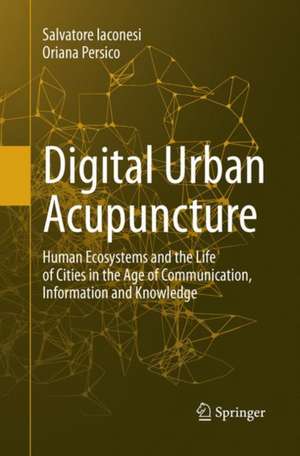
Digital Urban Acupuncture
Autor Salvatore Iaconesi, Oriana Persicoen Limba Engleză Paperback – 14 iun 2018
Subliniem aplicabilitatea practică a acestui volum în contextul redefinirii spațiului public prin prisma datelor omniprezente. Digital Urban Acupuncture nu este doar o explorare teoretică, ci un instrument metodologic pentru planificatorii urbani și sociologii care doresc să utilizeze fluxurile informaționale — provenite din rețele sociale și senzori — pentru a genera noi forme de cetățenie activă. Considerăm că tranziția propusă de Salvatore Iaconesi și Oriana Persico, de la acupunctura urbană tradițională la cea digitală, oferă o soluție concretă pentru intervenții punctuale, dar cu impact sistemic în „ecosistemele relaționale” ale metropolelor moderne.
Structura volumului facilitează o progresie logică de la fundamentul teoretic la validarea empirică. Primele capitole sintetizează teorii esențiale (de la Latour la Castells), culminând cu definirea conceptului de „Third Infoscape”, o nouă formă de lizibilitate a orașului. Această bază este urmată de studii de caz riguroase din Torino, Kansas City și Roma, care demonstrează cum analiza fluxurilor de emoții și cunoaștere poate influența deciziile civice. Lucrarea acoperă aceeași arie tematică precum Cityscape in the Era of Information and Communication Technologies de Agata Bonenberg, dar cu o abordare mult mai axată pe dimensiunea relațională și pe utilizarea tehnologiei ca mediu de coexistență, depășind simpla analiză a peisajului arhitectural.
Apreciem în mod deosebit modul în care autorii integrează tehnici precum teoria Actor-Rețea și urbanismul peer-to-peer pentru a propune un model de guvernare participativă. Volumul reușește să transforme datele abstracte în „intervenții chirurgicale” urbane, oferind un cadru de lucru interdisciplinar ce îmbină geografia culturală cu designul de date.
Preț: 607.64 lei
Preț vechi: 759.54 lei
-20%
Carte tipărită la comandă
Livrare economică 02-08 iunie
Specificații
ISBN-10: 3319828142
Pagini: 248
Ilustrații: XVII, 230 p. 58 illus., 47 illus. in color.
Dimensiuni: 155 x 235 x 13 mm
Greutate: 0.43 kg
Ediția:Softcover reprint of the original 1st edition 2017
Editura: Springer
Locul publicării:Cham, Switzerland
V-ar putea interesa
-
 AerotropolisJohn KasardaPreț: 119.25 lei
 -
 Marxism and the CityIra Katznelson-37%Preț: 644.26 lei1027.79 lei
 -
 Shoes Were For SundayMolly Weir-21%Preț: 58.60 lei74.55 lei
 -
 Ground ControlAnna MintonPreț: 108.42 lei
 -
 Triumph of the CityEdward Glaeser-44%Preț: 49.81 lei89.08 lei
 -
 Urban World/Global CityDavid Clark-15%Preț: 407.56 lei479.49 lei
 -
 Urban EcologyKevin J. GastonPreț: 436.59 lei
 -
 Campbell BunkJerry WhitePreț: 137.67 lei
 -
 Globalization, Fear and InsecurityS. Body-Gendrot-15%Preț: 608.42 lei715.79 lei
 -
 Spaces for ConsumptionSteven MilesPreț: 448.61 lei
 -
 -23%Preț: 426.52 lei553.91 lei
 -
 Cultures and Globalization: Cities, Cultural Policy and GovernanceHelmut K. Anheier-15%Preț: 563.60 lei663.06 lei
De ce să citești această carte
Recomandăm această carte profesioniștilor din urbanism, cercetătorilor și studenților la geografie umană care caută metode inovatoare de a utiliza Big Data în planificarea participativă. Cititorul câștigă o înțelegere profundă a modului în care spațiul digital și cel fizic fuzionează, oferind soluții practice pentru a transforma orașele în ecosisteme mai reziliente și mai incluzive prin tehnici de intervenție digitală precisă.
Despre autor
Salvatore Iaconesi și Oriana Persico sunt cercetători, artiști și designeri recunoscuți internațional pentru explorarea impactului tehnologiilor asupra societății. Salvatore Iaconesi este inginer și artist TED Fellow, fondator al centrului de cercetare AOS (Art is Open Source). Oriana Persico este specializată în comunicare și geo-jurnalism, activitatea sa concentrându-se pe intersecția dintre spațiul public și rețelele digitale. Împreună, aceștia au dezvoltat proiecte care utilizează datele ca mediu artistic și social, promovând o viziune critică și participativă asupra viitorului urban în era informației.
Descriere scurtă
The book starts by exploring the many theories and methodologies which have been used to try to capture and use the revolutionary potential found in the daily lives of cities. From De Certeau, to Latour, Bateson, Bhabha, and all the way to Castells, Clèment, Boyd, Casagrande. In a progression which moves from the Third Space (Soja, De Certeau), to the Third Landscape (Clèment), to the Third Generation City (Casagrande), to the Third Paradise (Pistoletto), the book arrives at a definition of the Third Infoscape, following up on Kevin Lynch: a new legibility and imageability of the city.
Its main themes and objectives lie in the desire to observe and understand the radical transformation of the definitions, boundaries and configurations of what we call public and private spaces, in different cultures and communities, in the age of communication, information and knowledge, and to use these understandings to formulate a set of working hypotheses for the positive, constructive, active and participatory usage of these transformed scenarios, contributing to the re-definition of concepts such as citizenship, city-governance, urban planning, civic decision-making, and more. And using, in the process, techniques such as Urban Acupuncture, Actor-Network Theory, Diasporic analysis, Peer-to-peer Urbanism and more. Multiple real-life research scenarios and documented case studies will be used, from 4 continents, coming from our research and from other international contributions.
Cuprins
Notă biografică
Oriana
Persico holds a degree in Communication Sciences, is an expert in participatory policies and digital inclusion. She is an artist and writer. She has worked together with national governments and the European Union to the creation of best practices, standards and researches in the areas of digital rights, social and technological innovation, Digital Business Ecosystems (DBE), practices for participation and knowledge sharing. Oriana writes critical, scientific, philosophical and poetical texts that connects to technological innovation,and on its cultural, sociological, economic and political impacts. She is an expert on the formal analysis of cultural and social trends, with specific focus on social networks. She creates breakthrough communication campaigns, performances, research methodologies and strategies