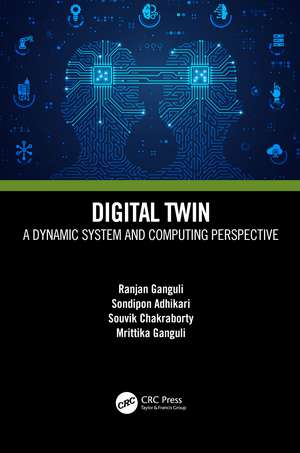
Digital Twin: A Dynamic System and Computing Perspective
Autor Ranjan Ganguli, Sondipon Adhikari, Souvik Chakraborty, Mrittika Gangulien Limba Engleză Hardback – 17 apr 2023
Preț: 1002.82 lei
Preț vechi: 1222.94 lei
-18%
Carte tipărită la comandă
Livrare economică 07-21 decembrie
Specificații
ISBN-10: 1032213620
Pagini: 252
Ilustrații: 5 Tables, black and white; 76 Line drawings, black and white; 2 Halftones, black and white; 78 Illustrations, black and white
Dimensiuni: 156 x 234 x 22 mm
Greutate: 0.44 kg
Ediția:1
Editura: CRC Press
Colecția CRC Press
V-ar putea interesa
-
 Introduction to Real-Time Computing for Mechanical Engineers, AnJoseph L. Garbini-15%Preț: 523.51 lei617.19 lei
 -
 -40%Preț: 458.81 lei768.90 lei
 -
 Preț: 356.58 lei
 -
 MechatronicsW. Bolton-11%Preț: 667.57 lei750.07 lei
 -
 Digital Twins in Industrial Production and Smart ManufacturingRajesh Kumar Dhanaraj-23%Preț: 690.28 lei896.46 lei
 -
 The Digital Twin 2.0Kevin Chen-20%Preț: 135.04 lei168.80 lei
 -
 Foundations of Analog and Digital Electronic CircuitsAnant Agarwal-27%Preț: 551.94 lei754.30 lei
 -
 The Nature of Code: Simulating Natural Systems with JavaScriptDaniel Shiffman-33%Preț: 218.06 lei325.94 lei
 -
 The Digital TwinNoel Crespi-20%Preț: 1381.08 lei1726.35 lei
 -
 Robust and Adaptive ControlEugene LavretskyPreț: 542.07 lei
 -
 Concise Guide to the Internet of ThingsMichael Mccarthy-20%Preț: 421.74 lei527.18 lei
 -
 Transforming Industry using Digital Twin TechnologyAshutosh MishraPreț: 483.08 lei
 -
 Digital AgricultureMuhammad Azhar IqbalPreț: 337.85 lei
 -
 -18%Preț: 1448.15 lei1766.03 lei
 -
 Networked SystemsSalem Lahlou-20%Preț: 996.76 lei1245.95 lei
 -
 -20%Preț: 547.54 lei684.43 lei
 -
 Digital TransformationBirgit Vogel-Heuser-20%Preț: 419.84 lei524.80 lei
 -
 -18%Preț: 1449.74 lei1767.97 lei
 -
 Data-Driven Cyber Physical SystemsFangyu Li-18%Preț: 1044.71 lei1274.04 lei
 -
 Digital Twins for Vessel Life Cycle ServiceHouxiang Zhang-20%Preț: 1084.99 lei1356.24 lei
Public țintă
AcademicCuprins
Descriere
The digital twin of a physical system is an adaptive computer analog which exists in the cloud and adapts to changes in the physical system dynamically.
This book introduces the computing, mathematical, and engineering background to understand and develop the concept of the digital twin. It provides background in modeling/simulation, computing technology, sensor/actuators, and so forth, needed to develop the next generation of digital twins.
Concepts on cloud computing, big data, IoT, wireless communications, high-performance computing, and blockchain are also discussed.
Features:
- Provides background material needed to understand digital twin technology
- Presents computational facet of digital twin
- Includes physics-based and surrogate model representations
- Addresses the problem of uncertainty in measurements and modeling
- Discusses practical case studies of implementation of digital twins, addressing additive manufacturing, server farms, predictive maintenance, and smart cities
This book is aimed at graduate students and researchers in Electrical, Mechanical, Computer, and Production Engineering.