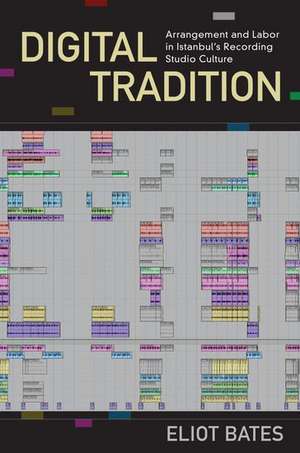
Digital Tradition
Autor Eliot Batesen Limba Engleză Paperback – 4 aug 2016
Preț: 220.86 lei
Preț vechi: 285.73 lei
-23%
Puncte Express: 331
Carte tipărită la comandă
Livrare economică 19-25 noiembrie
Livrare prin curier în România Termenul estimat este afișat lângă disponibilitate.
Transport gratuit de la 400.00 lei Plată online sau ramburs, în funcție de opțiunile comenzii.
Retur gratuit în 14 zile Comandă securizată și suport în română.
Specificații
ISBN-13: 9780190215743
ISBN-10: 0190215747
Pagini: 344
Ilustrații: 89
Dimensiuni: 155 x 234 x 18 mm
Greutate: 0.68 kg
Editura: Oxford University Press
Colecția OUP USA
Locul publicării:New York, United States
ISBN-10: 0190215747
Pagini: 344
Ilustrații: 89
Dimensiuni: 155 x 234 x 18 mm
Greutate: 0.68 kg
Editura: Oxford University Press
Colecția OUP USA
Locul publicării:New York, United States
V-ar putea interesa
-
 Listen to ThisAlex RossPreț: 92.40 lei
 -
 -13%Preț: 331.99 lei380.55 lei
 -
 Radical Traditions: Reimagining Culture in Balinese Contemporary MusicAndrew Clay McGraw-11%Preț: 245.25 lei274.68 lei
 -
 -9%Preț: 251.26 lei276.11 lei
 -
 -19%Preț: 245.67 lei301.83 lei
 -
 Preț: 249.81 lei
 -
 Ska'd for LifeHorace PanterPreț: 88.00 lei
 -
 Preț: 188.61 lei
 -
 Kate Bush: The biographyRob Jovanovic-27%Preț: 67.62 lei92.85 lei
 -
 Thrash MetalGarry Sharpe-YoungPreț: 240.43 lei
Recenzii
In Eliot Batess ethnographic Digital Tradition, he explores folk and traditional Turkish, Kurdish, and Laz music as it is recorded and distributed with 21st century digital recording technology and within modern markets. Additionally, through numerous cases and examples, he illustrates how recorded music affects identity, linguistic, and political factors in Turkish society.
Digital Tradition is a book that serves not only those interested in technology, industry, and Middle Eastern music studies but also those who wish to interrogate the boundaries between scholar, musician, and technical worker in a transnational context.
Digital Tradition is a book that serves not only those interested in technology, industry, and Middle Eastern music studies but also those who wish to interrogate the boundaries between scholar, musician, and technical worker in a transnational context.
Notă biografică
Dr. Eliot Bates is a scholar whose work focuses on the creative use of digital music technologies and the growth of hybrid digital music economies. An ethnomusicologist by training, he has conducted over three years of field research in Turkey, and is the author of Music in Turkey: Experiencing Music, Expressing Culture (OUP, 2011) and articles on musical instruments, aesthetics, studio architecture, and the emergence of an industry for Anatolian minority language popular musics. Eliot is a Lecturer in Ethnomusicology and Popular Music Studies at the University of Birmingham (UK). In addition to his scholarly interests, since 1994 Eliot has been a performer and recording artist on the oud, most recently (with organist Baby Dee) recording and performing as The Big Bumble Bees.
Cuprins
- Contents
- List of illustrations
- Preface and acknowledgments
- Notes about language
- Map of Turkey
- Part 1: A digital tradition of arrangement
- Chapter 1: Arrangement and engineering
- Arrangement and arrangers
- Engineering and engineers
- Social, technical, musical things
- Research methodology
- Chapter 2: Tradition
- Discourses of tradition and place
- Problems of place and identity
- Traditions of work
- Part 2: Arranged histories and arrangement industries
- Chapter 3: Arranged folklore in early Republican Turkey
- The demand for folklore
- A source-resource model for analyzing derleme
- Folklore at the birth of the Republic
- Folklore institutions during the one-party era
- Folklore and mass-media in the multi-party era
- Musical practices of arrangement, cleaning and restoration
- Cultural geographies of village, town, city and nation
- Postscript: revisiting Altun Karahan
- Chapter 4: The Anatolian "ethnic" music industry
- The growth of Turkey's recorded music industry
- Industries and ortak-s
- Ethnic language politics and emerging markets
- University ensembles: Grup Yorum, Karde¿ Türküler and Zu¿äi Berepe
- Organizational and production networks: the role and legacy of Kalan Müzik Yapim
- Concerns with foreign perceptions
- Social networks and the nature of professions
- Negotiating outside actors
- Part 3: The recording studio assemblage in Istanbul
- Chapter 5: The experience of studio work
- Auditory images and "visions" of the song arrangement
- Studio listening modalities and technologies of audition
- Latencies
- Built environments and social dynamics
- Chapter 6: Digital
- Hearing digital data, visualizing Anatolian soundings: synesthesia in the studio
- Digital audio, music, and non-musical sound
- Acoustic instruments and indirect computer users
- Chapter 7: Aesthetic keywords of the studio
- Introduction
- Denge/denk/denk gelmek: balance and suitability
- Fena de¿il and oldu galiba: the aesthetics of "not bad" when mixes happen
- Tav¿r, yorum and the art of interpretation
- Renk enstrümanlar¿
- Parlak and büyük ses
- Aesthetic relations
- Part 4: Case studies in arranged music
- Chapter 8: Arranged music and the dönem filmi genre
- Analyzing film music and sound
- The d:onem filmi genre
- Vizontele (2001) and the formation of a new film music genre
- Beynelmilel (2006) and the problems of leitmotif
- Özlem Taner's "Kara Tren/ Seher ¿nende"
- D:onem films as technological tragic comedies
- Chapter 9: Arranging the Black Sea
- Finding the Karadeniz
- G:okhan Birben, "Hele Mele" (on the outside)
- G:okhan Birben, "Denizde Dalga Birdur" (there's a wave in the ocean)
- Bizim Yäar Kabaosmano¿lu, "Nenni Nenni"
- Fatih Yäar "Sirlarumi Söyledum" (I told my secrets to the smoke on the mountain)
- Fatih Yäar "Çiktum Yüksek Dälara" (I headed up the high mountain)
- Ay¿enur Kolivar, "Mavili E¿arbumi / Lafun Aykirisi" (Blue scarf / Against this nonsense)
- Chapter 10: Towards a methodology for the study of digital music production
- Methodological Implications
- Glossary
- Bibliography
- Mediagraphy (audio recordings, feature films, and TV shows)
- Index