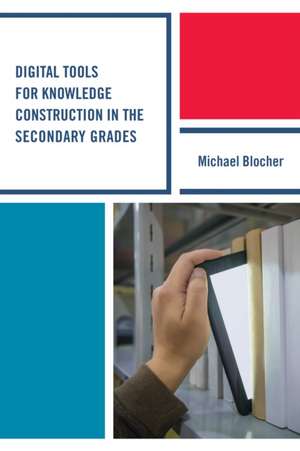
Digital Tools for Knowledge Construction in the Secondary Grades
Autor Michael Blocheren Limba Engleză Paperback – 22 aug 2016
This book is divided into two sections. Part I provides a foundation and rational for student-centered learning, instructional strategies for technology integration, and using this approach to help teachers assess their students in meeting academic standards. Part II includes foundational technology information and appropriate use of digital tools for communication, collaboration, research, publishing, and even games for learning.
This text provides methods and examples of technology integration that supports students' achievement of national academic standards by using today's digital tools for communication, collaboration, research and publishing. When students learn how to become knowledgeable global digital citizens they gain the requisite skills for tomorrow's creative thinkers, problem solvers, and decision makers.
Preț: 175.15 lei
Preț vechi: 237.81 lei
-26%
Puncte Express: 263
Carte tipărită la comandă
Livrare economică 18 noiembrie-02 decembrie
Livrare prin curier în România Termenul estimat este afișat lângă disponibilitate.
Transport gratuit de la 400.00 lei Plată online sau ramburs, în funcție de opțiunile comenzii.
Retur gratuit în 14 zile Comandă securizată și suport în română.
Specificații
ISBN-13: 9781475828474
ISBN-10: 1475828470
Pagini: 140
Dimensiuni: 151 x 228 x 10 mm
Greutate: 0.22 kg
Editura: Bloomsbury Publishing
Colecția Rowman & Littlefield
Locul publicării:New York, United States
ISBN-10: 1475828470
Pagini: 140
Dimensiuni: 151 x 228 x 10 mm
Greutate: 0.22 kg
Editura: Bloomsbury Publishing
Colecția Rowman & Littlefield
Locul publicării:New York, United States
V-ar putea interesa
-
 -18%Preț: 392.45 lei477.74 lei
 -
 Succeed in Your Medical School InterviewChristopher SeePreț: 160.83 lei
 -
 Learning to Teach Drama 11-18Andy Kempe-11%Preț: 332.37 lei373.28 lei
 -
 100 Ideas for Supporting Pupils on the Autistic SpectrumFrancine Brower-43%Preț: 71.45 lei124.71 lei
 -
 The New American High SchoolTed SizerPreț: 149.71 lei
 -
 -42%Preț: 74.75 lei128.78 lei
 -
 -42%Preț: 74.97 lei129.39 lei
 -
 Creating InnovatorsTony WagnerPreț: 105.58 lei
 -
 Cases on Quality Teaching Practices in Higher EducationDiane J. Salter-18%Preț: 995.10 lei1213.54 lei
 -
 Compute-IT: Student's Book 2 - Computing for KS3Mark Dorling-37%Preț: 146.45 lei233.21 lei
 -
 -42%Preț: 75.94 lei130.76 lei
 -
 14-18 - A New Vision for Secondary EducationLord Kenneth Baker-42%Preț: 125.82 lei216.46 lei
 -
 Creativity in Secondary EducationJonathan SavagePreț: 291.85 lei
 -
 -13%Preț: 105.71 lei121.61 lei
 -
 Chemistry Education – Best Practices, Opportunities and TrendsJ García–Martínez-14%Preț: 1273.01 lei1480.25 lei
Cuprins
Preface
Part I -Foundations
Chapter 1 - Perspective
Chapter 2 - Instructional Strategies
Chapter 3 - Standards & Assessment
Part II -Digital Tools for Learning
Chapter 4 - Technology Operations
Chapter 5 - Global Digital Citizenship
Chapter 6 - Communication & Collaboration
Chapter 7 - Research, Data Collection & Analysis
Chapter 8 - Creating & Publishing
Chapter 9 - Thinking Critically: Solving Problems and Making Decisions
Chapter 10 -Digital Games for Learning
Part I -Foundations
Chapter 1 - Perspective
Chapter 2 - Instructional Strategies
Chapter 3 - Standards & Assessment
Part II -Digital Tools for Learning
Chapter 4 - Technology Operations
Chapter 5 - Global Digital Citizenship
Chapter 6 - Communication & Collaboration
Chapter 7 - Research, Data Collection & Analysis
Chapter 8 - Creating & Publishing
Chapter 9 - Thinking Critically: Solving Problems and Making Decisions
Chapter 10 -Digital Games for Learning
Recenzii
Dr. Blocher has created a realistic approach for integrating technology into education. His focus is to engage students using digital tools to learn and understand academic content. This approach allows the student to develop complex knowledge by being at the center of the learning process and in control of the learning activity. I believe that this technology integration foundational text provides the reader with specific examples of meaningful ways to integrate technology into the classroom.
Dr. Blocher's text provides excellent examples of how technology can be integrated into a variety of content areas and instructional contexts in meaningful ways. This text goes far beyond the traditional "what is educational technology" and delves into important issues regarding the most effective ways to use technology to support innovative teaching and complex learning. This is an important contribution to the field of educational technology.
Dr. Blocher's text provides excellent examples of how technology can be integrated into a variety of content areas and instructional contexts in meaningful ways. This text goes far beyond the traditional "what is educational technology" and delves into important issues regarding the most effective ways to use technology to support innovative teaching and complex learning. This is an important contribution to the field of educational technology.