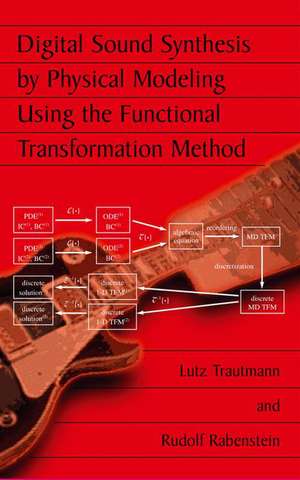
Digital Sound Synthesis by Physical Modeling Using the Functional Transformation Method
Autor Lutz Trautmann, Rudolf Rabensteinen Limba Engleză Hardback – 31 oct 2003
Preț: 664.01 lei
Preț vechi: 781.20 lei
-15%
Puncte Express: 996
Carte tipărită la comandă
Livrare economică 30 noiembrie-14 decembrie
Livrare prin curier în România Termenul estimat este afișat lângă disponibilitate.
Transport gratuit pentru acest produs Plată online sau ramburs, în funcție de opțiunile comenzii.
Retur gratuit în 14 zile Comandă securizată și suport în română.
Specificații
ISBN-13: 9780306478758
ISBN-10: 0306478757
Pagini: 256
Ilustrații: XXVI, 226 p.
Dimensiuni: 160 x 241 x 19 mm
Greutate: 0.5 kg
Ediția:2003
Editura: Springer
Locul publicării:New York, NY, United States
ISBN-10: 0306478757
Pagini: 256
Ilustrații: XXVI, 226 p.
Dimensiuni: 160 x 241 x 19 mm
Greutate: 0.5 kg
Ediția:2003
Editura: Springer
Locul publicării:New York, NY, United States
V-ar putea interesa
-
 From Calculus to Chaos: An Introduction to DynamicsDavid Acheson-28%Preț: 366.53 lei510.68 lei
 -
 Elementary Fluid DynamicsD. J. Acheson-24%Preț: 563.52 lei743.61 lei
 -
 -9%Preț: 1104.58 lei1213.83 lei
 -
 Dynamic Stability of StructuresWei-Chau Xie-11%Preț: 428.56 lei481.53 lei
 -
 Concepts in Submarine DesignRoy Burcher-8%Preț: 467.17 lei507.79 lei
 -
 Sliding Mode Control and ObservationYuri Shtessel-54%Preț: 385.06 lei840.94 lei
 -
 -23%Preț: 460.59 lei598.18 lei
 -
 -27%Preț: 881.27 lei1207.22 lei
 -
 Formulas for Dynamics ClBlevins-9%Preț: 912.85 lei1003.13 lei
 -
 Fundamentals of Mechanical VibrationsLiang-Wu Cal-27%Preț: 846.19 lei1159.16 lei
 -
 Engineering Vibroacoustic AnalysisStephen A Hambric-9%Preț: 887.64 lei975.43 lei
 -
 Time Series with Mixed SpectraTa-Hsin Li-18%Preț: 1282.73 lei1564.30 lei
 -
 Vibration Simulation Using MATLAB and ANSYSMichael R. Hatch-18%Preț: 1501.85 lei1831.52 lei
 -
 THEORY & PRACTICE OF HYDRODYNAMIC..(V20)Chakrabarti Subrata KPreț: 401.20 lei
Public țintă
ResearchCuprins
1. Introduction.- 2. Sound-Based Synthesis Methods.- 1 Wavetable synthesis.- 2 Granular synthesis.- 3 Additive synthesis.- 4 Subtractive synthesis.- 5 FM synthesis.- 6 Combinations of sound-based synthesis methods.- 3. Physical Description of Musical instruments.- 1 General notation.- 2 Subdivision of a musical instrument into vibration generators and a resonant body.- 3 Physical description of string vibrations.- 4 Physical description of membrane vibrations.- 5 Physical description of resonant bodies.- 6 Chapter summary.- 4. Classical Synthesis Methods Based on Physical Models.- 1 Finite difference method.- 2 Digital waveguide method.- 3 Modal synthesis.- 4 Chapter summary.- 5. Functional Transformation Method.- 1 Fundamental principles of the FTM.- 2 Application of the FTM to vibrating strings.- 3 Application of the FTM to vibrating membranes.- 4 Application of the FTM to resonant bodies.- 5 Chapter summary.- 6. Comparison of the Ftm with the Classical Physical Modeling Methods.- 1 Comparison of the FTM with the FDM.- 2 Comparison and combination of the FTM with the DWG.- 3 Comparison of the FTM with the MS.- 4 Chapter conclusions.- 7. Summary, Conclusions, and Outlook.
Recenzii
From the reviews:
"This is a book devoted to digital sound synthesis (DSS). The exposition makes full use of modern mathematical tools. … The book represents an interesting contribution to music synthesis and the reviewer thinks it will soon become a reference volume in the electric and mechanical domains." (D. Stanomir, Mathematical Reviews, 2005 b)
"This book … gives not only a thorough introduction to the Functional Transformation Method itself, but provides an excellent overview of existing alternatives. … The book is exemplary in clarity as well as for references and lists of symbols, variables, abbreviations, etc. More than fifty figures are included. … an innovative and far-reaching text that should find its way to all institutes where sound synthesis is taught or researched." (K. Guettler, Acta Acustica united with Acustica, Vol. 91 (4), 2005)
"This is a book devoted to digital sound synthesis (DSS). The exposition makes full use of modern mathematical tools. … The book represents an interesting contribution to music synthesis and the reviewer thinks it will soon become a reference volume in the electric and mechanical domains." (D. Stanomir, Mathematical Reviews, 2005 b)
"This book … gives not only a thorough introduction to the Functional Transformation Method itself, but provides an excellent overview of existing alternatives. … The book is exemplary in clarity as well as for references and lists of symbols, variables, abbreviations, etc. More than fifty figures are included. … an innovative and far-reaching text that should find its way to all institutes where sound synthesis is taught or researched." (K. Guettler, Acta Acustica united with Acustica, Vol. 91 (4), 2005)