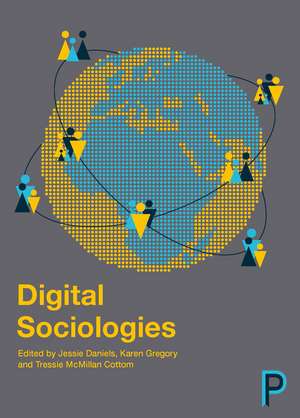
Digital Sociologies
Editat de Jessie Daniels, Karen Gregory, Tressie McMillan Cottomen Limba Engleză Paperback – 16 noi 2016
În volumul Digital Sociologies, abilitățile de analiză critică și cercetare sociologică aplicată mediului virtual au prioritate absolută. Găsim în această lucrare un efort colectiv de a ancora studiul tehnologiilor digitale în fundamentele sociologiei clasice, refuzând ideea că spațiul online este o entitate separată de realitatea materială. Apreciem modul în care editorii Jessie Daniels, Karen Gregory și Tressie McMillan Cottom au structurat cele 520 de pagini pentru a demonstra că inegalitățile de gen, rasă și clasă nu dispar în mediul digital, ci sunt adesea reconfigurate și amplificate.
Cartea este organizată riguros, începând cu o introducere teoretică solidă și continuând cu o primă parte dedicată vieții cotidiene. Aici, autorii analizează teme fascinante, de la modul în care benzile desenate ne ajută să înțelegem interactivitatea, până la „Orientalismul digital” pe platforme precum TripAdvisor. Această progresie de la micro-interacțiuni la instituții digitizate oferă o acoperire exhaustivă a domeniului. Digital Sociologies completează excelent titluri precum The Oxford Handbook of Digital Media Sociology, aducând o perspectivă mult mai tranșantă asupra justiției sociale și a raporturilor de putere, în timp ce față de The SAGE Handbook of Digital Society, se concentrează mai specific pe mecanismele inegalității structurale.
Lucrarea se înscrie natural în traiectoria academică a editorilor. Jessie Daniels continuă aici explorarea temelor din Cyber Racism și Being a Scholar in the Digital Era, extinzând analiza de la supremația albă online la o viziune sistemică asupra modului în care algoritmii și platformele modelează societatea contemporană. Este un volum de referință care transformă „digitalul” dintr-un subiect de nișă într-o lentilă esențială pentru orice investigație socială modernă.
Preț: 418.97 lei
Carte disponibilă
Livrare economică 12-26 noiembrie
Specificații
ISBN-10: 1447329015
Pagini: 520
Dimensiuni: 171 x 241 x 33 mm
Greutate: 0.84 kg
Editura: Bristol University Press
Colecția Policy Press
V-ar putea interesa
-
 Overspent American, TheJuliet B. SchorPreț: 99.87 lei
 -
 -15%Preț: 458.83 lei539.79 lei
 -
 Unhealthy Places: The Ecology of Risk in the Urban LandscapeKevin Fitzpatrick-15%Preț: 425.72 lei500.84 lei
 -
 Preț: 197.99 lei
 -
 CountlessKaren Gregory-24%Preț: 44.72 lei58.89 lei
 -
 SkylarksKaren Gregory-26%Preț: 48.15 lei64.99 lei
 -
 Preț: 264.51 lei
 -
 Research Methods in Social Sciences: In ArabicHasan YahyaPreț: 121.00 lei
 -
 Preț: 123.18 lei
 -
 Tales from America: Arab - American Issues (in Arabic)Hasan Yahya Ph. D.Preț: 106.69 lei
 -
 -23%Preț: 682.03 lei885.76 lei
 -
 Rise AgainJessie DanielsPreț: 90.38 lei
 -
 I Hold Your HeartKaren Gregory-25%Preț: 43.16 lei57.53 lei
 -
 -31%Preț: 129.24 lei187.49 lei
 -
 Preț: 242.30 lei
 -
 Preț: 367.93 lei
 -
 Preț: 264.88 lei
 -
 Women in Chinese SocietyMargery WolfPreț: 287.46 lei
 -
 The African Slave in Colonial Peru, 1524-1650Frederick P. BowserPreț: 405.98 lei
 -
 For-Profit UniversitiesTressie McMillan Cottom-15%Preț: 656.44 lei772.28 lei
 -
 Alondras Al VueloKaren GregoryPreț: 148.78 lei
De ce să citești această carte
Recomandăm această carte cercetătorilor și studenților la sociologie care doresc să depășească simpla descriere a fenomenelor online. Cititorul câștigă un aparat critic riguros pentru a analiza modul în care munca, identitatea și instituțiile se transformă sub influența tehnologiei. Este un instrument indispensabil pentru a înțelege că „digitalul” nu este doar o unealtă, ci un nou teren pe care se manifestă vechile inegalități sociale, oferind metode concrete de analiză a discursului și eticii digitale.
Despre autor
Jessie Daniels este profesor de sociologie și un expert recunoscut la nivel internațional în studiul rasismului în era digitală. Opera sa, care include titluri precum Cyber Racism și Nice White Ladies, se concentrează pe modul în care tehnologia mediază și perpetuează inegalitățile structurale. Karen Gregory și Tressie McMillan Cottom (autoare laureată a premiului MacArthur) aduc expertiză suplimentară în economia muncii digitale și sociologia educației. Împreună, acești editori au definit standardele de analiză pentru sociologia digitală contemporană, promovând o abordare care îmbină rigoarea academică cu activismul pentru justiție socială.
Descriere scurtă
Notă biografică
Cuprins
Preface
Saskia Sassen
Notes on the authors
Introduction
Karen Gregory, Tressie McMIllan Cottom, and Jessie Daniels
Part I: Digital sociology in everyday life
1 Structure and agency in a digital world
Karen Gregory
2 Beyond digital dualism: Modeling digital community
Alexia Maddox
3 A return to Gemeinschaft: Digital impression management and the sharing economy
Alexandrea J. Ravenelle
4 Digital discourse analysis: Finding meaning in small online spaces
Timothy Recuber
5 Virtually ethical: Ethnographic challenges in researching textile crafters online
Alison Mayne
6 Interactivity, social media, and Superman: How ccomic books can help us understand and conceptualize interactivity online
Harry T. Dyer
7 The digital solidarity trap: Social movement research, online activism, and accessing the other’s others
Theresa A. Hunt
8 Digital Orientalism: TripAdvisor and online travelers’ tales
Trevor Jamerson
Part II Digitized institutions
9 Digitized institutions and inequalities
Tressie McMillian Cottom
10 Toward a digital sociology of school
Neil Selwyn, Selena Nemorin, Scott Bulfin, and Nicola F. Johnson
11 Representing “inforgs” in data-driven decisions
Jeffrey Alan Johnson
12 Employee monitoring in a digital context
Calle Rosengren and Mikael Ottosson
13 Digital sociology’s vocational promise
Stephen R. Barnard
14 Black cyberfeminism: Ways forward for intersectionality and digital sociology
Tessie McMillan cottom
15 Deconstructing racism on college websites
Monita H. Mungo
16 Yakking about college life: Examining the role of anonymous forums on community identity formation
Francesca Tripodi
17 On Thursdays we watch Scandal: Communal viewing and Black Twitter
Apryl McKinney
19 Covert leisure and public spaces: Geocaching in post-9/11 New York City
Jonathan R. Wynn
Part III: Digital bodies
20 Bodies in code
Jessie Daniels
21 Personal data practices in the age of lively data
Deborah Lupton
22 “They’re just too urban”: Black gamers streaming on Twitch
Kishonna L. Gray
23 From “geek” to “chic”: Wearable technology and the woman question
Elizabeth Wissinger
24 Queer Facebook? Digital sociality and queer theory
Benjamin Haber
25 The Ms. Dewey “experience:” Technoculture, gender, and race
Miriam E. Sweeney
26 The Emperor’s new data clothes: Implications of “nudity” as a racialized and gendered metaphor in discourse on personal digital data
Yuliya Grinberg
27 Post your comments below: A case study of immigrant bashing online
Adrian Cruz and Kazuyo Kubo
28 Our mothers have always been machines: The conflation of media and motherhood
Kara van Cleaf
29 #notracist: Exploring racism denial talk on Twitter
Sanjay Sharma and Phillip Brooker
Index