
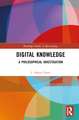
Digital Knowledge: A Philosophical Investigation: Routledge Studies in Epistemology
Autor J. Adam Carteren Limba Engleză Paperback – 27 mai 2025
Digital Knowledge: A Philosophical Investigation is the first book to squarely and rigorously investigate digital knowledge: what it is, how to make sense of it in connection with received theories of knowledge, and where it is going. Key questions J. Adam Carter examines along the way are the following:
- How is mere digital information converted into reliable digital knowledge?
- To what extent can digital knowledge be vindicated against sceptical challenges, and in what ways might digital knowledge stand distinctively subject to defeat?
- What is the epistemically optimal way for us to decide which tasks to outsource entirely to intelligent machines, and to what extent is further outsourcing appropriate (or not) to verify the results of that same outsourced cognition?
- Are there any ways in which the expansion of the datasphere threatens to make knowledge less, rather than more, easy to come by? If so, are there any promising ways to safeguard, epistemically, against such threats?
Din seria Routledge Studies in Epistemology
-
 Preț: 450.54 lei
 - 18%
 Preț: 1061.59 lei
 - 18%
 Preț: 1112.48 lei
 - 18%
 Preț: 1114.04 lei
 - 18%
 Preț: 1120.74 lei
 -
 Preț: 401.08 lei
 -
 Preț: 410.99 lei
 -
 Preț: 414.14 lei
 -
 Preț: 432.83 lei
 -
 Preț: 410.99 lei
 -
 Preț: 418.04 lei
 - 18%
 Preț: 1112.48 lei
 -
 Preț: 346.76 lei
 -
 Preț: 429.16 lei
 - 18%
 Preț: 1115.65 lei
 - 18%
 Preț: 1057.86 lei
 -
 Preț: 402.34 lei
 -
 Preț: 434.35 lei
 -
 Preț: 410.99 lei
 -
 Preț: 407.00 lei
 -
 Preț: 408.74 lei
 - 18%
 Preț: 1115.78 lei
 -
 Preț: 412.99 lei
 -
 Preț: 437.63 lei
 -
 Preț: 461.30 lei
 - 18%
 Preț: 1117.60 lei
 - 18%
 Preț: 1057.86 lei
 -
 Preț: 404.33 lei
 - 18%
 Preț: 1112.48 lei
 - 18%
 Preț: 1111.99 lei
 - 18%
 Preț: 1058.11 lei
 - 18%
 Preț: 1112.48 lei
Preț: 413.83 lei
Puncte Express: 621
Carte disponibilă
Livrare economică 10-24 noiembrie
Livrare express 27-31 octombrie pentru 28.44 lei
Livrare prin curier în România Termenul estimat este afișat lângă disponibilitate.
Transport gratuit pentru acest produs Plată online sau ramburs, în funcție de opțiunile comenzii.
Retur gratuit în 14 zile Comandă securizată și suport în română.
Specificații
ISBN-13: 9780367566906
ISBN-10: 0367566907
Pagini: 206
Ilustrații: 6
Dimensiuni: 156 x 234 x 11 mm
Greutate: 0.3 kg
Ediția:1
Editura: Taylor & Francis
Colecția Routledge
Seria Routledge Studies in Epistemology
Locul publicării:Oxford, United Kingdom
ISBN-10: 0367566907
Pagini: 206
Ilustrații: 6
Dimensiuni: 156 x 234 x 11 mm
Greutate: 0.3 kg
Ediția:1
Editura: Taylor & Francis
Colecția Routledge
Seria Routledge Studies in Epistemology
Locul publicării:Oxford, United Kingdom
V-ar putea interesa
-
 -32%Preț: 553.99 lei818.64 lei
 -
 Knowledge First: Approaches in Epistemology and MindJ. Adam Carter-19%Preț: 611.95 lei755.50 lei
 -
 Extended EpistemologyJ. Adam Carter-31%Preț: 637.76 lei921.59 lei
 -
 Socially Extended EpistemologyJ. Adam Carter-31%Preț: 617.46 lei892.94 lei
 -
 A Passion for BooksD. SalwakPreț: 390.28 lei
 -
 The Philosophy of Group Polarization: Epistemology, Metaphysics, PsychologyFernando Broncano-BerrocalPreț: 407.00 lei
 -
 Get Published Without Getting Ripped OffTed BowmanPreț: 59.36 lei
 -
 Museums, Migration and Identity in Europe: Peoples, Places and IdentitiesChristopher Whitehead-18%Preț: 1123.58 lei1370.22 lei
 -
 Library in the Life of the UserLynn Connaway SilipigniPreț: 183.73 lei
 -
 -15%Preț: 455.27 lei535.61 lei
 -
 The History of the Book (Yearbook of English Studies (45) 2015)Stephen Colclough-9%Preț: 794.59 lei873.18 lei
 -
 Preț: 253.99 lei
 -
 Preț: 299.67 lei
 -
 Preț: 65.39 lei
 -
 10 Years in Art PublishingLionel BovierPreț: 50.49 lei
Public țintă
Postgraduate and Undergraduate AdvancedCuprins
Preface 1. Digital Epistemology: A Research Programme Motivated 2. From Digital Information to Digital Knowledge 3. The Nature of Digital Knowledge: A Bi-Level Account 4. The Dark Side of Digital Knowledge: Scepticism and Defeat 5. A Digital Epistemology of Machine Learning 6. A Digital Epistemology of Big Data. Bibliography Index
Notă biografică
J. Adam Carter is Professor of Philosophy at the University of Glasgow, UK, where he is the deputy director of the COGITO Epistemology Research Centre. His books The Philosophy of Group Polarization and The Epistemology of Group Disagreement (both with Fernando Broncano-Berrocal), and Well-Founded Belief: New Essays on the Epistemic Basing Relation (with Patrick Bondy), are also available from Routledge. He is also the author of Autonomous Knowledge (2022) and PI on an AHRC-funded project on digital epistemology (2022–2025).
Descriere
Digital Knowledge: A Philosophical Investigation is the first book to fully explain and examine digital knowledge: what it is, how it compares to received theories of knowledge and where it is going.