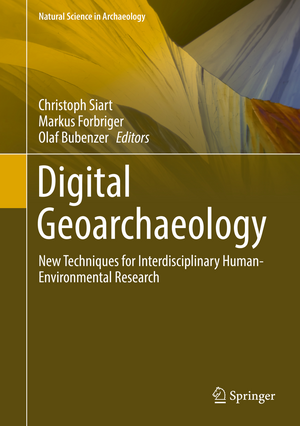
Digital Geoarchaeology: Natural Science in Archaeology
Editat de Christoph Siart, Olaf Bubenzer, Markus Forbrigeren Limba Engleză Hardback – 18 dec 2017
| Toate formatele și edițiile | Preț | Express |
|---|---|---|
| Paperback (1) | 610.32 lei 38-44 zile | |
| Springer International Publishing – 30 aug 2018 | 610.32 lei 38-44 zile | |
| Hardback (1) | 626.72 lei 6-8 săpt. | |
| Springer International Publishing – 18 dec 2017 | 626.72 lei 6-8 săpt. |
Din seria Natural Science in Archaeology
- 24%
 Preț: 1002.43 lei
 - 20%
 Preț: 614.48 lei
 - 15%
 Preț: 629.04 lei
 - 18%
 Preț: 920.45 lei
 - 18%
 Preț: 2019.40 lei
 - 18%
 Preț: 1329.59 lei
 - 18%
 Preț: 1185.07 lei
 - 18%
 Preț: 1764.96 lei
 - 18%
 Preț: 1065.87 lei
 - 24%
 Preț: 741.45 lei
 - 24%
 Preț: 915.12 lei
 - 18%
 Preț: 975.33 lei
 - 15%
 Preț: 626.96 lei
 - 24%
 Preț: 888.89 lei
 - 18%
 Preț: 1083.44 lei
 - 18%
 Preț: 756.81 lei
 -
 Preț: 438.65 lei
Preț: 626.72 lei
Preț vechi: 737.32 lei
-15%
Puncte Express: 940
Preț estimativ în valută:
110.81€ • 130.76$ • 97.04£
110.81€ • 130.76$ • 97.04£
Carte tipărită la comandă
Livrare economică 13-27 aprilie
Specificații
ISBN-13: 9783319253145
ISBN-10: 331925314X
Pagini: 284
Ilustrații: XIII, 269 p. 114 illus., 91 illus. in color.
Dimensiuni: 183 x 260 x 21 mm
Greutate: 0.74 kg
Ediția:1st edition 2018
Editura: Springer International Publishing
Seria Natural Science in Archaeology
Locul publicării:Cham, Switzerland
ISBN-10: 331925314X
Pagini: 284
Ilustrații: XIII, 269 p. 114 illus., 91 illus. in color.
Dimensiuni: 183 x 260 x 21 mm
Greutate: 0.74 kg
Ediția:1st edition 2018
Editura: Springer International Publishing
Seria Natural Science in Archaeology
Locul publicării:Cham, Switzerland
V-ar putea interesa
-
 HomeFrancis Pryor-20%Preț: 71.63 lei89.41 lei
 -
 Prehistoric Cultural Ecology and EvolutionDonald O. Henry-18%Preț: 931.61 lei1136.11 lei
 -
 Aftermath: Readings in the Archaeology of Recent ConflictJohn SchofieldPreț: 370.46 lei
 -
 The First ArtistsMichel Lorblanchet-18%Preț: 114.05 lei139.65 lei
 -
 The History of the Aztec & Inca: Two Illustrated Reference BooksCharles PhillipsPreț: 142.11 lei
 -
 A Consumer's Guide to Archaeological ScienceMary E Malainey-15%Preț: 678.33 lei798.03 lei
 -
 -17%Preț: 179.42 lei217.28 lei
 -
 Climate and Ancient SocietiesSusanne Kerner-11%Preț: 363.94 lei408.91 lei
 -
 -22%Preț: 398.63 lei508.92 lei
 -
 Preț: 226.64 lei
 -
 Preț: 292.64 lei
Cuprins
1. Digital Geoarchaeology - Bridging the Gap Between Archaeology, Geosciences and Computer Sciences.- 2. Spatial Analysis in Archaeology: Moving into New Territories.- 3. Methods and Perspectives of Geoarchaelogical Site Catchment Analysis: Identification of Paleoclimate Indicators in the Oder Region from the Iron to Middle Ages.- 4. Point Pattern Analysis as Tool for Digital Geoarchaeology – A Case Study of Megalithic Graves in Schleswig-Holstein, Germany.- 5. Visual Perception in Past Built Environments: Theoretical and Procedural Issues in the Archaeological Application of Three-Dimensional Visibility Analysis.- 6. Understanding by the Lines We Map: Material Boundaries and the Social Interpretation of Archaeological Built Space.- 7. Airborne and Spaceborne Remote Sensing and Digital Image Analysis in Archaeology.- 8. Paleo-Environmental Research in the Semiarid Lake Manyara Area, Northern Tanzania - A Synopsis.- 9. In Search of the Optimal Path to Cross the Desert: Geoarchaeology Traces Old Trans-Saharan Routes.- 10. Combined Aerial and Ground-Based Structure-From-Motion for Cultural Heritage Documentation.- 11. Introduction to LiDAR in Geoarchaeology from a Technological Perspective.- 12. 3D Laser Scanning for Geoarchaelogical Documentation and Analysis.- 13. Visual detection and Interpretation of Cultural Remnants on the Königstuhl Hillside in Heidelberg Using Airborne and Terrestrial LiDAR Data.- 14. An Introduction to Geophysical and Geochemical Methods in Digital Geoarchaeology.- 15. A geoarchaeological approach for the localization of the prehistoric harbor of Akrotiri, Thera.- 16. Merging the Views: Highlights on the Fusion of Surface and Subsurface Geodata and Their Potentials for Digital Geoarchaeology.
Recenzii
“This is an academic book … fascinating in its explorations in what can be done when practitioners in these seemingly disparate academic disciplines combine efforts.” (David M. Jones, Proceedings of the Open University Geological Society, Issue 5, 2019)
Textul de pe ultima copertă
This book focusses on new technologies and multi-method research designs in the field of modern archaeology, which increasingly crosses academic boundaries to investigate past human-environmental relationships and to reconstruct palaeolandscapes. It aims at establishing the concept of Digital Geoarcheology as a novel approach of interdisciplinary collaboration situated at the scientific interface between classical studies, geosciences and computer sciences. Among others, the book includes topics such as geographic information systems, spatiotemporal analysis, remote sensing applications, laser scanning, digital elevation models, geophysical prospecting, data fusion and 3D visualisation, categorized in four major sections. Each section is introduced by a general thematic overview and followed by case studies, which vividly illustrate the broad spectrum of potential applications and new research designs. Mutual fields of work and common technologies are identified and discussedfrom different scholarly perspectives. By stimulating knowledge transfer and fostering interdisciplinary collaboration, Digital Geoarchaeology helps generate valuable synergies and contributes to a better understanding of ancient landscapes along with their forming processes.
Chapters 1, 2, 6, 8 and 14 are published open access under a CC BY 4.0 license at link.springer.com.
Chapters 1, 2, 6, 8 and 14 are published open access under a CC BY 4.0 license at link.springer.com.
Caracteristici
Promotes interdisciplinary studies between disciplines such as archaeology, computer sciences, geography, geoinformatics, geodesy, and history Summarizes the digital aspects of geoarchaeological research Focusses on a multidisciplinary interface, with case studies throughout Unravels questions of man and his environment