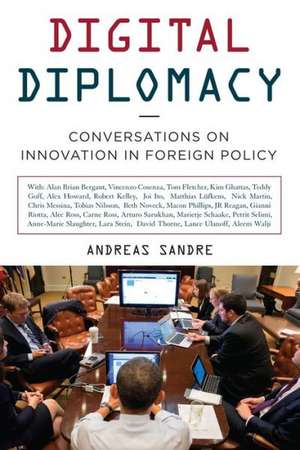
Digital Diplomacy: Conversations on Innovation in Foreign Policy
Autor Andreas Sandreen Limba Engleză Paperback – 22 ian 2015
Preț: 365.75 lei
Preț vechi: 463.79 lei
-21%
Puncte Express: 549
Carte tipărită la comandă
Livrare economică 26 noiembrie-10 decembrie
Livrare prin curier în România Termenul estimat este afișat lângă disponibilitate.
Transport gratuit de la 400.00 lei Plată online sau ramburs, în funcție de opțiunile comenzii.
Retur gratuit în 14 zile Comandă securizată și suport în română.
Specificații
ISBN-13: 9781442239128
ISBN-10: 1442239123
Pagini: 332
Dimensiuni: 149 x 227 x 24 mm
Greutate: 0.49 kg
Editura: Bloomsbury Publishing
Colecția Rowman & Littlefield
Locul publicării:New York, United States
ISBN-10: 1442239123
Pagini: 332
Dimensiuni: 149 x 227 x 24 mm
Greutate: 0.49 kg
Editura: Bloomsbury Publishing
Colecția Rowman & Littlefield
Locul publicării:New York, United States
Descriere
Through conversations with State Department officials, ambassadors, public relations executives, public policy experts, and academics, Digital Diplomacy explores what it means to be innovative in foreign policy and diplomacy.
Cuprins
Foreword
Claudio Bisogniero, Ambassador of Italy to the United States
Preface: Naked Diplomacy
Tom Fletcher, British Ambassador to Lebanon
Acknowledgments
Introduction: The Road To Diplomacy 3.0
Andreas Sandre
Part One: Traditional Vs. Innovative
Chapter 1: Twenty-First Century Statecraft
A conversation with Alec J. Ross, Senior Advisor for Innovation to the U.S. Secretary of State (2009-2013)
Chapter 2: The Arab Spring of Diplomacy
A conversation with Charles Firestone, Executive Director, Communications and Society Program, The Aspen Institute
Chapter 3: From A Skeptic's Point Of View
A conversation with Carne Ross, Founder and Executive mDirector, Independent Diplomat
Chapter 4: The Clinton Revolution
A conversation with Kim Ghattas, BBC State Department Correspondent, and author of The Secretary: A Journey with Hillary Clinton from Beirut to the Hearth of American
Power
Chapter 5: The Pillars of Digital Diplomacy
A conversation with Macon Phillips, Coordinator, International Information Programs, U.S. Department of State
Chapter 6: Let's Talk Strategy
A conversation withTeddy Goff, Digital Director, Obama 2012
Chapter 7: Pioneering Twitter Diplomacy
A conversation with Arturo Sarukhan, Ambassador of Mexico to the United States (2007-2012)
Chapter 8: Diplomacy in 140 Characters Or Less
A conversation with Matthias Lüfkens, Practice Leader Digital EMEA and author of @Twiplomacy, Burson-Marsteller
Chapter 9: From Davos To Global Virtual Communities
A conversation with Adrian Monck, Managing Director, Head of Public Engagement, World Economic Forum
Chapter 10: Engaging the World
A conversation with Stéphane Dujarric, Spokesperson of the Secretary-General of the United Nations and Deborah Seward, Director of Strategic Communications, Department of Public Information, United Nations
Chapter 11: The Power of the Hashtag
A conversation with: Chris Messina, Godfather of the Hashtag
Chapter 12: Content Matters
A conversation with Lance Ulanoff, Chief Correspondent and Editor-at-Large, Mashable
Chapter 13: The Numbers behind Social Media
A conversation with Vincenzo Cosenza, Social Media Strategist, BlogMeter
Part Two: The True Nature of Innovation
Chapter 14: The Power of Ideas
A conversation with Lara Stein, Founder and former Director, TEDx and TED Prize
Chapter 15: The Innovation Lab
A conversation with Joi Ito, Director of the MediaLab, The Massachusetts Institute of Technology
Chapter 16: Innovation: Buzzword or Reality?
A conversation with Alexander B. Howard, Fellow (2013-2014), Tow Center for Digital Journalism, Columbia University's Graduate School of Journalism and Research Fellow (2013), Networked Transparency Policy Project Ash Center, John F. Kennedy School of Government, Harvard University
Chapter 17: Training Minds and Ideas
A conversation with Nick Martin, Founder and CEO, TechChange
Chapter 18: Innovative Ideas for New Challenges
A conversation with Alain Brian Bergant, Secretary General, Bled Strategic Forum, Ministry of Foreign Affairs of the Republic of Slovenia and Timotej Soos, Director of the Young Bled Strategic Forum and Digital Diplomacy Coordinator, Ministry of Foreign Affairs of the Republic of Slovenia
Chapter 19: Innovation for Development
A conversation with: Aleem Walji, Director, Innovation labs, The World Bank
Part Three: Beyond Innovation and Social Media
Chapter 20: Power in Our Hyper-Connected World
A conversation with Anne-Marie Slaughter, President, New America Foundation
Chapter 21: A New Space for Diplomacy
A conversation with Robert Kelley, Assistant Professor, School of International Service, American University
Chapter 22: Digital Building Blocks for Democracy
A conversation with Petrit Selimi, Deputy Minister of Foreign Affairs of Kosovo
Chapter 23: An Incubator of Ideas and Growth
A conversation with David H. Thorne, Senior Advisor to the U.S. Secretary of State
Chapter 24: From Machiavelli To The Digital Age
A conversation with Gianni Riotta, Member of the Council on Foreign Relations and Pirelli Visitor Professor, Princeton University
Chapter 25: Technology and Freedom
A conversation with Marietje Schaake, Member of the European Parliament
Chapter 26: The Potential of Big Data
A conversation with JR Reagan, Principal, Deloitte & Touche
Biographies
Bibliography
Claudio Bisogniero, Ambassador of Italy to the United States
Preface: Naked Diplomacy
Tom Fletcher, British Ambassador to Lebanon
Acknowledgments
Introduction: The Road To Diplomacy 3.0
Andreas Sandre
Part One: Traditional Vs. Innovative
Chapter 1: Twenty-First Century Statecraft
A conversation with Alec J. Ross, Senior Advisor for Innovation to the U.S. Secretary of State (2009-2013)
Chapter 2: The Arab Spring of Diplomacy
A conversation with Charles Firestone, Executive Director, Communications and Society Program, The Aspen Institute
Chapter 3: From A Skeptic's Point Of View
A conversation with Carne Ross, Founder and Executive mDirector, Independent Diplomat
Chapter 4: The Clinton Revolution
A conversation with Kim Ghattas, BBC State Department Correspondent, and author of The Secretary: A Journey with Hillary Clinton from Beirut to the Hearth of American
Power
Chapter 5: The Pillars of Digital Diplomacy
A conversation with Macon Phillips, Coordinator, International Information Programs, U.S. Department of State
Chapter 6: Let's Talk Strategy
A conversation withTeddy Goff, Digital Director, Obama 2012
Chapter 7: Pioneering Twitter Diplomacy
A conversation with Arturo Sarukhan, Ambassador of Mexico to the United States (2007-2012)
Chapter 8: Diplomacy in 140 Characters Or Less
A conversation with Matthias Lüfkens, Practice Leader Digital EMEA and author of @Twiplomacy, Burson-Marsteller
Chapter 9: From Davos To Global Virtual Communities
A conversation with Adrian Monck, Managing Director, Head of Public Engagement, World Economic Forum
Chapter 10: Engaging the World
A conversation with Stéphane Dujarric, Spokesperson of the Secretary-General of the United Nations and Deborah Seward, Director of Strategic Communications, Department of Public Information, United Nations
Chapter 11: The Power of the Hashtag
A conversation with: Chris Messina, Godfather of the Hashtag
Chapter 12: Content Matters
A conversation with Lance Ulanoff, Chief Correspondent and Editor-at-Large, Mashable
Chapter 13: The Numbers behind Social Media
A conversation with Vincenzo Cosenza, Social Media Strategist, BlogMeter
Part Two: The True Nature of Innovation
Chapter 14: The Power of Ideas
A conversation with Lara Stein, Founder and former Director, TEDx and TED Prize
Chapter 15: The Innovation Lab
A conversation with Joi Ito, Director of the MediaLab, The Massachusetts Institute of Technology
Chapter 16: Innovation: Buzzword or Reality?
A conversation with Alexander B. Howard, Fellow (2013-2014), Tow Center for Digital Journalism, Columbia University's Graduate School of Journalism and Research Fellow (2013), Networked Transparency Policy Project Ash Center, John F. Kennedy School of Government, Harvard University
Chapter 17: Training Minds and Ideas
A conversation with Nick Martin, Founder and CEO, TechChange
Chapter 18: Innovative Ideas for New Challenges
A conversation with Alain Brian Bergant, Secretary General, Bled Strategic Forum, Ministry of Foreign Affairs of the Republic of Slovenia and Timotej Soos, Director of the Young Bled Strategic Forum and Digital Diplomacy Coordinator, Ministry of Foreign Affairs of the Republic of Slovenia
Chapter 19: Innovation for Development
A conversation with: Aleem Walji, Director, Innovation labs, The World Bank
Part Three: Beyond Innovation and Social Media
Chapter 20: Power in Our Hyper-Connected World
A conversation with Anne-Marie Slaughter, President, New America Foundation
Chapter 21: A New Space for Diplomacy
A conversation with Robert Kelley, Assistant Professor, School of International Service, American University
Chapter 22: Digital Building Blocks for Democracy
A conversation with Petrit Selimi, Deputy Minister of Foreign Affairs of Kosovo
Chapter 23: An Incubator of Ideas and Growth
A conversation with David H. Thorne, Senior Advisor to the U.S. Secretary of State
Chapter 24: From Machiavelli To The Digital Age
A conversation with Gianni Riotta, Member of the Council on Foreign Relations and Pirelli Visitor Professor, Princeton University
Chapter 25: Technology and Freedom
A conversation with Marietje Schaake, Member of the European Parliament
Chapter 26: The Potential of Big Data
A conversation with JR Reagan, Principal, Deloitte & Touche
Biographies
Bibliography
Recenzii
Digital Diplomacy explores what it means to be innovative in foreign policy and diplomacy. . . .In this emerging camp in which few established truths exist, this book is a significant effort to compile different points of view about trends and to provide a glimpse on how various actors deal with them. The structure of interviews makes the book readable and accessible, and the additional resources cited and suggested open avenues for further learning about the topic. In the course of the plethora of interviews compiled in this book, Andreas Sandre shows an in-depth knowledge of the latest facts, debates and trends in the subject area. Readers will find references to studies, books, websites, online tools and experts in the digital world, innovation and diplomacy (and all the different combinations among them). This is all the more important given that, as Sandre reminds us, we live in a world in which, in Africa more people have access to mobiles phones than to clean drinking water.
Sandre's work with practitioners who are coming to terms with digital technologies usefully complements the growing scholarly literature in diplomacy and communication studies.
Andreas Sandre offers keen insights regarding how the 21st Century interconnected global information environment is generating greater public pressure on foreign policymaking and how diplomats of all stripes must adapt as a result.
Digital Diplomacy offers fresh, compelling insights into how digital technology is re-defining the future of public diplomacy. This highly informative book is an important contribution to the growing discussion and study of the intersection between technology and diplomacy.
Throw the old diplomatic rule books out! Andreas Sandre explains how digital diplomacy is impacting and changing traditional diplomatic channels. Digital Diplomacy presents newchallenges for diplomats and governments to overcome, and at the same time fuels innovative government efforts to listen to and engage with citizens that have too often been left out of the process. If you want to better understand the intersection of digital and traditional diplomacy this is the book to read.
The impact of social media on diplomacy has been all encompassing. It has changed the way governments communicate their messages, interact with each other, influence opinion and stakeholders, and the expectations the public has in an open, constantly changing and connected world. The very idea of who and what matters is altered. The very idea of how to deal with, and communicate what matters, however complex, has changed. Most importantly, digital diplomacy shapes and impacts both governments that have adapted, and embraced these trends and dynamics, and those governments that have remained still as this shift has occurred - choosing to ignore digital diplomacy doesn't make the consequences and implications of these changes any less real. Few industry operators have grasped the significance of these changes as Andreas Sandre. His views on digital diplomacy are essential reading.
The arrival of social media has truly given substance and meaning to the phrase 'Power to the People'. Citizens of the world have more insight, more control and more influence over the new world order than ever before. Digital Diplomacy's rich and well-crafted insights quickly make you realize the impact and importance of a single tweet can go way beyond those 140 characters.
Sandre's work with practitioners who are coming to terms with digital technologies usefully complements the growing scholarly literature in diplomacy and communication studies.
Andreas Sandre offers keen insights regarding how the 21st Century interconnected global information environment is generating greater public pressure on foreign policymaking and how diplomats of all stripes must adapt as a result.
Digital Diplomacy offers fresh, compelling insights into how digital technology is re-defining the future of public diplomacy. This highly informative book is an important contribution to the growing discussion and study of the intersection between technology and diplomacy.
Throw the old diplomatic rule books out! Andreas Sandre explains how digital diplomacy is impacting and changing traditional diplomatic channels. Digital Diplomacy presents newchallenges for diplomats and governments to overcome, and at the same time fuels innovative government efforts to listen to and engage with citizens that have too often been left out of the process. If you want to better understand the intersection of digital and traditional diplomacy this is the book to read.
The impact of social media on diplomacy has been all encompassing. It has changed the way governments communicate their messages, interact with each other, influence opinion and stakeholders, and the expectations the public has in an open, constantly changing and connected world. The very idea of who and what matters is altered. The very idea of how to deal with, and communicate what matters, however complex, has changed. Most importantly, digital diplomacy shapes and impacts both governments that have adapted, and embraced these trends and dynamics, and those governments that have remained still as this shift has occurred - choosing to ignore digital diplomacy doesn't make the consequences and implications of these changes any less real. Few industry operators have grasped the significance of these changes as Andreas Sandre. His views on digital diplomacy are essential reading.
The arrival of social media has truly given substance and meaning to the phrase 'Power to the People'. Citizens of the world have more insight, more control and more influence over the new world order than ever before. Digital Diplomacy's rich and well-crafted insights quickly make you realize the impact and importance of a single tweet can go way beyond those 140 characters.