Cantitate/Preț
Produs
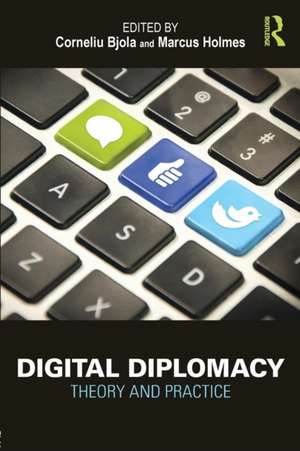
Digital Diplomacy: Theory and Practice de Corneliu Bjola

Digital Diplomacy: Theory and Practice

49384 lei
  • Economic11-25 ianuarie 27 49384 lei
Adaugă în listă741 Puncte Express
  • Transport gratuit pentru acest produs
  • Plată online sau ramburs
  • Retur gratuit în 14 zile

Despre carte

This book analyses digital diplomacy as a form of change management in international politics.

The recent spread of digital initiatives in foreign ministries is often argued to be nothing less than a revolution in the practice of diplomacy. In some respects this revolution is long overdue. Digital technology has changed the ways firms conduct business, individuals conduct social relations, and states conduct governance internally, but states are only just realizing its potential to change the ways all aspects of interstate interactions are conducted. In particular, the adoption of digital diplomacy (i.e., the use of social media for diplomatic purposes) has been implicated in changing practices of how diplomats engage in information management, public diplomacy, strategy planning, international negotiations or even crisis management. Despite these significant changes and the promise that digital diplomacy offers, little is known, from an analytical perspective, about how digital diplomacy works.

This volume, the first of its kind, brings together established scholars and experienced policy-makers to bridge this analytical gap. The objective of the book is to theorize what digital diplomacy is, assess its relationship to traditional forms of diplomacy, examine the latent power dynamics inherent in digital diplomacy, and assess the conditions under which digital diplomacy informs, regulates, or constrains foreign policy. Organized around a common theme of investigating digital diplomacy as a form of change management in the international system, it combines diverse theoretical, empirical, and policy-oriented chapters centered on international change.

This book will be of much interest to students of diplomatic studies, public diplomacy, foreign policy, social media and international relations.

Din seria Routledge New Diplomacy Studies

  • Diplomacy and Borderlands: African Agency at the Intersections of Orders
    44502 lei
  • Science Diplomacy and Foreign Policy in Northern Europe: Models, Frameworks, and Strategies
    136900 lei -18% 166951 lei
  • Gender and Diplomacy
    42936 lei
  • Diplomatic Style and Foreign Policy: A Case Study of South Korea
    46281 lei
  • Digital Diplomacy and International Organisations: Autonomy, Legitimacy and Contestation
    41376 lei
  • Diplomatic Cultures and International Politics: Translations, Spaces and Alternatives
    45996 lei -15% 54114 lei
  • Diplomacy as a Social World: Role Images and Diplomatic Memoirs
    47590 lei
  • Secret Diplomacy: Concepts, Contexts and Cases
    48999 lei
  • Global Cities, Governance and Diplomacy: The Urban Link
    47575 lei
  • Diplomacy, Communication, and Peace: Selected Essays
    41284 lei
  • Chinese Public Diplomacy: The Rise of the Confucius Institute
    47460 lei -15% 55835 lei
  • International Law, New Diplomacy and Counterterrorism: An interdisciplinary study of legitimacy
    31561 lei
  • Iran's Nuclear Diplomacy: Power politics and conflict resolution
    47803 lei
  • Reinvigorating the United Nations
    42299 lei
  • Countering Online Propaganda and Extremism: The Dark Side of Digital Diplomacy
    46767 lei
  • The Diplomatic Making of EU-China Relations: Structure, Substance and Style
    45268 lei
  • Diplomacy and Security Community-Building: EU Crisis Management in the Western Mediterranean
    82114 lei -18% 100140 lei
  • Diplomacy and Ideology: From the French Revolution to the Digital Age
    42542 lei
  • Theory and Practice of Paradiplomacy: Subnational Governments in International Affairs
    48093 lei
  • China's Cultural Diplomacy: A Great Leap Outward?
    44325 lei
  • Sports Diplomacy: Origins, Theory and Practice
    39144 lei -9% 43141 lei
  • Security through Cooperation: To the Same End
    38156 lei
  • Non-State Actors in Diplomacy: Peace Settlements with the Taliban and the Khmer Rouge
    135319 lei -18% 165023 lei
  • Chinese Cultural Diplomacy in the 21st Century: The China Cultural Centre Project
    136750 lei -18% 166768 lei
  • Transatlantic Relations and Modern Diplomacy: An interdisciplinary examination
    110348 lei -24% 146096 lei
  • New Public Diplomacy in the 21st Century: A Comparative Study of Policy and Practice
    43230 lei -20% 54074 lei
  • Dismantling the Iraqi Nuclear Programme: The Inspections of the International Atomic Energy Agency, 1991–1998
    114558 lei -23% 148763 lei

Detalii

ISBN-13
9781138843820
ISBN-10
1138843822
Editura
Taylor & Francis
Colecția
Routledge
Seria
Routledge New Diplomacy Studies
Ediția
1
Pagini
252
Ilustrații
5 black & white tables, 7 black & white line drawings
Dimensiuni
156 x 234 x 13 mm
Greutate
0.47 kg
Locul publicării
Oxford, United Kingdom

Cuprins

INTRODUCTION: Making Sense of Digital Diplomacy. I:DIGITAL DIPLOMACY: THE POLICY DIMENSION 1. Digital Diplomacy and International Change Management 2. Digital Diplomacy: Between Promises and Reality.3.‘Secrecy is for Losers’: Why Diplomats Should Embrace Openness to Protect National Security. 4. Social Media and Public Diplomacy: A Comparative Analysis of the digital diplomatic strategies of the EU, U.S. and Japan in China. 5. America's Selfie: How the U.S. portrays itself on its digital diplomacy channels.  II: DIGITAL DIPLOMACY: THE INSTITUTIONAL DIMENSION 6. Business as Usual? An Evaluation of British and Canadian Digital Diplomacy as Institutional Adaptation, 7. Evolution not revolution: The ‘digital divide’ in the American and Australian contexts.8. The International Criminal Court: Using Technology in Network Diplomacy. 9. When Doing Becomes the Message: The Case of Swedish Digital Diplomacy.10. The Power of Diplomacy: New Meanings, and the Methods for Understanding Digital Diplomacy. CONCLUSION: The Future of Digital Diplomacy. Glossary of Terms Bibliography

Notă biografică

Corneliu Bjola is Associate Professor in Diplomatic Studies, University of Oxford, and author or editor of three previous books, including Understanding International Diplomacy (with M. Kornprobst, Routledge 2013). Marcus Holmes is Assistant Professor of Government, College of William & Mary, USA.

Recenzii din presă

'Rapid increases in the availability and power of connection technologies are changing the modes of international relations and the conditions for statecraft in the 21st century. This volume makes an important contribution to our understanding of how. This is a smart read for foreign policy practioners and those that study them.' -- Alec Ross, Senior Advisor for Innovation to Secretary of State Hillary Clinton (2009-13)
‘This unique collection of case studies on digital diplomacy dispenses with technological determinism and concentrates upon the management of change across the core practices of diplomacy. As such, it represents a timely and indispensable intervention in an emerging field of practice and scholarship.’-- James Pamment, University of Austin, Texas, USA
'The authors in this book, academics and practitioners, do not only have an interest in everything digital. Crucially, they successfully marry that knowledge to a solid understanding of 21st-century diplomatic practice. That is what makes this book special and so far indeed a unique contribution to the field.' -- Jan Melissen, Netherlands Institute of International Relations 'Clingendael', and University of Antwerp, Belgium

Descriere

This book analyses digital diplomacy as a form of change management in international politics.

The recent spread of digital initiatives in foreign ministries is often argued to be nothing less than a revolution in the practice of diplomacy. In some respects this revolution is long overdue. Digital technology has changed the ways firms conduct business, individuals conduct social relations, and states conduct governance internally, but states are only just realizing its potential to change the ways all aspects of interstate interactions are conducted. In particular, the adoption of digital diplomacy (i.e., the use of social media for diplomatic purposes) has been implicated in changing practices of how diplomats engage in information management, public diplomacy, strategy planning, international negotiations or even crisis management. Despite these significant changes and the promise that digital diplomacy offers, little is known, from an analytical perspective, about how digital diplomacy works.

This volume, the first of its kind, brings together established scholars and experienced policy-makers to bridge this analytical gap. The objective of the book is to theorize what digital diplomacy is, assess its relationship to traditional forms of diplomacy, examine the latent power dynamics inherent in digital diplomacy, and assess the conditions under which digital diplomacy informs, regulates, or constrains foreign policy. Organized around a common theme of investigating digital diplomacy as a form of change management in the international system, it combines diverse theoretical, empirical, and policy-oriented chapters centered on international change.

This book will be of much interest to students of diplomatic studies, public diplomacy, foreign policy, social media and international relations.

Public țintă

Postgraduate, Professional, and Undergraduate