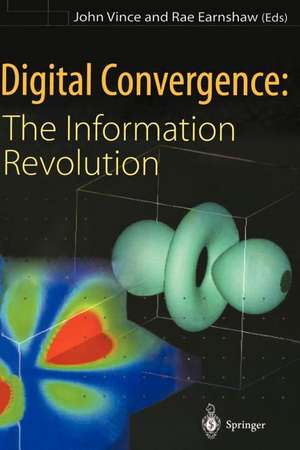
Digital Convergence: The Information Revolution
Editat de John Vince, Rae Earnshawen Limba Engleză Paperback – 27 dec 2011
Preț: 325.88 lei
Preț vechi: 407.36 lei
-20%
Puncte Express: 489
Carte tipărită la comandă
Livrare economică 08-22 decembrie
Livrare prin curier în România Termenul estimat este afișat lângă disponibilitate.
Transport gratuit de la 400.00 lei Plată online sau ramburs, în funcție de opțiunile comenzii.
Retur gratuit în 14 zile Comandă securizată și suport în română.
Specificații
ISBN-13: 9781447112204
ISBN-10: 1447112202
Pagini: 368
Ilustrații: XIV, 351 p.
Dimensiuni: 155 x 235 x 20 mm
Greutate: 0.56 kg
Ediția:Softcover reprint of the original 1st ed. 1999
Editura: Springer
Locul publicării:London, United Kingdom
ISBN-10: 1447112202
Pagini: 368
Ilustrații: XIV, 351 p.
Dimensiuni: 155 x 235 x 20 mm
Greutate: 0.56 kg
Ediția:Softcover reprint of the original 1st ed. 1999
Editura: Springer
Locul publicării:London, United Kingdom
V-ar putea interesa
-
 The Age of EarthquakesDouglas CouplandPreț: 106.59 lei
 -
 -27%Preț: 905.55 lei1240.48 lei
 -
 The Master SwitchTim WuPreț: 137.44 lei
 -
 The Great ConvergenceRichard BaldwinPreț: 117.78 lei
 -
 Encyclopedia of New MediaSteve Jones-9%Preț: 1028.24 lei1129.94 lei
 -
 -26%Preț: 68.27 lei92.57 lei
 -
 BiblioTech: ReReading the Post-digital LibraryNathan Jones-26%Preț: 126.02 lei170.26 lei
 -
 Preț: 353.19 lei
 -
 AI First, Human AlwaysSandy CarterPreț: 132.84 lei
 -
 Digital DegrowthNeil SelwynPreț: 79.12 lei
 -
 Preț: 141.27 lei
 -
 The Dark Forest Theory of the InternetBogna KoniorPreț: 86.72 lei
 -
 Digital ExhaustionPaul LeonardiPreț: 123.50 lei
 -
 The Reinvention of the U.S. Academic Library: 1990 to 2025Donald A. Barclay-15%Preț: 142.95 lei168.60 lei
 -
 The Information AnimalAlicia WanlessPreț: 242.32 lei
 -
 -19%Preț: 111.19 lei137.01 lei
 -
 Perspectives on Global TransformationG. K. Rajanikant-20%Preț: 1494.32 lei1867.90 lei
 -
 -23%Preț: 202.39 lei263.63 lei
Public țintă
ResearchCuprins
List of Contributors.- 1 Introduction.- 1 Broadband Internet: Future Applications and Challenges.- 2 The Future of Content: Towards a 5th Framework Programme in Multimedia Content &Tools.- 2 Cultural Issues.- 3 Digital Convergence at the User Interface.- 4 Cultural Objects in Digital Convergence.- 5 The Role of 3D Shared Worlds in Support of Chance Encounters in CSCW.- 6 Agent-Based Facial Animation.- 7 The Use of Dynamic Behaviors in a Network-Based Animation System.- 8 Virtual Rehearsal Over Networks.- 9 WWW Television News in Context: Organizational Practices and Media Products.- 10 Live Internet Broadcasting: Some Unique Experiences.- 11 Jogging the Memory: Dynamic Visualization Over the Web.- 12 “Thin” vs. “Fat” Visualization Clients.- 13 How to Build a Pan-European Multilingual Information Distribution System.- 3 Technological Issues.- 14 A Distributed Object-Based Architecture for Remote Rendering on theWWW.- 15 Multi-User Visualization: a CORBA/Web-Based Approach.- 16 Scene Capture and Modeling for Three-Dimensional Interactive Stereo Television Broadcasting.- 17 Semi-Automated Construction of Virtual Scenes from Cinematographic Data.- 18 Video Search and Retrieval: Current Practice and Future Evolution.- 19 Video Compression in MPEG-4.- 20 Implications of Television Over the Internet.- 21 The Implementation of PANIVE: a PC-Based Architecture for Networked Interactive Virtual Environments.- 22 Applications for 3-, 4- and 5-Sided CAVES.- Author Index.
Caracteristici
Edited volume of papers resulting from the International Conference on Digital Convergence: the Future of the Internet and World Wide Web, held in April 98 Brings together state-of-the-art developments in the Internet and WWW, and will be of great interest to those working in these areas
Textul de pe ultima copertă
The convergence of IT, telecommunications, and media is bringing about a revolution in the way information is collected, stored and accessed. There are three principal reasons why this is happening – reducing cost, increasing quality, and increasing bandwidth. Moore’s Law results in ever-decreasing costs of processing, storage, and transmission. Digital information preserves content accuracy (e.g. digital television) in a way other systems do not. High bandwidth transmission from one place to another on the planet is now possible. Information is ubiquitous and globally accessible, and can be held and accessed just as easily on a global network as on a local personal computer or in a local library. Devices are increasingly intelligent and are network-ready. User interfaces are becoming more adaptable and flexible, and can be tailored to particular application domains. Digital intelligence is becoming seamless and invisible, enabling more attention to be paid to the content and the user’s interaction with it. This revolution is having effects on the development and organisation of information and artefact repositories such as libraries, museums, and exhibitions, and the way in which physical and digital aspects are mediated to users. The changes that digital convergence is bringing about are substantial and are also likely to be long-lasting. This volume presents key aspects in this rapidly moving field in the areas of technology and information sciences - from international experts who are leaders in their fields.