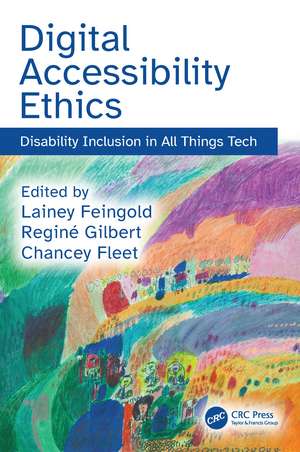
Digital Accessibility Ethics: Disability Inclusion in All Things Tech
Editat de Lainey Feingold, Reginé Gilbert, Chancey Fleeten Limba Engleză Paperback – 14 mai 2026
This book introduces the first Digital Accessibility Ethics Framework – an action-oriented, three-part tool designed to influence, change, and disrupt patterns of exclusion with values, actions, and questions. Thirty-nine disabled and nondisabled authors from ten countries and one commonwealth apply this framework across technologies, sectors, and countries.
The editors and authors – with over 600 years of combined accessibility and disability advocacy experience – aim to build a world that recognizes disabled people’s right to fully participate in every facet of digital life and to offer organizations an ethics lens to help eliminate the financial, legal, privacy, security, health and safety, and other risks and harms of disability exclusion. Through stories, recommendations, strategies, and other guidance, this book looks at a wide range of topics through a digital accessibility ethics lens: from gaming, hackathons, design, and burnout to procurement, AI, healthcare, cybersecurity, and more. It is for technologists, educators, students, marketers, policy makers, lawyers, and everyone who believes in a digital world for all of us.
As the world grows more digital, as AI is marketed everywhere, and as the number of people with disabilities expands, there has never been a more crucial time to expose, explore, and act at the intersection of ethics, disability, and digital accessibility. Digital Accessibility Ethics: Disability Inclusion in All Things Tech offers a roadmap to show us the way.
Preț: 228.33 lei
Preț vechi: 285.40 lei
-20%
Puncte Express: 342
Carte disponibilă
Livrare economică 14-28 noiembrie
Livrare express 31 octombrie-06 noiembrie pentru 39.38 lei
Livrare prin curier în România Termenul estimat este afișat lângă disponibilitate.
Transport gratuit de la 400.00 lei Plată online sau ramburs, în funcție de opțiunile comenzii.
Retur gratuit în 14 zile Comandă securizată și suport în română.
Specificații
ISBN-13: 9781041018681
ISBN-10: 1041018681
Pagini: 456
Ilustrații: 82
Dimensiuni: 178 x 254 mm
Greutate: 0.79 kg
Ediția:1
Editura: CRC Press
Colecția Chapman and Hall/CRC
ISBN-10: 1041018681
Pagini: 456
Ilustrații: 82
Dimensiuni: 178 x 254 mm
Greutate: 0.79 kg
Ediția:1
Editura: CRC Press
Colecția Chapman and Hall/CRC
V-ar putea interesa
-
 -29%Preț: 443.74 lei628.40 lei
 -
 A Kids Book About Digital EquityJuan Muro, Jr.-17%Preț: 79.28 lei95.44 lei
 -
 Don't Burn Anyone at the Stake TodayNaomi AldermanPreț: 121.20 lei
 -
 If Anyone Builds It, Everyone DiesEliezer Yudkowsky-20%Preț: 117.03 lei146.29 lei
 -
 -20%Preț: 394.12 lei492.64 lei
 -
 Against TechnoableismAshley ShewPreț: 65.45 lei
 -
 Preț: 297.57 lei
 -
 Ethics, Information, and TechnologyKip Currier-25%Preț: 394.34 lei523.86 lei
 -
 -19%Preț: 99.80 lei122.50 lei
 -
 An Inquirer’s Guide to Ethics in AIMatthew S.W. Silk-37%Preț: 167.68 lei267.87 lei
 -
 How to Organize Inclusive Events and ConferencesAlex D. Ketchum-20%Preț: 90.29 lei113.12 lei
 -
 Cybernetic Circulation ComplexNick Dyer-WithefordPreț: 129.05 lei
 -
 -18%Preț: 145.57 lei178.02 lei
 -
 -18%Preț: 77.33 lei94.27 leiNou
 -
 The AI ConEmily M. BenderPreț: 151.96 lei
 -
 Inclusive Digital Citizenship: Ideas and ImplementationKIRSTEN WILSON-15%Preț: 250.09 lei292.61 lei
 -
 Empire of AIKaren HaoPreț: 163.45 lei
Public țintă
General and Professional Practice & DevelopmentCuprins
Introduction: The Digital Accessibility Gap and the Need for an Ethics Framework
SECTION 1 Foundation
Chapter 1 Introducing the Digital Accessibility Ethics Framework
Lainey Feingold, Reginé Gilbert, and Chancey Fleet
Chapter 2 Disability and Accessibility: Understanding the Terms at the Heart of This Collection
Crystal Preston‑Watson
Chapter 3 The Ethical Dilemmas of Artificial Intelligence
Jutta Treviranus
Chapter 4 The Global Digital Accessibility Legal Landscape
Lainey Feingold
SECTION 2 Ethical Accessibility Practices
Chapter 5 Designing With: Widening Power and Participation of Disabled People in the Design Process
Josh Kim
Chapter 6 Achieving Ethical Accessibility in the Development Process
Léonie Watson
Chapter 7 The Ethics of Accessibility Leadership in India and Across the Globe
Shilpi Kapoor
Chapter 8 Empower All Minds: Cognitive Accessibility Ethics
Margaux Joffe
Chapter 9 Don’t Buy Broken Things: Ethical Accessible Procurement
Sheri Byrne‑Haber
Chapter 10 Hackathons, Student Projects, and Digital Accessibility Ethics
Joshua A. Miele
Chapter 11 Deaf Leaders Now! The Ethics of Hiring Disabled People in Science and Technology
Jenny C. Lu and Sheila Xu
Chapter 12 Making Every Voice Heard: The Ethics of Voice Recognition Technology
Meenakshi Das
Chapter 13 Digital Accessibility in Africa: Progress, Challenges, and Opportunities
Irene Mbari‑Kirika and Samuel Kabue
Chapter 14 Who Sees What? Ethics Issues in Describing the Visual World
Nefertiti Matos Olivares and Thomas Reid
Chapter 15 Facial Difference, AI Bias, and Digital Accessibility Ethics
Carly Findlay
Chapter 16 Everyone Needs (At Least a Little) Accessibility Education
Rolando J. Méndez Fernández and Kate Sonka
Chapter 17 Accessibility Overlays and the Harms of Marketing “Quick Fixes”
Adrian A. Roselli
Chapter 18 Accessibility Practitioner Burnout Is an Ethics Issue
Matt May
SECTION 3 Digital Accessibility Ethics Across Sectors
Chapter 19 No One Left Behind: Digital Accessibility Ethics and Emergency Preparedness
Erin E. Brown
Chapter 20 When My Seeing Eye Dog and I Surprise a Delivery Robot: New Technologies Need to Be Accessible, Too
Haben Girma
Chapter 21 Secure by Design, Accessible by Default: Building Cybersecurity Ethics that Include Everyone
Aliyu G. Yisa and Justin Merhoff
Chapter 22 From Both Sides of the Stethoscope: Digital Accessibility Ethics in Healthcare
Oluwaferanmi O. Okanlami and Heidi Joshi
Chapter 23 Beyond Technology: Ethics and Strategies for Inclusive Smart Cities
Monica Duhem, Josefina Ocampo Guchea, and James Thurston
Chapter 24 Tech‑Facilitated Disability Discrimination and Artificial Intelligence Tools at Work
Ariana H. Aboulafia
Chapter 25 Who Gets to Read, Who Gets to Publish? Digital Accessibility Ethics for Authors, Journalists, and Publishers
Laura Brady and Daniella Levy‑Pinto
Chapter 26 Democracy for All: Addressing Accessibility Challenges for Disabled Voters
Jess Moore Matthews
Chapter 27 Digital Accessibility and Open Source Need Each Other
Mike Gifford
Chapter 28 Immersive Technology Needs Digital Accessibility Ethics
Reginé Gilbert
Chapter 29 Public Relations, Marketing, Accessibility, and Ethics
Victoria Ottah Nnenna
Chapter 30 The Future of Game Accessibility is Grounded in Ethics
Aderyn Thompson
Chapter 31 Digital Accessibility and Public Digital Amenities
Chancey Fleet
Chapter 32 Legal Ethics, Access to Justice, and the Need for Digital Accessibility
Lainey Feingold
Conclusion: What’s Next for Digital Accessibility Ethics?
SECTION 1 Foundation
Chapter 1 Introducing the Digital Accessibility Ethics Framework
Lainey Feingold, Reginé Gilbert, and Chancey Fleet
Chapter 2 Disability and Accessibility: Understanding the Terms at the Heart of This Collection
Crystal Preston‑Watson
Chapter 3 The Ethical Dilemmas of Artificial Intelligence
Jutta Treviranus
Chapter 4 The Global Digital Accessibility Legal Landscape
Lainey Feingold
SECTION 2 Ethical Accessibility Practices
Chapter 5 Designing With: Widening Power and Participation of Disabled People in the Design Process
Josh Kim
Chapter 6 Achieving Ethical Accessibility in the Development Process
Léonie Watson
Chapter 7 The Ethics of Accessibility Leadership in India and Across the Globe
Shilpi Kapoor
Chapter 8 Empower All Minds: Cognitive Accessibility Ethics
Margaux Joffe
Chapter 9 Don’t Buy Broken Things: Ethical Accessible Procurement
Sheri Byrne‑Haber
Chapter 10 Hackathons, Student Projects, and Digital Accessibility Ethics
Joshua A. Miele
Chapter 11 Deaf Leaders Now! The Ethics of Hiring Disabled People in Science and Technology
Jenny C. Lu and Sheila Xu
Chapter 12 Making Every Voice Heard: The Ethics of Voice Recognition Technology
Meenakshi Das
Chapter 13 Digital Accessibility in Africa: Progress, Challenges, and Opportunities
Irene Mbari‑Kirika and Samuel Kabue
Chapter 14 Who Sees What? Ethics Issues in Describing the Visual World
Nefertiti Matos Olivares and Thomas Reid
Chapter 15 Facial Difference, AI Bias, and Digital Accessibility Ethics
Carly Findlay
Chapter 16 Everyone Needs (At Least a Little) Accessibility Education
Rolando J. Méndez Fernández and Kate Sonka
Chapter 17 Accessibility Overlays and the Harms of Marketing “Quick Fixes”
Adrian A. Roselli
Chapter 18 Accessibility Practitioner Burnout Is an Ethics Issue
Matt May
SECTION 3 Digital Accessibility Ethics Across Sectors
Chapter 19 No One Left Behind: Digital Accessibility Ethics and Emergency Preparedness
Erin E. Brown
Chapter 20 When My Seeing Eye Dog and I Surprise a Delivery Robot: New Technologies Need to Be Accessible, Too
Haben Girma
Chapter 21 Secure by Design, Accessible by Default: Building Cybersecurity Ethics that Include Everyone
Aliyu G. Yisa and Justin Merhoff
Chapter 22 From Both Sides of the Stethoscope: Digital Accessibility Ethics in Healthcare
Oluwaferanmi O. Okanlami and Heidi Joshi
Chapter 23 Beyond Technology: Ethics and Strategies for Inclusive Smart Cities
Monica Duhem, Josefina Ocampo Guchea, and James Thurston
Chapter 24 Tech‑Facilitated Disability Discrimination and Artificial Intelligence Tools at Work
Ariana H. Aboulafia
Chapter 25 Who Gets to Read, Who Gets to Publish? Digital Accessibility Ethics for Authors, Journalists, and Publishers
Laura Brady and Daniella Levy‑Pinto
Chapter 26 Democracy for All: Addressing Accessibility Challenges for Disabled Voters
Jess Moore Matthews
Chapter 27 Digital Accessibility and Open Source Need Each Other
Mike Gifford
Chapter 28 Immersive Technology Needs Digital Accessibility Ethics
Reginé Gilbert
Chapter 29 Public Relations, Marketing, Accessibility, and Ethics
Victoria Ottah Nnenna
Chapter 30 The Future of Game Accessibility is Grounded in Ethics
Aderyn Thompson
Chapter 31 Digital Accessibility and Public Digital Amenities
Chancey Fleet
Chapter 32 Legal Ethics, Access to Justice, and the Need for Digital Accessibility
Lainey Feingold
Conclusion: What’s Next for Digital Accessibility Ethics?
Notă biografică
Lainey Feingold is a globally recognized disability rights lawyer, author, and international speaker who has worked in the digital accessibility space since 1995. More information on Lainey’s website at https://www.lflegal.com/
Reginé Gilbert helps organizations navigate complexity through inclusive systems and emerging tech. She is the author of Inclusive Design for a Digital World (Apress, 2019; 2nd ed. 2025). More at https://reginegilbert.com/
Chancey Fleet is a Blind tech educator. A Library Journal Mover & Shaker and past Data & Society Fellow, she runs accessible tech coaching and a tactile graphics lab at the New York Public Library centering accessible learning and design for everyone. More at http://chanceyfleet.com/
Reginé Gilbert helps organizations navigate complexity through inclusive systems and emerging tech. She is the author of Inclusive Design for a Digital World (Apress, 2019; 2nd ed. 2025). More at https://reginegilbert.com/
Chancey Fleet is a Blind tech educator. A Library Journal Mover & Shaker and past Data & Society Fellow, she runs accessible tech coaching and a tactile graphics lab at the New York Public Library centering accessible learning and design for everyone. More at http://chanceyfleet.com/
Recenzii
"This volume is a masterclass in digital accessibility. Its pioneering Digital Accessibility Ethics Framework equips everyone involved in technology to build disability inclusion from the outset. This book is a must-read for anyone who is involved in the design, procurement, or use of digital technologies — i.e., everyone."
Karen Nakamura, Robert and Colleen Haas Distinguished Chair in Disability Studies and Professor of Anthropology; Director, Berkeley Disability Lab
"The wide-ranging contributions to this book provide an innovative and urgent response to disability exclusion in tech -- one that focuses on ethical obligation rather than mere legal compliance."
Samuel Bagenstos, University of Michigan Law Professor; former General Counsel, U.S. Department of Health and Human Services
"The 39 authors and editors of Digital Accessibility Ethics remind us that the digital accessibility gap is a design issue. Most exciting, this groundbreaking collection offers a novel and actionable ethics framework -- a roadmap for tech accessibility which benefits us all."
Merve Hickok, Founder, AIEthicist.org
"This much-needed book is a sweeping, ambitious invitation for all stakeholders in the future of accessible digital technology, calling us to a disciplined, specific examination of digital life with all its opportunities and challenges. It also contains much practical advice, with a sturdy framework that will guide best practices, and it's comparative in scope, including the voices of disabled people and their many experiences with technology's virtues and pitfalls."
Sara Hendren, design researcher and author of What Can A Body Do? How We Meet the Built World
"An extensive, expansive and important book."
Graham Pullin, Professor of Design and Disability, University of Dundee, Scotland; Co-founder of Studio Ordinary and author ofDesign Meets Disability
"Digital Accessibility Ethics offers a timely, much needed ethical framework that moves beyond narrow legal and cost-benefit approaches, grounding digital inclusion in real-world practice across diverse local and global contexts. An important read for all!"
Jasmine E. Harris, Professor of Law, University of Pennsylvania
"Digital Accessibility Ethics: Disability Inclusion in All Things Tech provides an easy-to-understand ethics framework to help build accessible technology products and services. Written by a diverse group of accessibility and disability experts, the guidance in this book is grounded in the history of disability and technology, showing what needs to change, why these barriers exist, and how ethics can help eliminate them."
Lola Odelola, Artist & Web Standards Technologist
Karen Nakamura, Robert and Colleen Haas Distinguished Chair in Disability Studies and Professor of Anthropology; Director, Berkeley Disability Lab
"The wide-ranging contributions to this book provide an innovative and urgent response to disability exclusion in tech -- one that focuses on ethical obligation rather than mere legal compliance."
Samuel Bagenstos, University of Michigan Law Professor; former General Counsel, U.S. Department of Health and Human Services
"The 39 authors and editors of Digital Accessibility Ethics remind us that the digital accessibility gap is a design issue. Most exciting, this groundbreaking collection offers a novel and actionable ethics framework -- a roadmap for tech accessibility which benefits us all."
Merve Hickok, Founder, AIEthicist.org
"This much-needed book is a sweeping, ambitious invitation for all stakeholders in the future of accessible digital technology, calling us to a disciplined, specific examination of digital life with all its opportunities and challenges. It also contains much practical advice, with a sturdy framework that will guide best practices, and it's comparative in scope, including the voices of disabled people and their many experiences with technology's virtues and pitfalls."
Sara Hendren, design researcher and author of What Can A Body Do? How We Meet the Built World
"An extensive, expansive and important book."
Graham Pullin, Professor of Design and Disability, University of Dundee, Scotland; Co-founder of Studio Ordinary and author ofDesign Meets Disability
"Digital Accessibility Ethics offers a timely, much needed ethical framework that moves beyond narrow legal and cost-benefit approaches, grounding digital inclusion in real-world practice across diverse local and global contexts. An important read for all!"
Jasmine E. Harris, Professor of Law, University of Pennsylvania
"Digital Accessibility Ethics: Disability Inclusion in All Things Tech provides an easy-to-understand ethics framework to help build accessible technology products and services. Written by a diverse group of accessibility and disability experts, the guidance in this book is grounded in the history of disability and technology, showing what needs to change, why these barriers exist, and how ethics can help eliminate them."
Lola Odelola, Artist & Web Standards Technologist
Descriere
Digital Accessibility Ethics is a practical guide with an urgent goal: to help end tech exclusion of 1.3 billion people across the world with disabilities. The book introduces the first Digital Accessibility Ethics Framework – an action-oriented, three-part tool designed to influence, change, and disrupt patterns of exclusion.