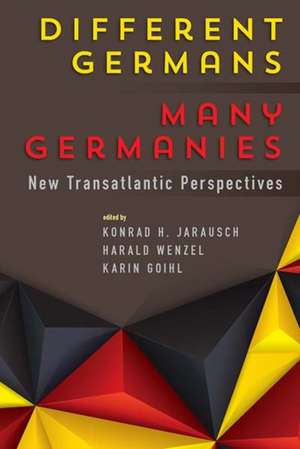
Different Germans, Many Germanies
Editat de Konrad H. Jarausch, Harald Wenzel, Karin Goihlen Limba Engleză Hardback – dec 2016
Preț: 757.66 lei
Preț vechi: 983.98 lei
-23%
Puncte Express: 1136
Carte tipărită la comandă
Livrare economică 26 noiembrie-10 decembrie
Livrare prin curier în România Termenul estimat este afișat lângă disponibilitate.
Transport gratuit pentru acest produs Plată online sau ramburs, în funcție de opțiunile comenzii.
Retur gratuit în 14 zile Comandă securizată și suport în română.
Specificații
ISBN-13: 9781785334306
ISBN-10: 1785334301
Pagini: 340
Ilustrații: 4 illustrations, 4 tables
Dimensiuni: 156 x 236 x 27 mm
Greutate: 0.61 kg
Editura: BERGHAHN BOOKS
ISBN-10: 1785334301
Pagini: 340
Ilustrații: 4 illustrations, 4 tables
Dimensiuni: 156 x 236 x 27 mm
Greutate: 0.61 kg
Editura: BERGHAHN BOOKS
V-ar putea interesa
-
 Preț: 120.86 lei
 -
 Pleasure Boating on the ThamesSimon Wenham-18%Preț: 110.40 lei133.83 lei
 -
 Queen of the CourtesansBarbara WhitePreț: 142.92 lei
 -
 Great War BritainLucinda GoslingPreț: 195.86 lei
 -
 Building a European IdentityAurélie Élisa Gfeller-23%Preț: 760.37 lei987.50 lei
 -
 Education Policy and Equal Opportunity in JapanAkito Okada-23%Preț: 758.97 lei985.68 lei
 -
 A State of Peace in EuropePetri Hakkarainen-23%Preț: 762.76 lei990.60 lei
 -
 -23%Preț: 763.98 lei992.18 lei
 -
 Journeys Into MadnessGemma Blackshaw-23%Preț: 759.35 lei986.17 lei
 -
 An Illustrated Introduction to the First World WarPhil CarradicePreț: 113.23 lei
 -
 Visions of the End of the Cold War in Europe, 1945-1990Frédéric BozoPreț: 307.03 lei
 -
 Impotent WarriorsSusie KilshawPreț: 159.65 lei
 -
 The Radical Right in SwitzerlandDamir Skenderovic-23%Preț: 992.16 lei1288.52 lei
Notă biografică
Konrad H. Jarausch is the Lurcy Professor of European Civilization at the University of North Carolina at Chapel Hill. He has written or edited some fifty books on modern German and European history. He has co-directed the Zentrum für Zeithistorische Forschung in Potsdam and co-founded the UNC Center for European Studies. His most recent book is Broken Lives: How Ordinary Germans Experienced the 20th Century (Princeton University Press, 2018).
Cuprins
Preface
Karin Goihl
Introduction
Konrad Jarausch and Harald Wenzel
PART I: RESPONSES TO MODERNITY
Chapter 1. A Modern Reich? American Perceptions of Wilhelmine Germany, 1890-1914
Scott H. Krause
Chapter 2. The Dual Training System: The Southwest's Contributions to German Economic Development
Hal Hansen
Chapter 3. The "German Forest" as an Emblem of Germany's Ambivalent Modernity
Jeffrey K. Wilson
Chapter 4. Health as a Public Good: The Positive Legacies of Volksgesundheit
Annette F. Timm
PART II: DEMOCRATIC TRANSFORMATION
Chapter 5. Antifascist Heroes and Nazi Victims: Myth-making and Political Reorientation in Berlin, 1945-1947
Clara M. Oberle
Chapter 6. The Pen is Mightier Than the Sword?: Student Newspapers and Democracy in Postwar West Germany
Brian M. Puaca
Chapter 7. Human Rights, Pluralism and the Democratization of Post-War Germany
Ned Richardson-Little
Chapter 8. African Students and Racial Ambivalence in the GDR during the 1960s
Sara Pugach
PART III: SEARCHING FOR A NEW MODEL
Chapter 9. The "German Model" in Renewable Energy Development
Carol Hager
Chapter 10. Germany's Approach to the Financial Crisis: A Product of Ordo-Liberalism?
Mark K. Cassell
Chapter 11. Dreams of Divided Berlin: Postmigrant Perspectives on German Nationhood in Die Schwäne vom Schlachthof
Jeffrey Jurgens
PART IV: GLOBAL IMPLICATIONS
Chapter 12. Inventing the German Film as Foreign Film: The Origins of a Fraught Transatlantic Exchange
Sara F. Hall
Chapter 13. Atlantic Transfers of Critical Theory: Alexander Kluge and the U.S. in Fiction
Matthew D. Miller
Chapter 14. Nation and Memory: Redemptive and Reflective Cosmopolitanism in Contemporary Germany
Michael Meng
Bibliography
Index
Karin Goihl
Introduction
Konrad Jarausch and Harald Wenzel
PART I: RESPONSES TO MODERNITY
Chapter 1. A Modern Reich? American Perceptions of Wilhelmine Germany, 1890-1914
Scott H. Krause
Chapter 2. The Dual Training System: The Southwest's Contributions to German Economic Development
Hal Hansen
Chapter 3. The "German Forest" as an Emblem of Germany's Ambivalent Modernity
Jeffrey K. Wilson
Chapter 4. Health as a Public Good: The Positive Legacies of Volksgesundheit
Annette F. Timm
PART II: DEMOCRATIC TRANSFORMATION
Chapter 5. Antifascist Heroes and Nazi Victims: Myth-making and Political Reorientation in Berlin, 1945-1947
Clara M. Oberle
Chapter 6. The Pen is Mightier Than the Sword?: Student Newspapers and Democracy in Postwar West Germany
Brian M. Puaca
Chapter 7. Human Rights, Pluralism and the Democratization of Post-War Germany
Ned Richardson-Little
Chapter 8. African Students and Racial Ambivalence in the GDR during the 1960s
Sara Pugach
PART III: SEARCHING FOR A NEW MODEL
Chapter 9. The "German Model" in Renewable Energy Development
Carol Hager
Chapter 10. Germany's Approach to the Financial Crisis: A Product of Ordo-Liberalism?
Mark K. Cassell
Chapter 11. Dreams of Divided Berlin: Postmigrant Perspectives on German Nationhood in Die Schwäne vom Schlachthof
Jeffrey Jurgens
PART IV: GLOBAL IMPLICATIONS
Chapter 12. Inventing the German Film as Foreign Film: The Origins of a Fraught Transatlantic Exchange
Sara F. Hall
Chapter 13. Atlantic Transfers of Critical Theory: Alexander Kluge and the U.S. in Fiction
Matthew D. Miller
Chapter 14. Nation and Memory: Redemptive and Reflective Cosmopolitanism in Contemporary Germany
Michael Meng
Bibliography
Index