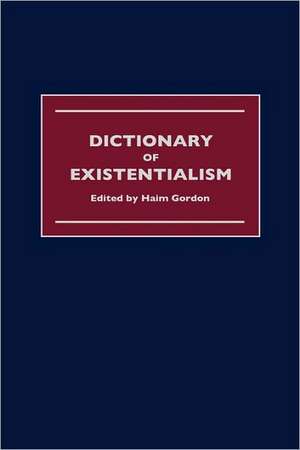
Dictionary of Existentialism
Editat de Haim Gordonen Limba Engleză Hardback – iul 1999
Preț: 1137.85 lei
Preț vechi: 1387.62 lei
-18%
Puncte Express: 1707
Carte tipărită la comandă
Livrare economică 07-21 decembrie
Livrare prin curier în România Termenul estimat este afișat lângă disponibilitate.
Transport gratuit pentru acest produs Plată online sau ramburs, în funcție de opțiunile comenzii.
Retur gratuit în 14 zile Comandă securizată și suport în română.
Specificații
ISBN-13: 9781579581671
ISBN-10: 1579581676
Pagini: 552
Dimensiuni: 152 x 229 x 35 mm
Greutate: 1.18 kg
Ediția:1
Editura: Taylor & Francis
Colecția Routledge
Locul publicării:Oxford, United Kingdom
ISBN-10: 1579581676
Pagini: 552
Dimensiuni: 152 x 229 x 35 mm
Greutate: 1.18 kg
Ediția:1
Editura: Taylor & Francis
Colecția Routledge
Locul publicării:Oxford, United Kingdom
V-ar putea interesa
-
 -15%Preț: 63.83 lei75.08 lei
 -
 Introduction to PhenomenologyDermont MoranPreț: 387.08 lei
 -
 Jean-Paul Sartre: Basic WritingsStephen PriestPreț: 319.09 lei
 -
 What is Literature?Jean-Paul SartrePreț: 156.31 lei
 -
 Sketch for a Theory of the EmotionsJean-Paul SartrePreț: 138.04 lei
 -
 Maurice Merleau-Ponty: Basic WritingsThomas BaldwinPreț: 379.76 lei
 -
 The Routledge Companion to PostmodernismStuart SimPreț: 334.79 lei
 -
 Art and PhenomenologyJoseph ParryPreț: 388.47 lei
 -
 Body Images: Embodiment as IntercorporealityGail WeissPreț: 409.25 lei
 -
 A Sneetch is a Sneetch PWartenbergPreț: 120.48 lei
 -
 The Art of Worldly WisdomBaltasar GraciánPreț: 60.46 lei
 -
 An Intellectual History of CannibalismC¿t¿lin AvramescuPreț: 274.45 lei
 -
 The I in WeAxel HonnethPreț: 168.90 lei
 -
 Deleuze and LawLaurent De Sutter-17%Preț: 233.85 lei280.90 lei
 -
 Preț: 164.39 lei
 -
 Preț: 172.54 lei
 -
 Just the ArgumentsMichael BrucePreț: 144.92 lei
 -
 The Bloomsbury Companion to ExistentialismDr Felicity Joseph-24%Preț: 285.36 lei373.25 lei
 -
 Classics of Western PhilosophySteven M. Cahn-22%Preț: 434.73 lei557.66 lei
 -
 Toward an Existential Philosophy of the SoulRichard SchainPreț: 80.30 lei
 -
 -26%Preț: 73.88 lei99.91 lei
 -
 Doing Philosophy ComparativelyTim Connolly-16%Preț: 201.31 lei240.44 lei
 -
 The Ego And His OwnMax StirnerPreț: 244.14 lei
 -
 Introducing Slavoj ZizekChristopher Kul-WantPreț: 56.58 lei
 -
 You Kant Make it Up!Gary HaydenPreț: 78.47 lei
Public țintă
Postgraduate and UndergraduateCuprins
Chapter 1 Aesthetics, Mathew Rampley; Chapter 2 Aesthetic Stage, Robert L. Perkins; Chapter 3 Alienation, Phyllis Kenevan; Chapter 4 Anguish, Phyllis Kenevan; Chapter 5 Anxiety, Constance L. Mui; Chapter 6 Appearance, William Hurst; Chapter 7 Hannah Arendt (1906–1975), Mordechai Gordon; Chapter 8 Art, Mathew Rampley; Chapter 9 Authenticity, Thomas R. Flynn; Chapter 10 Bad Faith, Thomas R. Flynn; Chapter 11 Simone de Beauvoir (1908–1986), Sonia Kruks; Chapter 12 Being, Rivca Gordon; Chapter 13 Being-in-the-World, John Protevi; Chapter 14 Belief, Jacob Meskin; Chapter 15 Nicolas Alexandrovich Berdyaev (1874–1948), Douglas Kellogg Wood; Chapter 16 Ludwig Binswanger (1881–1966), Roger Frie; Chapter 17 Body, Constance L. Mui; Chapter 18 Dietrich Bonhoeffer (1906–1945), Wayne Whitson FloydJr.; Chapter 19 Martin Buber (1878–1965), Rivca Gordon; Chapter 20 Rudolf Karl Bultmann (1884–1976), Houston Craighead; Chapter 21 Albert Camus (1913–1960), Gene Blocker; Chapter 22 Care, John Protevi; Chapter 23 Character, Abrahim H. Khan; Chapter 24 Choice, Lawrence J. Hatab; Chapter 25 Christianity, Thomas B. Ommen; Chapter 26 Community, Richard Polt; Chapter 27 Conscience, Daniel O. Dahlstrom; Chapter 28 Consciousness, Adrian Mirvish; Chapter 29 Contingency, Patrick Bourgeois; Chapter 30 Creativity, Doug Mann; Chapter 31 Dasein, John Protevi; Chapter 32 Death, Constance L. Mui; Chapter 33 Demythologizing, Houston Craighead; Chapter 34 Dialectical Reason, Thomas R. Flynn; Chapter 35 Fyodor Mikhailovich Dostoyevsky (1821–1881), Malcolm Jones; Chapter 36 Drama, Peter Royle; Chapter 37 Education, Nimrod Aloni; Chapter 38 Ego, Patrick Bourgeois; Chapter 39 Emotions, William Hurst; Chapter 40 Epistemology, Adrian Mirvish; Chapter 41 Eschatology, Houston Craighead; Chapter 42 Essence, Alfons Grieder; Chapter 43 Eternity, Ernest Sherman; Chapter 44 Ethical Stage, Robert L. Perkins; Chapter 45 Ethics, David Detmer; Chapter 46 Evil, David Detmer; Chapter 47 Existence, Stephen Tyman; Chapter 48 Existenz, Kurt Salamun; Chapter 49 Facticity, Thomas R. Flynn; Chapter 50 Faith, Daniel O. Dahlstrom; Chapter 51 Fear, Daniel O. Dalhstrom; Chapter 52 Feminism, Sylvia Walsh Perkins; Chapter 53 Freedom, Lawrence J. Hatab; Chapter 54 God, Murray A. Rae; Chapter 55 Friedrich Gogarten (1887–1967), Theodore Runyon; Chapter 56 Good, David Detmer; Chapter 57 Guilt, Peter Royle; Chapter 58 Martin Heidegger (1889–1976), John Protevi; Chapter 59 History, Doug Mann; Chapter 60 Humanism, Richard Polt; Chapter 61 Humor, John Morreall; Chapter 62 Edmund Husserl (1859–1938), Paul Gorner; Chapter 63 Ideology, Stephen Tyman; Chapter 64 Imagination, David J. Gouwens; Chapter 65 Immanence, Patrick Bourgeois; Chapter 66 Immortality, Sonya Sikka; Chapter 67 Roman Ingarden (1893–1970), Peter Simons; Chapter 68 Intention, William Hurst; Chapter 69 Intentionality, Peter Simons; Chapter 70 Introspection, David J. Gouwens; Chapter 71 Intuition, William Hurst; Chapter 72 Irony, Daniel Berthold-Bond; Chapter 73 Irrationalism, Peter Royle; Chapter 74 Karl Jaspers (1883–1969), Kurt Salamun; Chapter 75 Judaism, Michael Oppenheimer; Chapter 76 Franz Kafka (1883–1924), Jane Bennett; Chapter 77 Søren Kierkegaard (1813–1855), Robert L. Perkins; Chapter 78 Knowledge, Andrew J. Burgess; Chapter 79 Language, Mathew Rampley; Chapter 80 Leap, Peter Royle; Chapter 81 Lebenswelt, Phyllis Kenevan; Chapter 82 Emmanuel Levinas (1906–1996), Robert Bernasconi; Chapter 83 Liberty, Frank Schalow; Chapter 84 Life, Stuart Charme; Chapter 85 Literature, Jana Sawicki; Chapter 86 The Look, Thomas R. Flynn; Chapter 87 Love, Daniel Berthold-Bond; Chapter 88 Georg Lukacs (1885–1971), Ilan Gur Zeev; Chapter 89 Gabriel Marcel (1889–1973), Sonia Kruks; Chapter 90 Marxism, Frank Schalow; Chapter 91 Maurice Merleau-Ponty (1908–1961), Ernest Sherman; Chapter 92 Metaphysics, Frank Schalow; Chapter 93 Mind, William Hurst; Chapter 94 Mood, Vincent McCarthy; Chapter 95 Morality, Robert Holmes; Chapter 96 Mystery, Patrick Bourgeois; Chapter 97 Mysticism, Sonya Sikka; Chapter 98 Myth, Mathew Rampley; Chapter 99 Nature, W. Kim Rogers; Chapter 100 Negation, Thomas R. Flynn; Chapter 101 Friedrich Nietzsche (1844–1900), Laurence Lampert; Chapter 102 Nihilism, Phyllis Kenevan; Chapter 103 Nothingness, Thomas R. Flynn; Chapter 104 Object, Lawrence J. Hatab; Chapter 105 Ontic, John Protevi; Chapter 106 Ontology, Lawrence J. Hatab; Chapter 107 José Ortega y Gasset (1883–1955), Anton Donoso; Chapter 108 Perception, Patrick Bourgeois; Chapter 109 Person, Richard Polt; Chapter 110 Personality, Abrahim H. Khan; Chapter 111 Phenomenology, Paul Gorner; Chapter 112 Philosophical Anthropology, Patrick Bourgeois; Chapter 113 Philosophy, Steven Emmanuel; Chapter 114 Philosophy of History, Doug Mann; Chapter 115 Philosophy of Religion, Thomas B. Ommen; Chapter 116 Poetry, Mathew Rampley; Chapter 117 Political Philosophy, Sonya Sikka; Chapter 118 Power, Stephen Tympan; Chapter 119 Process, Frank Schaow; Chapter 120 Project, Constance L. Mui; Chapter 121 Projection, Phyllis Kenevan; Chapter 122 Psychology and Psychotherapy, Betty Cannon; Chapter 123 Karl Rahner (1904–1984), Tom O’Meara; Chapter 124 Realism, Gary Backhaus; Chapter 125 Redemption, Georg Kovacs; Chapter 126 Relation, Kurt Salamun; Chapter 127 Religion, Georg Kovacs; Chapter 128 Religious Stage, Robert L. Perkins; Chapter 129 Resentment, Laurence Lampert; Chapter 130 Responsibility, W. Kim Rogers; Chapter 131 Revelation, Murray A. Rae; Chapter 132 Rainer Maria Rilke (1875–1926), Herbert Lehnert; Chapter 133 Franz Rosenzweig (1886–1929), Zeev Levy; Chapter 134 Jean-Paul Sartre (1905–1980), Thomas R. Flynn; Chapter 135 Sensation, W. Kim Rogers; Chapter 136 Lev Shestov (1866–1938), Peter Royle; Chapter 137 Sin, Vincent McCarthy; Chapter 138 Situation, Stephen Tyman; Chapter 139 Society, Rivca Gordon; Chapter 140 Solipsism, Robert Richmond Ellis; Chapter 141 Space, William Hurst; Chapter 142 Spirit, Stephen Tyman; Chapter 143 Subject, Lawrence J. Hatab; Chapter 144 Suicide, Stuart Charme; Chapter 145 Superman, Laurence Lampert; Chapter 146 Teleology, Gail Weiss; Chapter 147 Theology, Thomas B. Ommen; Chapter 148 They, John Protevi; Chapter 149 Thrownness, John Protevi; Chapter 150 Paul Tillich (1886–1965), Jeff Owen Prudhomme; Chapter 151 Time, Phyllis Kenevan; Chapter 152 Transcendence, Gail Weiss; Chapter 153 Truth, Alfons Grieder; Chapter 154 Miguel De Unamuno Y Jugo (1864–1936), Robert Richmond Ellis; Chapter 155 Unconscious, Stuart Charme; Chapter 156 Value, David Detmer; Chapter 157 We, Peter Royle; Chapter 158 Wholeness, Richard Polt; Chapter 159 Will, Stephen Tyman; Chapter 160 Wisdom, Mark Peterson; Chapter 161 World, W. Kim Rogers; Chapter 162 Zarathustra, Laurence Lampert;
Descriere
This Dictionary provides--through alphabetically arranged entries--overviews of the various tenets, philosophers, and writers of existentialism, and of those writers/philosophers who seem to existentialists to espouse their philosophy.
Recenzii
Gordon's dictionary is badly needed, since no substantial dictionaries have appeared since the early 1970s, and those earlier dictionaries are limited..The entries are informative yet concise, are written and signed by academic experts, provide brief lists of references and have extensive cross-references printed in uppercase.. This dictionary provides the thorough reference source.. It is highly recommended for all academic collections, especially for undergraduates and advanced students investigating the influence of existentialism on culture and thinking.
Recommended for academic and large public libraries.
This will be a solid addition to the philosophy section of any reference collection, and a handsome complement to general and subject-specific encyclopedias.
The notion of producing a volume of this sort is rather ingenious..The outcome is an interesting pastiche that can be useful both to such scholars and to persons seeking information to whom the field of existentialism has hitheto been terra incognita..[H]aim Gordon, who is to be congratulated for this massive undertaking.
Recommended for academic and large public libraries.
This will be a solid addition to the philosophy section of any reference collection, and a handsome complement to general and subject-specific encyclopedias.
The notion of producing a volume of this sort is rather ingenious..The outcome is an interesting pastiche that can be useful both to such scholars and to persons seeking information to whom the field of existentialism has hitheto been terra incognita..[H]aim Gordon, who is to be congratulated for this massive undertaking.