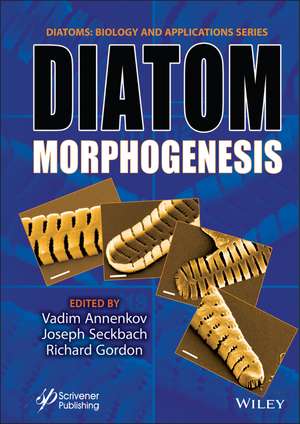
Diatom Morphogenesis
Editat de Vadim V Annenkov, Joseph Seckbach, Richard Gordonen Limba Engleză Hardback – 23 noi 2021
Această monografie tehnică, Diatom Morphogenesis, publicată de Wiley, reprezintă o sinteză riguroasă a mecanismelor prin care celulele algale produc cele mai complexe structuri solide multiscalare cunoscute în natură. Observăm o abordare interdisciplinară necesară, având în vedere că formarea cochiliei de silice implică procese biochimice, genetice și citoscheletale ce se întind pe șapte ordine de mărime. Volumul nu se limitează la descrierea biologică, ci alocă spații generoase simulărilor computerizate și metodelor numerice folosite pentru a înțelege arhitectura porilor. Structura cărții este concepută pentru a facilita accesul cercetătorilor din fizică sau știința materialelor, oferind un glosar terminologic esențial. Descoperim aici o analiză detaliată a modului în care nanotehnologia modernă poate imita morfogeneza diatomeelor pentru a crea noi materiale. Comparabil cu Silicon and Siliceous Structures in Biological Systems în rigurozitate, acest volum este însă actualizat pentru progresele tehnologice recente, integrând date obținute prin microscopie de forță atomică (AFM) și metode bazate pe fluorescență, tehnologii care au revoluționat domeniul în ultimul deceniu. De asemenea, lucrarea completează perspectiva taxonomică oferită de Diatoms de F. E. Round, concentrându-se mai puțin pe atlasul genurilor și mai mult pe procesele dinamice de biosilicificare. Tonul este unul academic, precis, axat pe rezolvarea întrebărilor fundamentale care încă persistă în fiziologia acestor organisme complexe.
Preț: 1409.07 lei
Preț vechi: 1829.96 lei
-23%
Carte disponibilă
Livrare economică 02-16 mai
Livrare express 21-25 aprilie pentru 30.89 lei
Specificații
ISBN-10: 1119487951
Pagini: 448
Dimensiuni: 10 x 10 x 10 mm
Greutate: 0.45 kg
Editura: Wiley
Locul publicării:Hoboken, United States
V-ar putea interesa
-
 McDonald's Veterinary EndocrinMauricio Pineda-5%Preț: 979.41 lei1030.96 lei
 -
 Breeding Major Food StaplesManjit Kang-9%Preț: 1466.74 lei1611.81 lei
 -
 Orange Sherbet and Hot ChocolateRichard GordonPreț: 83.31 lei
 -
 Scotland '74Richard Gordon-18%Preț: 68.78 lei84.14 lei
 -
 Gordon, R: Tales from the DugoutRichard Gordon-19%Preț: 56.69 lei69.84 lei
 -
 -8%Preț: 407.65 lei443.10 lei
 -
 Membrane protein insertionRebecca KohlerPreț: 339.15 lei
 -
 GeheimkotDaphne Isabel JostPreț: 341.36 lei
 -
 Das Zystennierenprotein DZIP1LJennifer von Bothmer-8%Preț: 408.17 lei443.67 lei
 -
 Chitinases in the tree of lifeTim Staufenberger-8%Preț: 404.08 lei439.23 lei
 -
 The Role of Spike Patterns in Neuronal Information ProcessingMarkus Christen-8%Preț: 528.73 lei574.70 lei
 -
 -8%Preț: 405.17 lei440.40 lei
 -
 Prokaryotische Diversität der Ionischen See, GriechenlandTorsten Staller-8%Preț: 409.48 lei445.09 lei
 -
 Anwendungspotentiale multipotenter Zellen aus RegenbogenforellenhautSebastian Rakers-8%Preț: 526.28 lei572.05 lei
 -
 -8%Preț: 467.28 lei507.91 lei
 -
 -8%Preț: 488.83 lei531.33 lei
De ce să citești această carte
Această carte se adresează cercetătorilor și studenților la master sau doctorat din biologie marină, chimie și nanotehnologie. Cititorul câștigă o înțelegere profundă a proceselor de auto-asamblare biologică a silicei, beneficiind de un glosar specializat și de o trecere în revistă a celor mai noi ipoteze de lucru. Este o resursă esențială pentru cei care doresc să aplice principiile biologice în designul de noi nanomateriale.
Despre autor
Vadim V Annenkov, Joseph Seckbach și Richard Gordon sunt editorii acestui volum, reunind experți de talie mondială în studiul diatomeelor. Joseph Seckbach este un nume de referință în domeniu, fiind cunoscut și pentru coordonarea seriei Cellular Origin, Life in Extreme Habitats and Astrobiology. Experiența lor cumulată acoperă un spectru larg, de la microbiologie și fiziologie algală până la aplicații practice în nanotehnologie, oferind lucrării o autoritate științifică incontestabilă în literatura de specialitate.