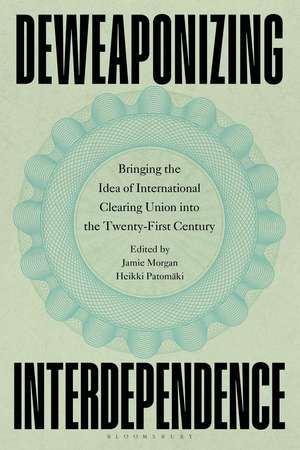
Deweaponizing Interdependence: Bringing the Idea of International Clearing Union into the Twenty-First Century
Editat de Professor Jamie Morgan, Heikki Patomakien Limba Engleză Paperback – 19 feb 2026
This volume focuses on how ICU proposals interact with economic theory and normative principles of ethics and politics. It examines key contemporary political issues including de-dollarisation, development, overcoming nationalism, principles of fairness in trade and finance, commodity pricing, fixed vs. floating exchange rates, capital controls, the need for planning, and global public investments, as well as urgent issues of climate emergency and ecological breakdown. As such, this important volume provides a wide range of perspectives from both the Global North and Global South, as well as from different disciplines including politics, economics and political theory.
'The ebook editions of this book are available open access under a CC BY-NC-ND 4.0 licence on bloomsburycollections.com. Open access was funded by The University of Helsinki.
Preț: 158.70 lei
Preț vechi: 190.66 lei
-17%
Puncte Express: 238
Carte disponibilă
Livrare economică 29 octombrie-12 noiembrie
Livrare express 14-20 octombrie pentru 57.91 lei
Livrare prin curier în România Termenul estimat este afișat lângă disponibilitate.
Transport gratuit de la 400.00 lei Plată online sau ramburs, în funcție de opțiunile comenzii.
Retur gratuit în 14 zile Comandă securizată și suport în română.
Specificații
ISBN-13: 9781350574847
ISBN-10: 1350574848
Pagini: 304
Dimensiuni: 156 x 232 x 24 mm
Greutate: 0.35 kg
Editura: Bloomsbury Publishing
Colecția Bloomsbury Academic
Locul publicării:London, United Kingdom
ISBN-10: 1350574848
Pagini: 304
Dimensiuni: 156 x 232 x 24 mm
Greutate: 0.35 kg
Editura: Bloomsbury Publishing
Colecția Bloomsbury Academic
Locul publicării:London, United Kingdom
V-ar putea interesa
-
 The Third PillarRaghuram RajanPreț: 106.35 lei
 -
 Making Globalization WorkJoseph E. Stiglitz-30%Preț: 66.01 lei93.99 lei
 -
 The Economic Government of the WorldMartin DauntonPreț: 147.61 lei
 -
 Global Justice & FinanceTim Hayward-13%Preț: 265.23 lei305.56 lei
 -
 Principles of International Economic LawMatthias Herdegen-19%Preț: 572.09 lei706.29 lei
 -
 The International Monetary System, the IMF and the G20Richard Samans-15%Preț: 653.56 lei768.89 lei
 -
 Preț: 214.73 lei
 -
 Preț: 262.71 lei
 -
 Capitalism and Its CriticsJohn CassidyPreț: 227.62 lei
 -
 The Death of MoneyJames Rickards-31%Preț: 63.50 lei92.05 lei
 -
 Globalizing CapitalBarry EichengreenPreț: 292.32 lei
 -
 Paper PromisesPhilip Coggan-20%Preț: 62.40 lei78.11 lei
 -
 Introduction to International Political EconomyDavid N. Balaam-9%Preț: 820.53 lei901.69 lei
 -
 Decolonizing EconomicsDevika DuttPreț: 140.83 lei
 -
 The Republic of InnovationAndrea Lorenzo CapusselaPreț: 138.67 lei
 -
 The Collapse of Global LiberalismPhilip PilkingtonPreț: 112.99 lei
 -
 -26%Preț: 58.05 lei78.35 lei
 -
 KaputWolfgang MunchauPreț: 79.03 lei
 -
 Doom LoopEswar S. PrasadPreț: 185.03 lei
Cuprins
List of Figures
List of Contributors
Preface
Chapter 1: Introduction: The idea of an ICU and its relevance in the twenty-first century by Jamie Morgan and Heikki Patomäki
Chapter 2: Keynes versus the globalists: From the gold standard to currency clearing to stabilization funds to digital currency clearing by Jan Kregel
Chapter 3: Regional clearing systems: From the European payments union to current initiatives confronting dollar dominance by Massimo Amato, Luca Fantacci and Lucio Gobbi
Chapter 4: Towards a new global financial architecture: The role of multipolarity, expanded BRICS and the Global South by Haider A. Khan
Chapter 5: Resolving the balance of payments problematic: Feasible reforms for the twenty-first century by Niina Kari and Lauri Holappa
Chapter 6: International monetary adjustment with and without a global fiscal authority by Nathaniel Cline, David Fields and Matías Vernengo
Chapter 7: An analysis of conflicts and the world monetary system: A case against unilateral responses and for a twenty-first-century global clearing union by Heikki Patomäki
Chapter 8: Beyond monetary hegemony: Normative underpinnings of a global clearing union by Konsta Kotilainen
Chapter 9: Designing the rules and principles of the International Clearing Union: Past and present debated issues by Adrien Faudot
Chapter 10: The ecor as global special purpose money: Towards a green international monetary system to finance sustainable and just transformation by Nicolás Aguila, Paula Haufe and Joscha Wullweber
Index
List of Contributors
Preface
Chapter 1: Introduction: The idea of an ICU and its relevance in the twenty-first century by Jamie Morgan and Heikki Patomäki
Chapter 2: Keynes versus the globalists: From the gold standard to currency clearing to stabilization funds to digital currency clearing by Jan Kregel
Chapter 3: Regional clearing systems: From the European payments union to current initiatives confronting dollar dominance by Massimo Amato, Luca Fantacci and Lucio Gobbi
Chapter 4: Towards a new global financial architecture: The role of multipolarity, expanded BRICS and the Global South by Haider A. Khan
Chapter 5: Resolving the balance of payments problematic: Feasible reforms for the twenty-first century by Niina Kari and Lauri Holappa
Chapter 6: International monetary adjustment with and without a global fiscal authority by Nathaniel Cline, David Fields and Matías Vernengo
Chapter 7: An analysis of conflicts and the world monetary system: A case against unilateral responses and for a twenty-first-century global clearing union by Heikki Patomäki
Chapter 8: Beyond monetary hegemony: Normative underpinnings of a global clearing union by Konsta Kotilainen
Chapter 9: Designing the rules and principles of the International Clearing Union: Past and present debated issues by Adrien Faudot
Chapter 10: The ecor as global special purpose money: Towards a green international monetary system to finance sustainable and just transformation by Nicolás Aguila, Paula Haufe and Joscha Wullweber
Index
Recenzii
As the Trump presidency sets about collapsing the existing world order and China and the BRICs countries explore alternatives to the dollar, there is an urgent need for sound monetary alternatives to the system of a single sovereign reserve currency. That is why the publication of this book could not be more timely. Its contributors - monetary experts all - expound with considerable authority on sound alternatives to the imbalances and instability of the current world order. I recommend it highly to scholars, policymakers and those activists wanting to build a more peaceful world.
This edited volume on the pivotal importance of an international clearing union (of some form) to steer the current fast-fragmenting system of international economic governance away from the precipice of conflict could not come at a timelier moment. It is unique in rendering a potentially technical subject matter very accessible to a wide audience by combining a well-informed re-take on historical debates with a range of contemporary perspectives on ways forward - technically, politically and institutionally. It also stands out for its explicit consideration of the concerns of developing countries.
In short, this is an absolute must for anyone, not just economists, with an interest in exploring ambitious yet also realistic proposals to achieve long over-due reforms of global economic governance that recognize past failures and that support the long-ignored ambitions and capabilities of developing countries, in the process.
This edited volume on the pivotal importance of an international clearing union (of some form) to steer the current fast-fragmenting system of international economic governance away from the precipice of conflict could not come at a timelier moment. It is unique in rendering a potentially technical subject matter very accessible to a wide audience by combining a well-informed re-take on historical debates with a range of contemporary perspectives on ways forward - technically, politically and institutionally. It also stands out for its explicit consideration of the concerns of developing countries.
In short, this is an absolute must for anyone, not just economists, with an interest in exploring ambitious yet also realistic proposals to achieve long over-due reforms of global economic governance that recognize past failures and that support the long-ignored ambitions and capabilities of developing countries, in the process.