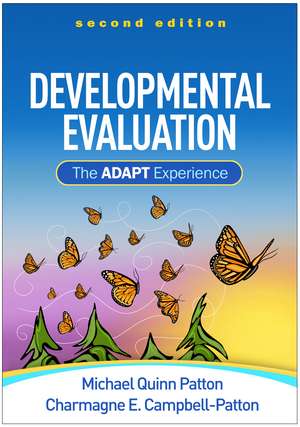
Developmental Evaluation, Second Edition: The ADAPT Experience
Autor Michael Quinn Patton, Charmagne E. Campbell-Pattonen Limba Engleză Paperback – 6 ian 2027
New To This Edition
- Insights, wisdom, and data from over 15 years of large-scale implementation and DE training around the world.
- New and expanded topics--the intensifying climate crisis; evaluation lessons learned from COVID-19; emerging applications of AI; developments in data visualization, systems mapping, and theories of transformation; and more.
- New chapter organization highlighting each element of ADAPT.
- Every chapter concludes with “Tips and Traps--what to watch for and what to avoid.
Preț: 393.83 lei
Preț vechi: 440.17 lei
-11% Precomandă
Puncte Express: 591
Carte nepublicată încă
Livrare prin curier în România Precomanda se expediază când titlul devine disponibil.
Transport gratuit de la 400.00 lei Plată online sau ramburs, în funcție de opțiunile comenzii.
Retur gratuit în 14 zile Comandă securizată și suport în română.
Doresc să fiu notificat când acest titlu va fi disponibil:
Se trimite...
Specificații
ISBN-13: 9781462564767
ISBN-10: 1462564763
Pagini: 297
Dimensiuni: 178 x 254 mm
Ediția:2
Editura: Guilford Publications
Colecția Guilford Press
ISBN-10: 1462564763
Pagini: 297
Dimensiuni: 178 x 254 mm
Ediția:2
Editura: Guilford Publications
Colecția Guilford Press
Recenzii
“This book arrives at exactly the right moment. Where the first edition focused on evaluating social innovation, the second edition shows how DE is more broadly relevant for any project, program, policy, or organization operating in our turbulent world. The new ADAPT framework will serve both first-time readers and experienced practitioners returning to it throughout an evaluation. Patton and Campbell-Patton bring together three decades of DE practice with insights from new practices in evaluation, public policy, and management. New ways of doing evaluation are urgently needed to support organizations responding to compound, cascading global crises--this book delivers them.â€--Patricia J. Rogers, PhD, independent consultant and former Professor of Public Sector Evaluation, RMIT University, Australia
“This book is ideal for graduate courses in evaluation, public policy, organizational development, and the applied social sciences, as well as for executive education and evaluation professional development training. I plan to use the second edition to help students and practitioners develop the mindset and skills needed to design, adapt, and use evaluation in real time in complex, dynamic environments. The second edition stands out for its integration of contemporary advances in complexity science, systems thinking, and emergent strategy, and for its rich, practice-based examples. It offers exceptional conceptual clarity paired with highly actionable guidance.â€--Stewart I. Donaldson, PhD, Distinguished University Professor, Claremont Graduate University; Executive Director, Claremont Evaluation Center and The Evaluators' Institute
“Since the publication of the first edition, Patton and Campbell-Patton have continued to critically reevaluate and refine DE through the many social, political, economic, and legal changes that have occurred. The second edition's intentional inclusion of culturally responsive, Indigenous, and equity practices using a DE lens offers the field of evaluation new ways to consider how allies can meaningfully contribute to a broader conversation and academic discourse. More in evaluation should be having this conversation. Developmental evaluation gives us another option that is untethered to business-as-usual in the field of evaluation and offers us a rooted and realistic way to grow, unlearn, and relearn through evaluation and as evaluators. DE offers a pathway into uncovering, understanding, and addressing complexity, unknowns, turbulent times, trauma, and destruction on a systemic and global level for humans and the earth that can advance healing and transformation efforts through evaluation.â€--Nicole Bowman, PhD, (Lunaape/Mohican), President, Bowman Performance Consulting; Wisconsin Center for Education Research, University of Wisconsin–Madison
“This second edition is a magnum opus that expands the use of DE beyond innovation for adaptive resilience to continuous change. The authors draw on a vast range of interdisciplinary, intercultural, and intersectoral theory and practice. The advances in DE presented here will resonate with evaluation professionals, users, and funders who seek to co-create practice aligned with the ADAPT framework, in the service of social and ecological transformation.â€--Andrealisa Belzer, CE, MA, President, International Evaluation Academy
-
“This book is ideal for graduate courses in evaluation, public policy, organizational development, and the applied social sciences, as well as for executive education and evaluation professional development training. I plan to use the second edition to help students and practitioners develop the mindset and skills needed to design, adapt, and use evaluation in real time in complex, dynamic environments. The second edition stands out for its integration of contemporary advances in complexity science, systems thinking, and emergent strategy, and for its rich, practice-based examples. It offers exceptional conceptual clarity paired with highly actionable guidance.â€--Stewart I. Donaldson, PhD, Distinguished University Professor, Claremont Graduate University; Executive Director, Claremont Evaluation Center and The Evaluators' Institute
“Since the publication of the first edition, Patton and Campbell-Patton have continued to critically reevaluate and refine DE through the many social, political, economic, and legal changes that have occurred. The second edition's intentional inclusion of culturally responsive, Indigenous, and equity practices using a DE lens offers the field of evaluation new ways to consider how allies can meaningfully contribute to a broader conversation and academic discourse. More in evaluation should be having this conversation. Developmental evaluation gives us another option that is untethered to business-as-usual in the field of evaluation and offers us a rooted and realistic way to grow, unlearn, and relearn through evaluation and as evaluators. DE offers a pathway into uncovering, understanding, and addressing complexity, unknowns, turbulent times, trauma, and destruction on a systemic and global level for humans and the earth that can advance healing and transformation efforts through evaluation.â€--Nicole Bowman, PhD, (Lunaape/Mohican), President, Bowman Performance Consulting; Wisconsin Center for Education Research, University of Wisconsin–Madison
“This second edition is a magnum opus that expands the use of DE beyond innovation for adaptive resilience to continuous change. The authors draw on a vast range of interdisciplinary, intercultural, and intersectoral theory and practice. The advances in DE presented here will resonate with evaluation professionals, users, and funders who seek to co-create practice aligned with the ADAPT framework, in the service of social and ecological transformation.â€--Andrealisa Belzer, CE, MA, President, International Evaluation Academy
-
Cuprins
1. The Adaptation Imperative
- The Ongoing Evolution of DE
- Why DE?
- DE in Support of an Experimenting Society
- Proliferation of Evaluation Approaches and Options
- The Emergence of DE
- Early Implementation of DE
- Developmental Purpose
- Beyond Niche to Mainstream
- DE Applications in Support of Adaptation
- Adaptation versus Adoption of a Model
- Large-Scale DE
- The DE Experience
- Tips & Traps
- Summary and Conclusion
2. The ADAPT Frame
- ADAPT
- A--AGILE
- D--DYNAMIC
- A--ACTIONABLE
- P--PRINCIPLED
- T--TIMELY
- Tips & Traps
- Summary and Conclusion
3. Agile
- Agile Mindsets
- Agile Adaptation During COVID-19
- The Agile Manifesto
- Agile Facilitation
- Tips & Traps
- Summary and Conclusion
4. Dynamic
- Developmental Dynamics
- Dynamic DE Design
- The Dynamic Nature of Systems Thinking
- Systems Mapping
- Systems Change
- Complexity Framing
- The Dynamics of Emergence
- Nonlinear Dynamics
- Distinguishing Simple, Complicated, and Complex
- Rigor in Dynamic Designs
- Dynamic Planning
- Dynamic Evaluation Questions
- Dynamic Data Collection
- Dynamic Monitoring
- DE as Dynamic Reframing
- Dynamic DE Exemplar: COBALT Place-Based Systems Change
- Tips & Traps
- Summary and Conclusion
5. Actionable
- Utilization Focus
- Situational Alignment
- The Seven Directions Medicine Wheel as an Actionable Inquiry Framework
- What Makes an Insight Actionable
- Variations in Action Context
- Actionable DE Exemplar: World Savvy
- Actionable Learning
- Adaptive Action
- Actionable Lessons
- Reflection in Action and Reflection on Action
- Action Research
- Tips & Traps
- Summary and Conclusion
6. Principled
- Principles-Focused Evaluation
- Principles of DE
- Interconnected Principles in Practice
- Principles-Focused DE
- DE Champion Spotlight: Randi Roth as Exemplary Commissioner, Funder, Partner, and User of DE
- Tips & Traps
- Summary and Conclusion
7. Timely
- Timely Data
- Aligned Timelines
- Just-in-Time Feedback
- Rapid Baselines and Rapid Recon
- Time Requirements
- Timely Relationships
- Timeliness Throughout the ADAPT Frame
- Timeliness and Artificial Intelligence
- Timely Data Visualization
- Direction, Pace, and Distance
- Past, Present, and Future DE
- Summative versus Summary: Drawing Conclusions from DE
- Synthesizing Over Time and Phases
- Making Senese of Cumulative Developments
- The Logic of Evaluation
- The Development of a DE Synthesis
- Tips & Traps
- Summary and Conclusion
8. The Future of Developmental Evaluation: Emergent Applications and a Learning Agenda
- Increased Use and Scope of DE
- The ADAPT Experience
- Variations on a Theme: Diverse Contributions of DE
- Looking Ahead: Five Premises about the Future
- Alternative and Aligned Actions
- Reflective Practice
- Failure to ADAPT
- A Glimpse Toward the Future of Evaluation
- Tips & Traps
- Summary and Conclusion
References
Index
- The Ongoing Evolution of DE
- Why DE?
- DE in Support of an Experimenting Society
- Proliferation of Evaluation Approaches and Options
- The Emergence of DE
- Early Implementation of DE
- Developmental Purpose
- Beyond Niche to Mainstream
- DE Applications in Support of Adaptation
- Adaptation versus Adoption of a Model
- Large-Scale DE
- The DE Experience
- Tips & Traps
- Summary and Conclusion
2. The ADAPT Frame
- ADAPT
- A--AGILE
- D--DYNAMIC
- A--ACTIONABLE
- P--PRINCIPLED
- T--TIMELY
- Tips & Traps
- Summary and Conclusion
3. Agile
- Agile Mindsets
- Agile Adaptation During COVID-19
- The Agile Manifesto
- Agile Facilitation
- Tips & Traps
- Summary and Conclusion
4. Dynamic
- Developmental Dynamics
- Dynamic DE Design
- The Dynamic Nature of Systems Thinking
- Systems Mapping
- Systems Change
- Complexity Framing
- The Dynamics of Emergence
- Nonlinear Dynamics
- Distinguishing Simple, Complicated, and Complex
- Rigor in Dynamic Designs
- Dynamic Planning
- Dynamic Evaluation Questions
- Dynamic Data Collection
- Dynamic Monitoring
- DE as Dynamic Reframing
- Dynamic DE Exemplar: COBALT Place-Based Systems Change
- Tips & Traps
- Summary and Conclusion
5. Actionable
- Utilization Focus
- Situational Alignment
- The Seven Directions Medicine Wheel as an Actionable Inquiry Framework
- What Makes an Insight Actionable
- Variations in Action Context
- Actionable DE Exemplar: World Savvy
- Actionable Learning
- Adaptive Action
- Actionable Lessons
- Reflection in Action and Reflection on Action
- Action Research
- Tips & Traps
- Summary and Conclusion
6. Principled
- Principles-Focused Evaluation
- Principles of DE
- Interconnected Principles in Practice
- Principles-Focused DE
- DE Champion Spotlight: Randi Roth as Exemplary Commissioner, Funder, Partner, and User of DE
- Tips & Traps
- Summary and Conclusion
7. Timely
- Timely Data
- Aligned Timelines
- Just-in-Time Feedback
- Rapid Baselines and Rapid Recon
- Time Requirements
- Timely Relationships
- Timeliness Throughout the ADAPT Frame
- Timeliness and Artificial Intelligence
- Timely Data Visualization
- Direction, Pace, and Distance
- Past, Present, and Future DE
- Summative versus Summary: Drawing Conclusions from DE
- Synthesizing Over Time and Phases
- Making Senese of Cumulative Developments
- The Logic of Evaluation
- The Development of a DE Synthesis
- Tips & Traps
- Summary and Conclusion
8. The Future of Developmental Evaluation: Emergent Applications and a Learning Agenda
- Increased Use and Scope of DE
- The ADAPT Experience
- Variations on a Theme: Diverse Contributions of DE
- Looking Ahead: Five Premises about the Future
- Alternative and Aligned Actions
- Reflective Practice
- Failure to ADAPT
- A Glimpse Toward the Future of Evaluation
- Tips & Traps
- Summary and Conclusion
References
Index
Notă biografică
Michael Quinn Patton, PhD, is an independent consultant who has been conducting program evaluations since the 1970s. Based in Minnesota, he was on the faculty of the University of Minnesota for 18 years and is a former president of the American Evaluation Association (AEA). Dr. Patton is author of more than a dozen books on evaluation. He is a recipient of the Alva and Gunnar Myrdal Evaluation Practice Award, the Paul F. Lazarsfeld Evaluation Theory Award, and the Research on Evaluation Award, all from AEA. He has also received the Lester F. Ward Distinguished Contribution to Applied and Clinical Sociology Award from the Association for Applied and Clinical Sociology. In 2021, Dr. Patton received the first Transformative Evaluator Award from EvalYouth. He is an active speaker, trainer, and workshop presenter who has conducted applied research and evaluation on a broad range of issues and has worked with organizations and programs at the international, national, state, provincial, and local levels.
Charmagne E. Campbell-Patton, MA, is a second-generation evaluator and 12th-generation European settler based in Minneapolis. Since the early 2000s, her professional experience spans program design, implementation, and evaluation work across a range of fields, including youth engagement, education, criminal and juvenile justice, and philanthropy. Ms. Campbell-Patton specializes in qualitative research methods and utilization-focused developmental evaluation.
Charmagne E. Campbell-Patton, MA, is a second-generation evaluator and 12th-generation European settler based in Minneapolis. Since the early 2000s, her professional experience spans program design, implementation, and evaluation work across a range of fields, including youth engagement, education, criminal and juvenile justice, and philanthropy. Ms. Campbell-Patton specializes in qualitative research methods and utilization-focused developmental evaluation.
Descriere
Developmental evaluation (DE) has evolved into a mainstream approach, supported by the revised second edition of this book. The ADAPT framework guides Agile, Dynamic, Actionable, Principled, and Timely evaluations for equitable, resilient futures. Features include examples, cartoons, sidebars, and Tips and Traps.