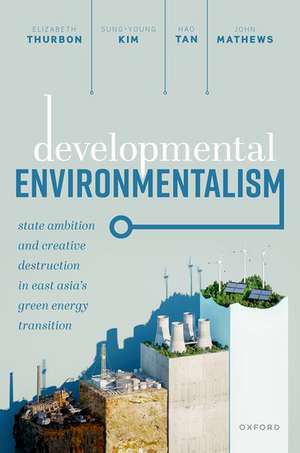
Developmental Environmentalism: State Ambition and Creative Destruction in East Asia’s Green Energy Transition
Autor Elizabeth Thurbon, Sung-Young Kim, Hao Tan, John A Mathewsen Limba Engleză Paperback – 2 mai 2023
Preț: 251.69 lei
Preț vechi: 305.54 lei
-18%
Puncte Express: 378
Carte disponibilă
Livrare economică 06-17 noiembrie
Livrare express 23-29 octombrie pentru 87.34 lei
Livrare prin curier în România Termenul estimat este afișat lângă disponibilitate.
Transport gratuit de la 400.00 lei Plată online sau ramburs, în funcție de opțiunile comenzii.
Retur gratuit în 14 zile Comandă securizată și suport în română.
Specificații
ISBN-13: 9780192898500
ISBN-10: 0192898507
Pagini: 272
Dimensiuni: 156 x 235 x 15 mm
Greutate: 0.42 kg
Ediția:1
Editura: OUP OXFORD
Colecția OUP Oxford
Locul publicării:Oxford, United Kingdom
ISBN-10: 0192898507
Pagini: 272
Dimensiuni: 156 x 235 x 15 mm
Greutate: 0.42 kg
Ediția:1
Editura: OUP OXFORD
Colecția OUP Oxford
Locul publicării:Oxford, United Kingdom
Recenzii
Essential reading
This valuable book explains where China and Korea are at and where they are going
Impressive scholarship, with fresh insights accessible to the general reader
a compelling case
breaks new ground and shows persuasively that it is possible for us to both 'green' and 'grow' our economy
this beautifully written analysis is one of the most interesting and important works of political economy I have read in recent years
a must read for those interested in the future of the planet
This is a must read
This meticulous, forceful account... is a valuable resource
Developmental Environmentalism contributes to deepening our knowledge on the recent evolution of Developmental Environmentalism in East Asia, providing insights into how and why the region became the forerunner of the global green energy transition.
This valuable book explains where China and Korea are at and where they are going
Impressive scholarship, with fresh insights accessible to the general reader
a compelling case
breaks new ground and shows persuasively that it is possible for us to both 'green' and 'grow' our economy
this beautifully written analysis is one of the most interesting and important works of political economy I have read in recent years
a must read for those interested in the future of the planet
This is a must read
This meticulous, forceful account... is a valuable resource
Developmental Environmentalism contributes to deepening our knowledge on the recent evolution of Developmental Environmentalism in East Asia, providing insights into how and why the region became the forerunner of the global green energy transition.
Notă biografică
Elizabeth Thurbon is a Scientia Fellow in International Relations in the School of Social Sciences at UNSW Sydney and a Fellow of The Asia Society (2021-22). Her research focusses on the state's strategic role in techno-industrial development and change. Her most significant contributions to the field examine varieties of economic statecraft, the rise and transformation of East Asia's developmental states, and the state's strategic role in the clean energy shift. Her most recent book Developmental Mindset (Cornell University Press) offers a fresh way of conceptualizing and analysing East Asia's developmental states and examining their emergence and evolution.Sung-Young Kim is Senior Lecturer in the Discipline of Politics and International Relations, Macquarie School of Social Sciences, Macquarie University. His work is published in Energy Policy, Journal of Environment and Development, Review of International Political Economy, New Political Economy, Global Policy, Politics & Society, Review of Evolutionary Political Economy, and The Asia-Pacific Journal. His research and teaching is on the international political economy of renewable energy transitions in East Asia. He is Regional Editor (Korea) for Asian Studies Review journal and serves on the Executive Committees of the Australian Political Studies Association and the Korean Studies Association of Australasia.Hao Tan is an Associate Professor with Newcastle Business School in the University of Newcastle Australia. His research is focused on energy transitions and their global implications from management and policy research perspectives. His work has appeared in Nature, Foreign Affairs, Journal of World Business, California Management Review, Management and Organization Review, and Energy Policy. He also writes frequently for influential English and Chinese-language media outlets on issues relating to China's energy industry and climate policy. He currently serves as an Associate Editor for Technological Forecasting and Social Change, a leading academic journal in innovation studies.John Mathews is Professor Emeritus at Macquarie University, Sydney, in the Macquarie Business School. Formerly Professor of Strategy at MGSM, from 2009 to 2012 he held concurrently the Eni Chair of Competitive Dynamics and Global Strategy at LUISS University in Rome. Professor Mathews has focused recently on the strategic dynamics of greening of industry. In 2017 he published Global Green Shift with Anthem Press in London. In July 2018 Professor Mathews was awarded the biannual Schumpeter Prize in recognition of his work and most recent book. The four authors of Developmental Environmentalism won the Review of Evolutionary Political Economy Best Paper Award 2022/2023.
Cuprins
- 1: Cutting Through the Conflicting Images of East Asia's Green Energy Shift
- 2: Northeast Asia's Performance in the Green Energy Shift: What Does The Data Reveal?
- 3: A Novel Analytical Framework
- 4: Creative-Destruction in Korea's Hydrogen Fuel Cell Electric Vehicle Industry
- 5: Creative-Destruction in China's Strong and Smart Grid Initiatives: The Shift to Ultra-High Voltage (UHV)
- 8: Drivers and Dynamics of Northeast Asia's Green Energy Shift: A Comparative Strategic Analysis
- 9: The Global Green Shift in an Era of Geostrategic Rivalry