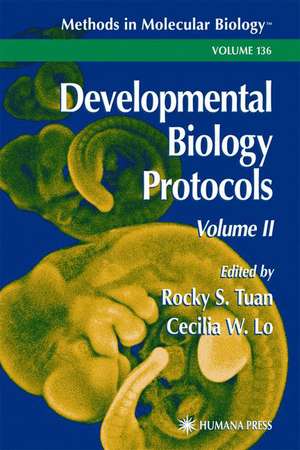
Developmental Biology Protocols
Editat de Rocky S. Tuan, Cecilia W. Loen Limba Engleză Hardback – 17 ian 2000
Preț: 1002.40 lei
Preț vechi: 1222.43 lei
-18%
Puncte Express: 1504
Carte tipărită la comandă
Livrare economică 05-19 decembrie
Livrare prin curier în România Termenul estimat este afișat lângă disponibilitate.
Transport gratuit pentru acest produs Plată online sau ramburs, în funcție de opțiunile comenzii.
Retur gratuit în 14 zile Comandă securizată și suport în română.
Specificații
ISBN-13: 9780896038530
ISBN-10: 089603853X
Pagini: 568
Ilustrații: XXV, 505 p.
Dimensiuni: 183 x 260 x 35 mm
Greutate: 1.19 kg
Ediția:2000
Editura: Humana
Locul publicării:Totowa, NJ, United States
ISBN-10: 089603853X
Pagini: 568
Ilustrații: XXV, 505 p.
Dimensiuni: 183 x 260 x 35 mm
Greutate: 1.19 kg
Ediția:2000
Editura: Humana
Locul publicării:Totowa, NJ, United States
V-ar putea interesa
-
 Regenerative Biology and MedicineDavid L. Stocum-24%Preț: 559.36 lei736.04 lei
 -
 Genes and EvolutionVirginie Orgogozo-33%Preț: 1007.91 lei1509.60 lei
 -
 Essays on Developmental Biology Part BPaul Wassarman-29%Preț: 1016.78 lei1433.57 lei
 -
 Mammalian Preimplantation DevelopmentMelvin L DePamphilis-30%Preț: 1010.79 lei1441.77 lei
 -
 -33%Preț: 947.72 lei1415.11 lei
 -
 Controversies In Diabetic NeuropathyNigel Calcutt-33%Preț: 943.10 lei1412.50 lei
 -
 Developmental Biology: A Very Short IntroductionLewis Wolpert-20%Preț: 55.78 lei70.14 lei
 -
 Mechanisms in Plant DevelopmentOttoline Leyser-8%Preț: 608.78 lei661.72 lei
 -
 Recombinant Gene Expression ProtocolsRocky S. Tuan-18%Preț: 996.47 lei1215.21 lei
 -
 Recombinant Protein ProtocolsRocky S. Tuan-18%Preț: 1273.15 lei1552.62 lei
 -
 Pollination Services to Agriculture: Sustaining and enhancing a key ecosystem serviceBarbara Gemmill-Herren-15%Preț: 520.16 lei611.95 lei
 -
 Biological AgingTrygve O. Tollefsbol-15%Preț: 707.45 lei832.29 lei
 -
 Kidney Development and DiseaseRachel K. Miller-18%Preț: 1271.93 lei1551.14 lei
 -
 Avian ReproductionTomohiro Sasanami-24%Preț: 1076.62 lei1416.62 lei
Public țintă
ResearchCuprins
Developmental Biology Protocols.- Organogenesis.- Drosophila as a Genetic Tool to Define Vertebrate Pathway Players.- Bioassays for Studying the Role of the Peptide Growth Factor Activin in Early Amphibian Embryogenesis.- Analysis of Mammary Gland Morphogenesis.- Specification of Cardiac Mesenchyme and Heart Morphogenesis In Vitro.- Craniofacial Development and Patterning.- Craniofacial Skeletel Morphogenesis In Vitro.- Skeletal Morphogenesis.- Transplantation and Culture Techniques for the Analysis of Urodele Limb Regeneration.- Retroviral Infection of T-Cell Precursors in Thymic Organ Culture.- Assay for the Isolation of Hepatogenic Factors.- Skin Morphogenesis.- Apoptosis in Development.- Methods to Detect Patterns of Cell Death in Drosophila.- Abnormal Development and Teratology.- Mechanisms of Neurulation.- Neurulation and Neural Tube Closure Defects.- Neural Tube Defects.- Experimental Manipulation and Morphometric Analysis of Neural Tube Development.- Isolation of Neuroepithelium and Formation of Minispheres.- Examination of Normal and Abnormal Placentation in the Mouse.- Palatal Dysmorphogenesis.- Palatal Dysmorphogenesis.- Transspecies Grafting as a Tool to Understand the Basis of Murine Developmental Limb Abnormalities.- Assessment of Laterality Defects in Rodent Embryos.- Cardiac Morphogenesis and Dysmorphogenesis I. Normal Development.- Analysis of Two Aspects of Left-Right Patterning of the Vertebrate Heart.- Biologically Based Risk Assessment Models for Developmental Toxicity.- Screening and Mapping of Novel Genes and Mutations.- Positional Cloning.- Gene Trapping in Embryonic Stem Cells In Vitro to Identify Novel Developmentally Regulated Genes in the Mouse.- PCR-Based Cloning of Cortically Localized RNAs from Xenopus Oocytes.- Analysis of mRNA ExpressionDuring Preimplantation Development.- Differential Screens with Subtracted PCR-Generated cDNA Libraries from Subregions of Single Mouse Embryos.- HPLC-Based mRNA Differential Display.- Production of Transgenic Drosophila.- Transgenic Manipulation of the Sea Urchin Embryo.- Transgenic Zebrafish.- Production of Avian Chimeras and Germline Transmission.- Incorporation of Genetically Modified Cells in Chicken Chimeras.- Long-Term Culture of Chicken Blastodermal Cells (CBCs) and Selection of Transfected CBCs Using Antibiotic Resistance.- Nuclear Transplantation and Cloning in Mammals.- Production of Transgenic Mice.- Production of Transgenic Mice with Yeast Artificial Chromosomes.- Gene-Targeting Strategies.- Chimeric Animals and GermlineTransmission.- Conditional Gene Knockout Using Cre Recombinase.- Application of Cre/loxP in Drosophila.
Recenzii
"We live in a time of rising expectations. Being a developmental biologist at the turn of the millenium demands expertise in embryological manipulation, viral gene expression, in situ hybridization, videomicroscopy, in vitro assays, transgenic embryo production, cell lineage analysis, PCR techniques, and computer-enhanced imaging technology. Rocky Tuan and Cecilia Lo have done the field (and each scientist within it) a wonderful service by collecting and editing the protocols of the masters of each echnique. More than 100 papers spanning these areas (and more) patiently lead one through each method, giving details on what brand of microscope slides to use, what centrifuge tubes work best, and where to purchase each piece of equipment. Copious notes provide details based on the laboratories' experiences of what works and what doesn't. Developmental Biology Protocols is a library in itself and will be essential for every laboratory of developmental biology. This
is the collection to get before your next grant application is due."-Scott Gilbert, Department of Biology, Swarthmore College, Swarthmore, PA
"The range of techniques, from viral vectors to imaging, and of organisms, from sea urchins to mammals, is comprehensive yet focused. This work should be an invaluable aid to those interested in all aspects of comparative development. This work is logically organized and presents a great opportunity for not only picking up a technique but also placing it in a logical context. Well done!" -Barbara B. Knowles, Director of Research, Jackson Labs, Bar Harbor, ME
"Among similar laboratory manuals Developmental Biology Protocols edited by Tuan and Lo impress by their breadth of coverage, timeliness, and scrupulous attention to detail. . .these protocols will be an invaluable aid to every geneticist and developmental biologist."-Davor Solter, Director of Developmental Biology, Max-Planck Institute, Freiburg, Germany
is the collection to get before your next grant application is due."-Scott Gilbert, Department of Biology, Swarthmore College, Swarthmore, PA
"The range of techniques, from viral vectors to imaging, and of organisms, from sea urchins to mammals, is comprehensive yet focused. This work should be an invaluable aid to those interested in all aspects of comparative development. This work is logically organized and presents a great opportunity for not only picking up a technique but also placing it in a logical context. Well done!" -Barbara B. Knowles, Director of Research, Jackson Labs, Bar Harbor, ME
"Among similar laboratory manuals Developmental Biology Protocols edited by Tuan and Lo impress by their breadth of coverage, timeliness, and scrupulous attention to detail. . .these protocols will be an invaluable aid to every geneticist and developmental biologist."-Davor Solter, Director of Developmental Biology, Max-Planck Institute, Freiburg, Germany
Textul de pe ultima copertă
The molecular biology revolution has transformed developmental biology into one of the most exciting and fruitful fields in experimental biomedical research today. In Developmental Biology Protocols, established leaders in this field demonstrate this achievement with a comprehensive collection of cutting-edge protocols for studying and analyzing the events of embryonic development. Drawing on state-of-the-art cellular and molecular techniques, as well as new and sophisticated imaging and information technologies, this 2nd volume of three describes state-of-the-art methods for the study of organogenesis, the analysis of abnormal development and teratology, the screening and mapping of novel genes and mutations, and the application of transgenesis, including the production of transgenic animals and gene knockouts. The 1st and 3rd volumes in this seminal set complete today's widest-ranging collection of techniques designed to decipher the exact cellular, molecular, and genetic mechanisms that control the form, structure, and function of the developing embryo. Volume 1 presents readily reproducible methods for establishing and characterizing several widely used experimental model systems, for both the study of developmental patterns and morphogenesis, and the examination of embryo structure and function. In addition, there are step-by-step methods for the analysis of cell lineage, the production and use of chimeras, and the experimental molecular manipulation of embryos, including the application of viral vectors. No less innovative, volume 3 introduces powerful techniques for the manipulation of developmental gene expression and function, the analysis of gene expression, the characterization of tissue morphogenesis and development, the in vitro study of differentiation and development, and the genetic analysis of developmental models of diseases.
Highly practical and richly annotated, the three volumes of Developmental Biology Protocols describe multiple experimental systems and details techniques adopted from the broadest array of biomedical disciplines. Every researcher will not only better understand the principles, background, and rationale for how form and function are elaborated in an organism, but also gain full practical access to today's best methods for its analysis.
Highly practical and richly annotated, the three volumes of Developmental Biology Protocols describe multiple experimental systems and details techniques adopted from the broadest array of biomedical disciplines. Every researcher will not only better understand the principles, background, and rationale for how form and function are elaborated in an organism, but also gain full practical access to today's best methods for its analysis.