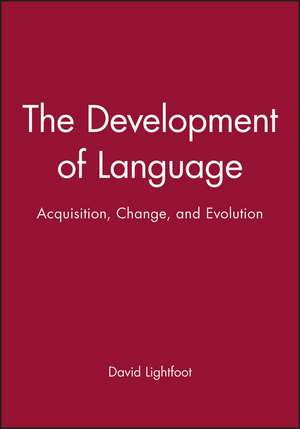
Development of Language
Autor Lightfooten Limba Engleză Paperback – 21 dec 1998
Preț: 454.90 lei
Preț vechi: 590.78 lei
-23%
Puncte Express: 682
Carte tipărită la comandă
Livrare economică 28 noiembrie-12 decembrie
Livrare prin curier în România Termenul estimat este afișat lângă disponibilitate.
Transport gratuit pentru acest produs Plată online sau ramburs, în funcție de opțiunile comenzii.
Retur gratuit în 14 zile Comandă securizată și suport în română.
Specificații
ISBN-13: 9780631210603
ISBN-10: 0631210601
Pagini: 300
Dimensiuni: 152 x 229 x 16 mm
Greutate: 0.51 kg
Ediția:New.
Editura: Wiley
Locul publicării:Chichester, United Kingdom
ISBN-10: 0631210601
Pagini: 300
Dimensiuni: 152 x 229 x 16 mm
Greutate: 0.51 kg
Ediția:New.
Editura: Wiley
Locul publicării:Chichester, United Kingdom
V-ar putea interesa
-
 The Prodigal TongueMark AbleyPreț: 115.08 lei
 -
 The Life of SlangJulie Coleman-17%Preț: 85.46 lei102.80 lei
 -
 Slang: The People's PoetryMichael Adams-20%Preț: 122.20 lei153.44 lei
 -
 Relabeling in Language GenesisClaire Lefebvre-22%Preț: 360.32 lei464.29 lei
 -
 -18%Preț: 769.73 lei938.69 lei
 -
 Urban Voices: Accent Studies in the British IslesPaul FoulkesPreț: 410.99 lei
 -
 Exploring World Englishes: Language in a Global ContextPhilip SeargeantPreț: 467.73 lei
 -
 Princples Diachronic SyxD. W. LightfootPreț: 386.29 lei
 -
 Verb MovementDavid LightfootPreț: 347.81 lei
 -
 How New Languages EmergeDavid LightfootPreț: 351.23 lei
 -
 -25%Preț: 54.71 lei72.67 lei
 -
 Modular Programming LanguagesDavid Lightfoot-20%Preț: 328.93 lei411.16 lei
Public țintă
undergraduates, graduates and researchers in language change, language acquisition and the evolution of language and some specialists in evolutionary theoryNotă biografică
David Lightfoot is Professor of Linguistics at the University of Maryland, College Park where he is also Associate Director of the program in Neural and Cognitive Science. His books include The Language Lottery and How to Set Parameters.
Cuprins
Foreword. Part I: Introduction:.
1. Progress or Degeneration?.
2. The Records, our Witnesses.
3. Lack of Change and Historical Explanation.
4. Our Odyssey.
Part II: The Nineteenth: Century of History:.
5. Historical Relationships.
6. Sound Change.
7. Historical Explanations.
8. Determinist Views of History.
Part III: Grammars and Language Acquisition:.
9. We Know More than we Learn.
10. The Nature of Grammars.
11. The Acquisition Problem: The Poverty of the Stimulus.
12. The Analytical Triplet.
13. Real-Time Acquisition of Grammars.
Part IV: Gradualism and Catastrophes:.
14. Grammars and Change.
15. Social Grammars.
16. Gradualism, Imagined and Real.
17. Catastrophes.
18. Competing Grammars.
19. The Spread of New Grammars.
20. Parametric Change.
Part V: The Loss of Case and its Syntactic Effects:.
21. Case.
22. Middle English Split Genitives.
23. Inherent Case and Thematic Roles in Early English.
24. The Loss and Origin of Case Systems.
Part VI: Cue-Based Acquisition and Change in Grammars:.
25. Models of Learnability.
26. Cue-Based Acquisition and Loss of Verb-Second.
27. V-to-I Raising and its Cue.
28. Creolization and Signed Languages.
Part VII: Equilibrium and Small Punctuations:.
29. Equilibrium.
30. English Auxiliary Verbs in the Eighteenth Century.
31. French chez.
Part VIII: Historicism: The Use and Abuse of Clio:.
32. Principles of History.
33. Clio Working through Biology.
34. Diachronic Reanalyses.
35. Trajectories.
Part IX: The Evolution of the Language Faculty:.
36. Bumpiness.
37. Explaining Evolution.
38. A UG Condition on Movement Traces.
39. The Condition is Maladaptive.
40. Conclusion.
Part X: A Science of History:.
41. Classical and Chaotic Views of Science.
43. History as an Epiphenomenon.
References.
Index.
1. Progress or Degeneration?.
2. The Records, our Witnesses.
3. Lack of Change and Historical Explanation.
4. Our Odyssey.
Part II: The Nineteenth: Century of History:.
5. Historical Relationships.
6. Sound Change.
7. Historical Explanations.
8. Determinist Views of History.
Part III: Grammars and Language Acquisition:.
9. We Know More than we Learn.
10. The Nature of Grammars.
11. The Acquisition Problem: The Poverty of the Stimulus.
12. The Analytical Triplet.
13. Real-Time Acquisition of Grammars.
Part IV: Gradualism and Catastrophes:.
14. Grammars and Change.
15. Social Grammars.
16. Gradualism, Imagined and Real.
17. Catastrophes.
18. Competing Grammars.
19. The Spread of New Grammars.
20. Parametric Change.
Part V: The Loss of Case and its Syntactic Effects:.
21. Case.
22. Middle English Split Genitives.
23. Inherent Case and Thematic Roles in Early English.
24. The Loss and Origin of Case Systems.
Part VI: Cue-Based Acquisition and Change in Grammars:.
25. Models of Learnability.
26. Cue-Based Acquisition and Loss of Verb-Second.
27. V-to-I Raising and its Cue.
28. Creolization and Signed Languages.
Part VII: Equilibrium and Small Punctuations:.
29. Equilibrium.
30. English Auxiliary Verbs in the Eighteenth Century.
31. French chez.
Part VIII: Historicism: The Use and Abuse of Clio:.
32. Principles of History.
33. Clio Working through Biology.
34. Diachronic Reanalyses.
35. Trajectories.
Part IX: The Evolution of the Language Faculty:.
36. Bumpiness.
37. Explaining Evolution.
38. A UG Condition on Movement Traces.
39. The Condition is Maladaptive.
40. Conclusion.
Part X: A Science of History:.
41. Classical and Chaotic Views of Science.
43. History as an Epiphenomenon.
References.
Index.
Descriere
How and why do languages change over time? Could the way an individual child develops affect aggregate language change? What do the mechanisms of change tell us about the evolution of language in our species? This book asserts that a child develops a grammar on exposure to some triggering experience.