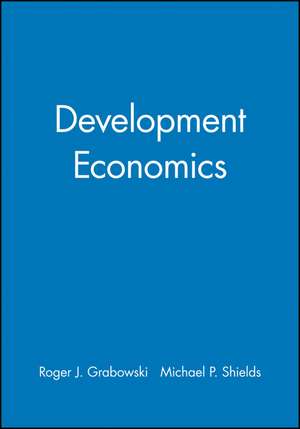
Development Economics
Autor Grabowski Shiel, Shieldsen Limba Engleză Hardback – mai 1996
The text is exceptional in that it provides more continuity between the methods of development economics and other fields of economics.
The text is a framework for the study of development theory. Because development theory is based on the microeconomics of household and firm choice, students will be familair with the methods of economics used. It also illustrates extensions of standard economic theory to development economics using graphical and mathematiclal expositions.
Preț: 705.06 lei
Preț vechi: 965.84 lei
-27%
Puncte Express: 1058
Carte tipărită la comandă
Livrare economică 27 noiembrie-11 decembrie
Livrare prin curier în România Termenul estimat este afișat lângă disponibilitate.
Transport gratuit pentru acest produs Plată online sau ramburs, în funcție de opțiunile comenzii.
Retur gratuit în 14 zile Comandă securizată și suport în română.
Specificații
ISBN-13: 9781557867063
ISBN-10: 1557867062
Pagini: 312
Dimensiuni: 183 x 260 x 21 mm
Greutate: 0.68 kg
Ediția:New.
Editura: Wiley
Locul publicării:Chichester, United Kingdom
ISBN-10: 1557867062
Pagini: 312
Dimensiuni: 183 x 260 x 21 mm
Greutate: 0.68 kg
Ediția:New.
Editura: Wiley
Locul publicării:Chichester, United Kingdom
V-ar putea interesa
-
 Economics: A Very Short IntroductionPartha Dasgupta-19%Preț: 57.70 lei71.46 lei
 -
 Economics of DevelopmentDwight H. Perkins-11%Preț: 472.68 lei531.10 lei
 -
 Development EconomicsDebraj Ray-23%Preț: 762.68 lei990.50 lei
 -
 MarketingGary Armstrong-9%Preț: 555.65 lei610.61 lei
 -
 Digitally CuriousAndrew GrillPreț: 143.82 lei
 -
 The New Nature of BusinessAndre HoffmannPreț: 116.02 lei
 -
 Business EconomicsAndrew Ashwin-24%Preț: 414.51 lei545.99 lei
 -
 The Republic of InnovationAndrea Lorenzo CapusselaPreț: 140.60 lei
 -
 Marketing - A Sociological ApproachKevin MelletPreț: 138.46 lei
 -
 Once Upon a TomeOliver Darkshire-19%Preț: 63.71 lei78.75 lei
 -
 Recent Studies in Economics of Development, Business and AccountingBeta Yulianita Gitaharie-26%Preț: 1283.14 lei1742.23 lei
 -
 Take Me to the RiverJackie KempPreț: 144.22 lei
 -
 With the Law on Our SideLady HalePreț: 191.77 lei
 -
 Recent Developments in the Economics of SportWladimir AndreffPreț: 644.84 lei
 -
 World Development: A Core TextbookBarry Baker-27%Preț: 98.75 lei135.09 lei
 -
 The Classical Marketing BookAnthony Tasgal-12%Preț: 62.54 lei71.01 lei
 -
 Designed to StayGestalten-8%Preț: 434.08 lei471.83 lei
 -
 LikeMartin ReevesPreț: 194.17 lei
 -
 Another WayDave WhortonPreț: 189.16 lei
Public țintă
undergraduate and graduate students of development economics, comparative economics and international tradeNotă biografică
Richard Grabowski is in the Department of Economics, Southern Illinois University at Carbondale, USA.
Cuprins
1. Growth and Development: Some Views. Historical Theories of Development.
The Classic Theory.
Keynesian Growth Models.
The Neoclassical Model.
The New Growth Economics.
Conclusion.
Notes.
2. A Unifying Theme.
Rationality: Individual Choice.
Rationality: Household Choice.
Extensions of Rationality: A Sociology of Choice.
Limitations of Rationality.
The Development Process.
Conclusion.
Notes.
3. The Traditional Sector and Development.
The Traditional Sector.
Market Integration and Transaction Costs.
Development by Displacement.
Traditional Sector Development.
Historical Illustrations.
Land Tenancy.
Technological Change.
Traditional Sector: Manufacturing.
Distorted Development.
Conclusion.
Notes.
4. Fertility and Population.
Malthus and Malthusianism.
Transition Theory.
Endogenous Population Growth Models (Neo-Malthusian).
Economic Theories.
Proximate Determinants Approaches.
Morality.
Conclusion.
Appendix.
Notes.
5. Labor.
Unemployment.
Migration.
Efficiency Wage Models.
Appropriate Technique and Appropriate Technology.
Education.
Conclusion.
Notes.
6. Public Economics.
Welfare Economics and Consumer Surplus.
Shadow Prices: Valuing Outputs and Inputs.
Cost-Benefit Analysis.
Public Revenues.
Conclusion.
Notes.
7. International Trade.
Traditional Perspective.
Protectionist Arguments.
Results of Import Substitution.
Conclusion.
Notes.
8. The State.
Concerning Market Imperfections.
Protecting Ruling Coalitions.
Fostering Development and Institutional Change.
Conclusion.
Notes.
Index.
The Classic Theory.
Keynesian Growth Models.
The Neoclassical Model.
The New Growth Economics.
Conclusion.
Notes.
2. A Unifying Theme.
Rationality: Individual Choice.
Rationality: Household Choice.
Extensions of Rationality: A Sociology of Choice.
Limitations of Rationality.
The Development Process.
Conclusion.
Notes.
3. The Traditional Sector and Development.
The Traditional Sector.
Market Integration and Transaction Costs.
Development by Displacement.
Traditional Sector Development.
Historical Illustrations.
Land Tenancy.
Technological Change.
Traditional Sector: Manufacturing.
Distorted Development.
Conclusion.
Notes.
4. Fertility and Population.
Malthus and Malthusianism.
Transition Theory.
Endogenous Population Growth Models (Neo-Malthusian).
Economic Theories.
Proximate Determinants Approaches.
Morality.
Conclusion.
Appendix.
Notes.
5. Labor.
Unemployment.
Migration.
Efficiency Wage Models.
Appropriate Technique and Appropriate Technology.
Education.
Conclusion.
Notes.
6. Public Economics.
Welfare Economics and Consumer Surplus.
Shadow Prices: Valuing Outputs and Inputs.
Cost-Benefit Analysis.
Public Revenues.
Conclusion.
Notes.
7. International Trade.
Traditional Perspective.
Protectionist Arguments.
Results of Import Substitution.
Conclusion.
Notes.
8. The State.
Concerning Market Imperfections.
Protecting Ruling Coalitions.
Fostering Development and Institutional Change.
Conclusion.
Notes.
Index.
Descriere
Aimed at the upper-level undergraduate, and at graduate courses on marketing for economic development and international trade, this analytical text contains comprehensive citations of recent literature, and has numerous Japanese examples which provide a global distinction.