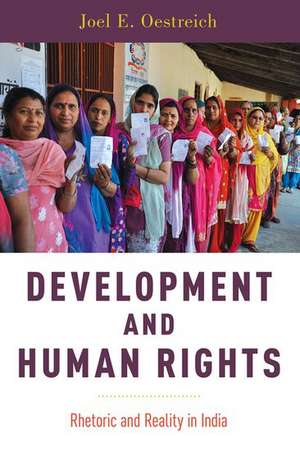
Development and Human Rights: Rhetoric and Reality in India
Autor Joel E. Oestreichen Limba Engleză Paperback – 7 ian 2020
Subliniem valoarea aplicată a acestei lucrări prin studiile de caz detaliate care analizează prezența a cinci agenții majore ale ONU în India. Development and Human Rights nu se limitează la teorie, ci investighează modul în care UNICEF, UNDP, Banca Mondială, UNFPA și UN Women navighează pe terenul politic dificil al unui stat suveran pentru a implementa standarde internaționale. Autorul analizează critic trecerea de la simpla asistență la o abordare bazată pe drepturi, o schimbare de paradigmă adoptată oficial în 2003, care prioritizează drepturile economice și sociale în detrimentul celor civile și politice.
Apreciem rigoarea cu care Joel E. Oestreich documentează gradul de intruziune a acestor organizații în politicile interne ale Indiei, un fenomen care depășește așteptările tradiționale privind suveranitatea națională. Lucrarea extinde cadrul propus de Reinventing Development? cu date noi din contextul specific al Indiei, oferind o evaluare echilibrată a impactului real pe care agențiile îl au asupra comportamentului statului.
În contextul operei sale, această carte reprezintă o evoluție firească de la lucrarea anterioară, Power and Principle. Dacă în volumul precedent Oestreich se concentra pe inovația politicilor în cadrul IGO-urilor la nivel global, aici el mută lentila pe execuția locală, oferind prima analiză completă a modului în care aceste principii sunt testate într-o singură țară. Stilul este unul academic precis, structurat pentru a servi atât cercetătorilor din domeniul relațiilor internaționale, cât și practicienilor din organizații neguvernamentale care caută să înțeleagă mecanismele schimbării în sistemele de guvernanță complexe.
Preț: 186.11 lei
Preț vechi: 253.95 lei
-27%
Carte tipărită la comandă
Livrare economică 27 noiembrie-08 decembrie
Specificații
ISBN-10: 0190086858
Pagini: 226
Dimensiuni: 155 x 231 x 13 mm
Greutate: 0.34 kg
Editura: Oxford University Press
Colecția OUP USA
Locul publicării:New York, United States
V-ar putea interesa
-
 -24%Preț: 142.90 lei188.54 lei
 -
 Revolutionary Sparks: Freedom of Expression in Modern AmericaMargaret A. Blanchard-18%Preț: 380.69 lei461.82 lei
 -
 Freedom SummerDoug McAdam-14%Preț: 108.44 lei125.57 lei
 -
 Reforming Jim Crow: Southern Politics and State in the Age Before BrownKimberley Johnson-28%Preț: 364.07 lei503.81 lei
 -
 -33%Preț: 915.27 lei1361.57 lei
 -
 Dismantling Public Policy: Preferences, Strategies, and EffectsMichael W. Bauer-21%Preț: 417.48 lei531.79 lei
 -
 -32%Preț: 987.25 lei1461.61 lei
 -
 National Minority Rights in EuropeTove H. Malloy-32%Preț: 637.16 lei941.86 lei
 -
 Indigenous Peoples, Postcolonialism, and International Law: The ILO Regime (1919-1989)Luis Rodríguez-Piñero-33%Preț: 1046.27 lei1553.81 lei
 -
 -22%Preț: 523.95 lei672.77 lei
 -
 -31%Preț: 932.89 lei1355.79 lei
 -
 The Protections for Religious Rights: Law and PracticeSir James Dingemans-33%Preț: 1922.60 lei2860.81 lei
 -
 An International Bill of the Rights of ManHersch Lauterpacht-28%Preț: 507.28 lei707.13 lei
 -
 -18%Preț: 1121.80 lei1368.04 lei
 -
 Preț: 295.89 lei
 -
 Genocide and the EuropeansKaren E Smith-19%Preț: 177.02 lei219.77 lei
 -
 Human Rights, State Compliance, and Social ChangeRyan GoodmanPreț: 249.91 lei
 -
 -15%Preț: 434.24 lei510.88 lei
 -
 Preț: 240.32 lei
 -
 Obamacare SimplifiedZephyros PressPreț: 63.27 lei
 -
 Tibet: U.S. Policy, Human Rights & Religious FreedomLionel Johnson-27%Preț: 1022.89 lei1395.36 lei
 -
 The Abolition Of LibertyPeter Hitchens-31%Preț: 63.66 lei92.21 lei
De ce să citești această carte
Recomandăm această carte specialiștilor în politici publice și relații internaționale care doresc să înțeleagă pragmatismul din spatele retoricii ONU. Cititorul câștigă o perspectivă clară asupra modului în care drepturile omului pot fi integrate în strategii de dezvoltare fără a compromite total relația cu statele gazdă. Este o resursă esențială pentru a vedea cum teoria drepturilor omului se traduce în realitate administrativă în India.
Despre autor
Joel E. Oestreich este profesor de științe politice la Universitatea Drexel și un expert recunoscut în studiul organizațiilor internaționale. Experiența sa academică este dublată de o expertiză practică solidă, acesta activând în calitate de consultant pentru UNICEF. Această dublă perspectivă îi permite să analizeze mecanismele interne ale agențiilor ONU cu o claritate rară, combinând rigoarea cercetării cu înțelegerea nuanțată a provocărilor operaționale de pe teren. Lucrările sale se concentrează pe intersecția dintre guvernanța globală, dezvoltarea economică și standardele internaționale ale drepturilor omului.
Descriere
Recenzii
Oestreich's analysis of UN advocacy and implementation of first and second generation rights in the world's biggest democracy breaks new ground in demonstrating why multilateralism matters. As the book's subtitle makes clear, UN officials can make a difference to the quality of human life in reality, not merely in rhetoric."
Development and Human Rights solidifies Oestreich's reputation as a leader in the deep study of international organizations. This important contribution to the analysis of international organizations beyond the global level carefully illustrates how international organizations act intrusively in, and independently of, states, while simultaneously navigating resistance within states. It demonstrates the necessity - and difficulty - of maintaining a connection between economic, social and cultural rights and civil and political rights to further transformative development."