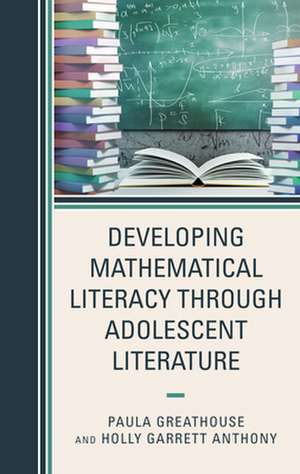
Developing Mathematical Literacy through Adolescent Literature: Adolescent Literature as a Completement to the Content Area
Editat de Paula Greathouse, Holly Anthonyen Limba Engleză Paperback – 15 ian 2022

Preț: 211.64 lei
Preț vechi: 284.27 lei
-26%
Puncte Express: 317
Carte tipărită la comandă
Livrare economică 08-22 decembrie
Livrare prin curier în România Termenul estimat este afișat lângă disponibilitate.
Transport gratuit de la 400.00 lei Plată online sau ramburs, în funcție de opțiunile comenzii.
Retur gratuit în 14 zile Comandă securizată și suport în română.
Specificații
ISBN-13: 9781475861532
ISBN-10: 1475861532
Pagini: 240
Dimensiuni: 151 x 230 x 18 mm
Greutate: 0.35 kg
Editura: Bloomsbury Publishing
Colecția Rowman & Littlefield
Seria Adolescent Literature as a Completement to the Content Area
Locul publicării:New York, United States
ISBN-10: 1475861532
Pagini: 240
Dimensiuni: 151 x 230 x 18 mm
Greutate: 0.35 kg
Editura: Bloomsbury Publishing
Colecția Rowman & Littlefield
Seria Adolescent Literature as a Completement to the Content Area
Locul publicării:New York, United States
Cuprins
INTRODUCTION
Paula Greathouse and Holly Garrett Anthony
CHAPTER 1
The Mathematics of Imagination: Uncovering Math and Meaning in the Graphic Novel The
Magic Fish
Katherine Baker, Summer Melody Pennell and Bryan Fede
CHAPTER 2
Take It to The Limit: Maximizing Mathematical Literacy and (Re)solving Conflict
Holly Garrett Anthony, Paula Greathouse and Kaylee Gentry
CHAPTER 3
Extracting Mathematical Topics Embedded in Holes and Examining the Text Through a Critical
Lens
Marilyn E. Strutchens, Mike P. Cook and Brea C. Ratliff
CHAPTER 4
Reading Like a Mathematician: Exploring Data, Narratives, and Phenomena in A Long Walk to
Water
Suki Jones Mozenter and Robin Keturah Anderson
CHAPTER 5
Exploring All of the Above: Platonic Solids, Scale, Proportions, and Characterization
Jennifer R. Meadows and Amber Spears
CHAPTER 6
Reasoning with Equations and Functions in The 5th Wave
Rebecca Grice Gault and Jennifer Edelman
CHAPTER 7
"Absolute Zeros Solve for Why" Using the Pythagorean Theorem in Island of the Unknowns
Brian Rothbaum and Julie Grasfield Weil
CHAPTER 8
Exploring Math, Culture, and Stories Through Math Girls
Shelly Shaffer and Carlos Castillo-Garsow
CHAPTER 9
Making a Deal with The Number Devil: Scaffolding, Deepening and Extending Students'
Mathematical Literacy
Amanda Huffman, Rachel Colby, Jenna Repkin and Shelly Furuness
CHAPTER 10
Matchmaking Mathematics: Teaching Algorithms and Probability with Nandini Bajpai's A
Match Made in Mehendi
Jen McConnel and Allen Harbaugh
CHAPTER 11
Simulating Success Based on Societal Odds: A Mathematical Read of The Hunger Games
Robin Keturah Anderson, Melissa Troudt, Candace Joswick and Lisa Skultety
ABOUT THE EDITORS
ABOUT THE CONTRIBUTORS
SUBJECT INDEX
Paula Greathouse and Holly Garrett Anthony
CHAPTER 1
The Mathematics of Imagination: Uncovering Math and Meaning in the Graphic Novel The
Magic Fish
Katherine Baker, Summer Melody Pennell and Bryan Fede
CHAPTER 2
Take It to The Limit: Maximizing Mathematical Literacy and (Re)solving Conflict
Holly Garrett Anthony, Paula Greathouse and Kaylee Gentry
CHAPTER 3
Extracting Mathematical Topics Embedded in Holes and Examining the Text Through a Critical
Lens
Marilyn E. Strutchens, Mike P. Cook and Brea C. Ratliff
CHAPTER 4
Reading Like a Mathematician: Exploring Data, Narratives, and Phenomena in A Long Walk to
Water
Suki Jones Mozenter and Robin Keturah Anderson
CHAPTER 5
Exploring All of the Above: Platonic Solids, Scale, Proportions, and Characterization
Jennifer R. Meadows and Amber Spears
CHAPTER 6
Reasoning with Equations and Functions in The 5th Wave
Rebecca Grice Gault and Jennifer Edelman
CHAPTER 7
"Absolute Zeros Solve for Why" Using the Pythagorean Theorem in Island of the Unknowns
Brian Rothbaum and Julie Grasfield Weil
CHAPTER 8
Exploring Math, Culture, and Stories Through Math Girls
Shelly Shaffer and Carlos Castillo-Garsow
CHAPTER 9
Making a Deal with The Number Devil: Scaffolding, Deepening and Extending Students'
Mathematical Literacy
Amanda Huffman, Rachel Colby, Jenna Repkin and Shelly Furuness
CHAPTER 10
Matchmaking Mathematics: Teaching Algorithms and Probability with Nandini Bajpai's A
Match Made in Mehendi
Jen McConnel and Allen Harbaugh
CHAPTER 11
Simulating Success Based on Societal Odds: A Mathematical Read of The Hunger Games
Robin Keturah Anderson, Melissa Troudt, Candace Joswick and Lisa Skultety
ABOUT THE EDITORS
ABOUT THE CONTRIBUTORS
SUBJECT INDEX
Recenzii
This book offers some interesting features overall aimed at helping teachers use young adult literature (YAL) to make mathematical concepts both relevant and meaningful to students. Using 11 YAL-appropriate texts, chapter authors provide various practical examples using a common framework-introduction; text summary; instructional activities before, during, and after reading the text; follow-up extension activities; and supportive references.. The lessons are practical and seem to have been tested in the classroom. Though a teacher may choose not to use these particular lessons or texts, the suggested approach provides a model for how teachers can use YAL to motivate students and help them gain mathematical literacy. Greathouse and Anthony provide a good resource worthy of consideration by secondary school mathematics teachers and teachers still in training. Recommended. Graduate students and professionals.
This curated collection of essays reflects best practices for engaging students in learning mathematics while developing literacy skills. The volume provides teachers with resources for enacting units of study in the mathematics classroom, in a humanities course, or through a collaboration among mathematics and literacy instructors. Each chapter is packed with rich mathematics explorations that help students better understand real problems through the lens of young adult literature protagonists. Structured chapters provide activities to prepare students for understanding a text through pre-reading, while-reading, and after-reading tasks, all of which are founded on best practices that emphasize a growth mindset in the learning of mathematics. The young adult literature has been carefully mined for engaging students in a mathematical exploration of the world; from examining water security near and far through the use of scales in mapping, to personal discoveries of one's relationship to mathematics, this collection will not only uncover the power of thinking mathematically, but will also capture students' interests and awaken their passion for active participation in our world.
This book's use of YA literature is a powerful approach for secondary school mathematics teachers to improve the relevance of the mathematics they teach, connecting both to other subjects and to real world contexts. The common format used across the chapters provides very practical assistance for secondary school mathematics teachers to meaningfully incorporate YA literature into their classroom to build their students' mathematical knowledge and connect it to other subjects and to the world in which they live. A strong theme across the chapters of this book is the promotion of both a deep understanding of important mathematical content but also how mathematics can be used by students to "read the world" to address significant issues in their social content.
This curated collection of essays reflects best practices for engaging students in learning mathematics while developing literacy skills. The volume provides teachers with resources for enacting units of study in the mathematics classroom, in a humanities course, or through a collaboration among mathematics and literacy instructors. Each chapter is packed with rich mathematics explorations that help students better understand real problems through the lens of young adult literature protagonists. Structured chapters provide activities to prepare students for understanding a text through pre-reading, while-reading, and after-reading tasks, all of which are founded on best practices that emphasize a growth mindset in the learning of mathematics. The young adult literature has been carefully mined for engaging students in a mathematical exploration of the world; from examining water security near and far through the use of scales in mapping, to personal discoveries of one's relationship to mathematics, this collection will not only uncover the power of thinking mathematically, but will also capture students' interests and awaken their passion for active participation in our world.
This book's use of YA literature is a powerful approach for secondary school mathematics teachers to improve the relevance of the mathematics they teach, connecting both to other subjects and to real world contexts. The common format used across the chapters provides very practical assistance for secondary school mathematics teachers to meaningfully incorporate YA literature into their classroom to build their students' mathematical knowledge and connect it to other subjects and to the world in which they live. A strong theme across the chapters of this book is the promotion of both a deep understanding of important mathematical content but also how mathematics can be used by students to "read the world" to address significant issues in their social content.