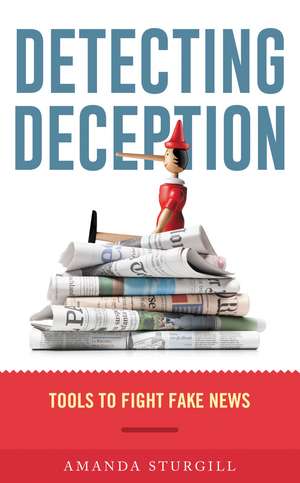
Detecting Deception: Tools to Fight Fake News
Autor Amanda Sturgillen Limba Engleză Paperback – 20 aug 2020
Pithy and practical, Amanda Sturgill draws from present day news examples to help students recognize the most common bad arguments people make. Detecting Deception is an essential tool for training future journalists to build stories that recognize faulty arguments and hold their subjects to a higher standard.
Preț: 135.54 lei
Preț vechi: 171.91 lei
-21%
Puncte Express: 203
Carte tipărită la comandă
Livrare economică 28 noiembrie-12 decembrie
Livrare prin curier în România Termenul estimat este afișat lângă disponibilitate.
Transport gratuit de la 400.00 lei Plată online sau ramburs, în funcție de opțiunile comenzii.
Retur gratuit în 14 zile Comandă securizată și suport în română.
Specificații
ISBN-13: 9781538141038
ISBN-10: 1538141035
Pagini: 160
Ilustrații: 2 b/w illustrations; 4 graphs
Dimensiuni: 154 x 230 x 10 mm
Greutate: 0.23 kg
Editura: Bloomsbury Publishing
Colecția Rowman & Littlefield
Locul publicării:New York, United States
ISBN-10: 1538141035
Pagini: 160
Ilustrații: 2 b/w illustrations; 4 graphs
Dimensiuni: 154 x 230 x 10 mm
Greutate: 0.23 kg
Editura: Bloomsbury Publishing
Colecția Rowman & Littlefield
Locul publicării:New York, United States
V-ar putea interesa
-
 Borderland: Decolonizing the Words of WarChrisanthi Giotis-16%Preț: 199.72 lei236.43 lei
 -
 Preț: 366.11 lei
 -
 Forecasting with Maximum EntropyHugo Fort-15%Preț: 713.94 lei839.93 lei
 -
 Maximum VantageBill MaxwellPreț: 149.95 lei
 -
 Depth Public Relations: After the MasqueradeJohanna Fawkes-18%Preț: 1006.29 lei1227.18 lei
 -
 Social Media Images and ConflictsMette Mortensen-18%Preț: 1008.39 lei1229.75 lei
 -
 Preț: 382.13 lei
 -
 -15%Preț: 680.07 lei800.09 lei
 -
 Preț: 347.50 lei
 -
 Biostatistics: An Introduction and Conceptual CritiqueDavid Baronov-15%Preț: 499.08 lei587.16 lei
 -
 -18%Preț: 1000.71 lei1220.38 lei
 -
 -11%Preț: 717.35 lei806.00 lei
 -
 We Are #ALTGOV: Social Media Resistance from the InsideAmanda Sturgill-23%Preț: 260.07 lei337.07 lei
 -
 Mind the Gap: Global Learning at Home and AbroadNina NamastePreț: 326.28 lei
 -
 -27%Preț: 255.22 lei349.77 lei
 -
 Untold LondonDan CarrierPreț: 143.88 lei
 -
 Preț: 521.39 lei
Cuprins
Preface: Detecting Deception and Why It Matters
Section 1: Distractions and Deceptions
1. The Personal Attack: "We Shouldn't Listen to Dummies"
2. Poisoning the Well: "Nothing to See Here"
3. The Straw Man: "Said No One Ever"
4. The Appeal to Hypocrisy: "She Did It First!"
5. The Red Herring: "Look! Squirrel!"
6. The Black and White: "There Are Only Two Things That Could Happen"
7. The Slippery Slope: "And You'll End up Living in a Van by the River"
8. The Fallacy of Fallacies: "One Rotten Apple Spoils the Grocery Store"
9. The Faulty Analogy: "Comparing Oranges to Falsehoods"
10. The Irrelevant Conclusion: "Cool. Don't Care"
11. The Hasty Generalization: "I Saw a Thing Once"
12. The Division Fallacy: "All the Children Are Above Average"
13. The Composition Fallacy: "Great Players Must Make a Great Band"
14. Begging the Question: "The Blue Sky Is Blue"
15. The Appeal to Purity: "Real Men Don't Eat Haggis"
16. Equivocation: "I Mean, I Am Nice"
17. The Sunk Cost: "We've Already Invested so Much"
Section 2: Unrelated Evidence
18. The Appeal to Pity: "If You Really Cared About Me"
19. The Appeal to Force: "Agree-or Else"
20. The Appeal to Ignorance: "No One Has Proved You Can't"
21. The Appeal to Authority: "I'm Not a Doctor But . . ."
22. The Appeal to Tradition: "We've Always Done It This Way"
23. The Appeal to Popularity: "A Lot of People Agree"
24. The Big Lie and Conspiracy Theories: "The Sky Is Green. The Sky Is Green. The Sky Is Green"
Section 3: Issues with Numbers and Data
25 Ignoring the Base Rate: "100 Percent of People Die"
26 The False Cause: "Spider Bites and Spelling Bees"
27 The Hidden Variable: "Rabbit Feet and Lucky Rocks"
28 Unnecessary Precision: "The Difference That Doesn't Matter"
29 Naive Probability and the Audience It Confuses: "This Slot Machine Is Hot"
30 Deception with Charts: "A Picture Is Worth 1,000 Lies"
31 Misrepresenting Polls and Surveys: "Four out of Five Dentists Surveyed Agree"
Appendix 1: Possible Answers to Section 1 Exercises
Appendix 2: Possible Answers to Section 2 Exercises
Appendix 3: Possible Answers to Section 3 Exercises
Section 1: Distractions and Deceptions
1. The Personal Attack: "We Shouldn't Listen to Dummies"
2. Poisoning the Well: "Nothing to See Here"
3. The Straw Man: "Said No One Ever"
4. The Appeal to Hypocrisy: "She Did It First!"
5. The Red Herring: "Look! Squirrel!"
6. The Black and White: "There Are Only Two Things That Could Happen"
7. The Slippery Slope: "And You'll End up Living in a Van by the River"
8. The Fallacy of Fallacies: "One Rotten Apple Spoils the Grocery Store"
9. The Faulty Analogy: "Comparing Oranges to Falsehoods"
10. The Irrelevant Conclusion: "Cool. Don't Care"
11. The Hasty Generalization: "I Saw a Thing Once"
12. The Division Fallacy: "All the Children Are Above Average"
13. The Composition Fallacy: "Great Players Must Make a Great Band"
14. Begging the Question: "The Blue Sky Is Blue"
15. The Appeal to Purity: "Real Men Don't Eat Haggis"
16. Equivocation: "I Mean, I Am Nice"
17. The Sunk Cost: "We've Already Invested so Much"
Section 2: Unrelated Evidence
18. The Appeal to Pity: "If You Really Cared About Me"
19. The Appeal to Force: "Agree-or Else"
20. The Appeal to Ignorance: "No One Has Proved You Can't"
21. The Appeal to Authority: "I'm Not a Doctor But . . ."
22. The Appeal to Tradition: "We've Always Done It This Way"
23. The Appeal to Popularity: "A Lot of People Agree"
24. The Big Lie and Conspiracy Theories: "The Sky Is Green. The Sky Is Green. The Sky Is Green"
Section 3: Issues with Numbers and Data
25 Ignoring the Base Rate: "100 Percent of People Die"
26 The False Cause: "Spider Bites and Spelling Bees"
27 The Hidden Variable: "Rabbit Feet and Lucky Rocks"
28 Unnecessary Precision: "The Difference That Doesn't Matter"
29 Naive Probability and the Audience It Confuses: "This Slot Machine Is Hot"
30 Deception with Charts: "A Picture Is Worth 1,000 Lies"
31 Misrepresenting Polls and Surveys: "Four out of Five Dentists Surveyed Agree"
Appendix 1: Possible Answers to Section 1 Exercises
Appendix 2: Possible Answers to Section 2 Exercises
Appendix 3: Possible Answers to Section 3 Exercises
Recenzii
This practical guide was designed to help train potential journalists "to spot problematic reasoning so it can be questioned or corrected." Dividing her text into three parts, Sturgill employs contemporary news stories throughout to illustrate how facts can be presented in misleading ways. Each chapter ends with a "Your Turn" section, presenting reflective questions that challenge readers to practice the skill introduced in the chapter at hand. An appendix that includes possible answers to the questions makes this a resource that can be independently consulted by individuals seeking self-study.... More practical and pedagogical than similar works.this volume will serve as an affordable and accessible handbook for undergraduate students studying journalism, or any reader interested in improving their news evaluation skills. Recommended.
Detecting Deception is both readable and fun. Amanda Sturgill uses references from pop culture and current events to engage readers, and the Your Turn sections engage interactive thought. Students, professors and others will benefit from exploring the strategies used by senders of messages to build a case; however, Sturgill goes farther to give her audience strategies to identify and combat weak arguments. The work is well researched and includes insightful references
Truth is difficult to discern in today's news media, so this intelligent and pragmatic book arrives none too soon. Filled with relevant examples and new insights, Sturgill instructs us on how to sift through the plethora of messages that characterize today's complex and often divisive media environment; she does so with refreshingly crisp and clear writing. This is the foundation for identifying good journalism that we've been waiting for.
Detecting Deception is both readable and fun. Amanda Sturgill uses references from pop culture and current events to engage readers, and the Your Turn sections engage interactive thought. Students, professors and others will benefit from exploring the strategies used by senders of messages to build a case; however, Sturgill goes farther to give her audience strategies to identify and combat weak arguments. The work is well researched and includes insightful references
Truth is difficult to discern in today's news media, so this intelligent and pragmatic book arrives none too soon. Filled with relevant examples and new insights, Sturgill instructs us on how to sift through the plethora of messages that characterize today's complex and often divisive media environment; she does so with refreshingly crisp and clear writing. This is the foundation for identifying good journalism that we've been waiting for.