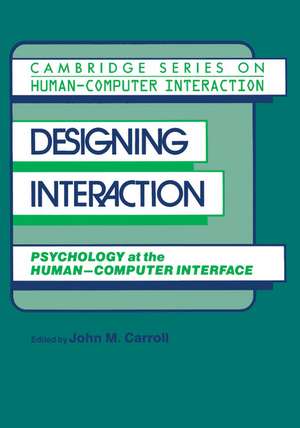
Designing Interaction: Psychology at the Human-Computer Interface: Cambridge Series on Human-Computer Interaction, cartea 4
Editat de John Millar Carrollen Limba Engleză Paperback – 27 iun 1991


Preț: 352.11 lei
Preț vechi: 440.14 lei
-20%
Puncte Express: 528
Carte tipărită la comandă
Livrare economică 09-23 iulie
Livrare prin curier în România Termenul estimat este afișat lângă disponibilitate.
Transport gratuit de la 400.00 lei Plată online sau ramburs, în funcție de opțiunile comenzii.
Retur gratuit în 14 zile Comandă securizată și suport în română.
Specificații
ISBN-13: 9780521409216
ISBN-10: 0521409217
Pagini: 346
Dimensiuni: 179 x 252 x 18 mm
Greutate: 0.6 kg
Ediția:New.
Editura: Cambridge University Press
Colecția Cambridge University Press
Seria Cambridge Series on Human-Computer Interaction
Locul publicării:Cambridge, United Kingdom
ISBN-10: 0521409217
Pagini: 346
Dimensiuni: 179 x 252 x 18 mm
Greutate: 0.6 kg
Ediția:New.
Editura: Cambridge University Press
Colecția Cambridge University Press
Seria Cambridge Series on Human-Computer Interaction
Locul publicării:Cambridge, United Kingdom
V-ar putea interesa
-
 -38%Preț: 189.24 lei307.37 lei
 -
 Human Factors for Informatics UsabilityB. Shackel-20%Preț: 372.99 lei466.24 lei
 -
 The Reactive KeyboardJohn J. Darragh-20%Preț: 277.83 lei347.30 lei
 -
 -20%Preț: 250.83 lei313.53 lei
 -
 -20%Preț: 384.15 lei480.19 lei
 -
 -20%Preț: 345.02 lei431.28 lei
 -
 -20%Preț: 337.55 lei421.94 lei
 -
 Ubiquitous Computing FundamentalsJohn Krumm-20%Preț: 1017.98 lei1272.47 lei
 -
 Game AnalyticsMagy Seif El-Nasr-20%Preț: 766.46 lei958.07 lei
 -
 Experience Design: Concepts and Case StudiesPeter Benz-17%Preț: 231.40 lei278.38 lei
 -
 This is Service Design DoingMarc Stickdorn-20%Preț: 246.08 lei307.59 lei
 -
 Practical TableauRyan Sleeper-20%Preț: 314.11 lei392.64 lei
 -
 Learning in CommunitiesJohn M. Carroll-15%Preț: 632.92 lei744.61 lei
 -
 Brain-Computer Interface Research: A State-of-the-Art Summary 5Christoph Guger-20%Preț: 312.62 lei390.78 lei
 -
 -20%Preț: 317.85 lei397.31 lei
 -
 -20%Preț: 975.27 lei1219.09 lei
 -
 -20%Preț: 552.18 lei690.23 lei
 -
 -20%Preț: 315.48 lei394.35 lei
 -
 Preț: 351.48 lei
Cuprins
Preface; Contributors; 1. Introduction: The Kittle House Manifesto John M. Carroll; 2. Cognitive artifacts Donald A. Norman; 3. Some remarks on the theory-practice gap Zenon W. Pylyshyn; 4. Comparative task analysis: an alternative direction for human-computer interaction science Ruven Brooks; 5. Let's get real: a position paper on the role of cognitive psychology in the design of humanly useful and usable systems Thomas K. Landauer; 6. The task-artifact cycle John M. Carroll, Wendy A. Kellogg and Mary Beth Rosson; 7. Bridging between basic theories and the artifacts of human-computer interaction Philip Barnard; 8. Interface problems and interface resources Stephen J. Payne; 9. Inner and outer theory in human-computer interaction Clayton Lewis; 10. Local sciences: viewing the design of human-computer systems as cognitive science Andrea A. diSessa; 11. The role of German work psychology in the design of artifacts Siegfried Greif; 12. Beyond the interface: encountering artifacts in use Liam J. Bannon and Susanne Bødker; 13. A development perspective on interface, design and theory Austin Henderson; 14. Working with the design process: supporting effective and efficient design John Karat and John L. Bennett; 15. Discussion: perspectives on methodology in HCI research and practice Linda Tetzlaff and Robert L. Mack; Index.
Descriere
Designing Interaction, first published in 1991, presents a broadbased and fundamental re-examination of human-computer interaction as a practical and scientific endeavor.