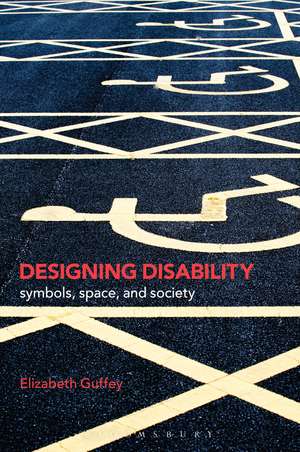
Designing Disability: Symbols, Space, and Society
Autor Elizabeth Guffeyen Limba Engleză Hardback – 28 dec 2017
Infirmity and illness may be seen as part of human experience, but 'disability' is a social construct, a way of thinking about and responding to a natural human condition. Elizabeth Guffey's highly original and wide-ranging study considers the period both before and after the introduction of the ISA, tracing the design history of the wheelchair, a product which revolutionised the mobility needs of many disabled people from the 1930s onwards. She also examines the rise of 'barrier-free architecture' in the reception of the ISA, and explores how the symbol became widely adopted and even a mark of identity for some, especially within the Disability Rights Movement.
Yet despite the social progress which is inextricably linked to the ISA, a growing debate has unfurled around the symbol and its meanings. The most vigorous critiques today have involved guerrilla art, graffiti and studio practice, reflecting new challenges to the relationship between design and disability in the twenty-first century.
Preț: 582.81 lei
Preț vechi: 677.68 lei
-14%
Puncte Express: 874
Carte tipărită la comandă
Livrare economică 01-15 decembrie
Livrare prin curier în România Termenul estimat este afișat lângă disponibilitate.
Transport gratuit pentru acest produs Plată online sau ramburs, în funcție de opțiunile comenzii.
Retur gratuit în 14 zile Comandă securizată și suport în română.
Specificații
ISBN-13: 9781350004283
ISBN-10: 1350004286
Pagini: 240
Ilustrații: 75 BW illus
Dimensiuni: 162 x 236 x 20 mm
Greutate: 0.5 kg
Editura: Bloomsbury Publishing
Colecția Bloomsbury Academic
Locul publicării:London, United Kingdom
ISBN-10: 1350004286
Pagini: 240
Ilustrații: 75 BW illus
Dimensiuni: 162 x 236 x 20 mm
Greutate: 0.5 kg
Editura: Bloomsbury Publishing
Colecția Bloomsbury Academic
Locul publicării:London, United Kingdom
V-ar putea interesa
-
 The Minority Body: A Theory of DisabilityElizabeth Barnes-15%Preț: 111.60 lei131.72 lei
 -
 Preț: 206.64 lei
 -
 HunchbackSaou IchikawaPreț: 77.83 lei
 -
 -8%Preț: 450.42 lei489.59 lei
 -
 What Can a Body Do?: How We Meet the Built WorldSara HendrenPreț: 156.99 lei
 -
 -5%Preț: 455.94 lei479.94 lei
 -
 -5%Preț: 368.80 lei388.21 lei
 -
 After Universal Design: The Disability Design RevolutionElizabeth Guffey-13%Preț: 166.62 lei191.50 lei
 -
 -17%Preț: 193.22 lei233.42 lei
 -
 Designing Inclusive Public Toilets: Wee the PeopleJo-Anne Bichard-14%Preț: 177.00 lei206.66 lei
 -
 For Dear Life: Art, Medicine, and DisabilityJill DawseyPreț: 384.62 lei
 -
 Preț: 206.96 lei
 -
 Preț: 135.56 lei
 -
 Why I Burned My BookPaul LongmorePreț: 197.07 lei
 -
 The World We Can BuildEliza HullPreț: 94.97 lei
 -
 Up in the AirHolly SmithPreț: 154.08 lei
 -
 -18%Preț: 145.57 lei178.02 lei
 -
 Enforcing NormalcyLennard J. DavisPreț: 114.15 lei
 -
 Design and DisabilityNatalie KanePreț: 206.65 lei
 -
 Ramping Up RightsRachel Charlton-DaileyPreț: 124.93 lei
Cuprins
Acknowledgments
Illustrations
Introduction: Disability By Design?
Design's Misfit
Defining Disability
Defining a Symbol
PART ONE: History of an Idea: Access (- 1961)
Origins of a Misfit Design: The Advent of the Modern
Wheelchair (- 1945)
An Environmental Misfit
A Symbol of Defeat?
How to Behave in a Bath-Chair
The Chair That Changed the World
Fitting In (1945 - 1961)
Accessing a Culture on Four Wheels
The Nugent Ethic
An Attack on Barriers
PART TWO: Redesigning Signs and Space (1961 - 1974)
The Personal Politics of Signs (1961 - 1965)
What a Good Sign Can Do
Down the "Welfare Path"
The Ideologies of "Self-Help" and "Social Welfare Cultures"
Breaking Barriers
Signs of Discrimination (1965 - 1968)
The Secret Signs of Disabled People
Positive Discrimination and the Psychology of Disablement
Towards s Universal Sign
A Design for the Real World? (1968 - 1974)
A Technical Aid
Man and The Environment
A Misfit Head
A Positive Step Forward
PART THREE: A Mark of Identity? (1974 - Today)
Signs of Protest (1974 - 1990)
"The Selma of Handicapped Rights"
Rights and Protest
Passing the ADA: Compliance and Defiance
A Critical Design? (1990 - Today)
A Cry for Help
A 21st Century Makeover
Epilogue: The Beginning of the End?
Bibliography
Illustrations
Introduction: Disability By Design?
Design's Misfit
Defining Disability
Defining a Symbol
PART ONE: History of an Idea: Access (- 1961)
Origins of a Misfit Design: The Advent of the Modern
Wheelchair (- 1945)
An Environmental Misfit
A Symbol of Defeat?
How to Behave in a Bath-Chair
The Chair That Changed the World
Fitting In (1945 - 1961)
Accessing a Culture on Four Wheels
The Nugent Ethic
An Attack on Barriers
PART TWO: Redesigning Signs and Space (1961 - 1974)
The Personal Politics of Signs (1961 - 1965)
What a Good Sign Can Do
Down the "Welfare Path"
The Ideologies of "Self-Help" and "Social Welfare Cultures"
Breaking Barriers
Signs of Discrimination (1965 - 1968)
The Secret Signs of Disabled People
Positive Discrimination and the Psychology of Disablement
Towards s Universal Sign
A Design for the Real World? (1968 - 1974)
A Technical Aid
Man and The Environment
A Misfit Head
A Positive Step Forward
PART THREE: A Mark of Identity? (1974 - Today)
Signs of Protest (1974 - 1990)
"The Selma of Handicapped Rights"
Rights and Protest
Passing the ADA: Compliance and Defiance
A Critical Design? (1990 - Today)
A Cry for Help
A 21st Century Makeover
Epilogue: The Beginning of the End?
Bibliography
Recenzii
Erudite, accessible, and with an impressive breadth of reference, this engaging and highly readable book offers fresh historical and cultural perspectives on the fit/misfit binary. Focussing on how design both creates and responds to different notions of disability, it gives an at times fascinating alternative history of activism and identity through the study of the ISA - the International Symbol of Access.
The strength of Designing Disability is the way significant moments in the history of access and disability are woven together with society's perception and the design of a universal icon ... It is an impressively researched and thought-provoking text that leaves the reader wanting to closely follow the shifting social construct as history continues to unfold.
An engaging account of the evolution of the barrier-free architecture movement, and its thorny relationship with the ISA.
Elizabeth Guffey's search for the origins of the International Symbol of Access takes her on an unexpected path, discovering not only the history of the modern wheelchair but a new perspective on disability at the intersection of design, the body and space. and most readers will delight in following her quest.
Informed and erudite, Designing Disability shows how the analysis of a single symbol can act as a gateway to discussions of disability theory and history. Elizabeth Guffey's critical insight augments and develops our understandings of disability experiences and subjectivities.
From the invention of the modern wheel chair and early critiques of disabling design conventions, Guffey makes a history of the international symbol of access come alive. An original and insightful analysis that furthers our understanding of both the symbol's history and associated access debates. This book will appeal to appeal to students and academics across a range of disciplines, shedding further light not only on a symbol and its history, but also how disability continues to be socially produced.
Design Incubation is excited to announce Elizabeth Guffey's latest book published by Bloomsbury Publishing, titled Designing Disability: Symbols, Space, and Society. This book describes the development of disability as an idea. Disability, accessibility, its institutionalization, acceptance, and integration is considered within the context of design history.
I encourage anyone to read this important book... it should catalyse reflection and discussion about the implications for disabled people and non-disabled people, designers and design-and provoke new directions in disability-led design.
The strength of Designing Disability is the way significant moments in the history of access and disability are woven together with society's perception and the design of a universal icon ... It is an impressively researched and thought-provoking text that leaves the reader wanting to closely follow the shifting social construct as history continues to unfold.
An engaging account of the evolution of the barrier-free architecture movement, and its thorny relationship with the ISA.
Elizabeth Guffey's search for the origins of the International Symbol of Access takes her on an unexpected path, discovering not only the history of the modern wheelchair but a new perspective on disability at the intersection of design, the body and space. and most readers will delight in following her quest.
Informed and erudite, Designing Disability shows how the analysis of a single symbol can act as a gateway to discussions of disability theory and history. Elizabeth Guffey's critical insight augments and develops our understandings of disability experiences and subjectivities.
From the invention of the modern wheel chair and early critiques of disabling design conventions, Guffey makes a history of the international symbol of access come alive. An original and insightful analysis that furthers our understanding of both the symbol's history and associated access debates. This book will appeal to appeal to students and academics across a range of disciplines, shedding further light not only on a symbol and its history, but also how disability continues to be socially produced.
Design Incubation is excited to announce Elizabeth Guffey's latest book published by Bloomsbury Publishing, titled Designing Disability: Symbols, Space, and Society. This book describes the development of disability as an idea. Disability, accessibility, its institutionalization, acceptance, and integration is considered within the context of design history.
I encourage anyone to read this important book... it should catalyse reflection and discussion about the implications for disabled people and non-disabled people, designers and design-and provoke new directions in disability-led design.
Notă biografică
Elizabeth Guffey is Professor of Art and Design History and directs the MA in Modern and Contemporary Art, Criticism and Theory at the State University of New York, Purchase College, USA. She is co-editor of Making Disability Modern (Bloomsbury, 2020) and author of Designing Disability (Bloomsbury, 2018), Posters: A Global History (2015) and Retro: The Culture of Revival (2013). She is Founding Editor of Design and Culture and has also published essays in a number of popular publications, including The New York Times and The Nation.