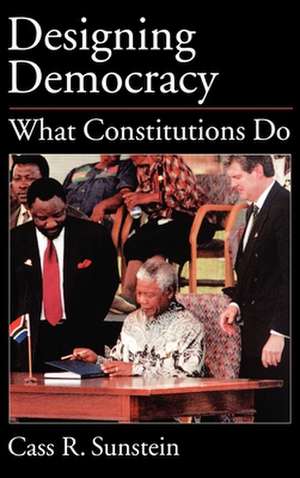
Designing Democracy
Autor Cass R. Sunsteinen Limba Engleză Hardback – 27 sep 2001
Preț: 595.50 lei
Preț vechi: 735.19 lei
-19%
Puncte Express: 893
Carte tipărită la comandă
Livrare economică 07-21 decembrie
Livrare prin curier în România Termenul estimat este afișat lângă disponibilitate.
Transport gratuit pentru acest produs Plată online sau ramburs, în funcție de opțiunile comenzii.
Retur gratuit în 14 zile Comandă securizată și suport în română.
Specificații
ISBN-13: 9780195145427
ISBN-10: 0195145429
Pagini: 292
Dimensiuni: 157 x 235 x 22 mm
Greutate: 0.63 kg
Editura: Oxford University Press
ISBN-10: 0195145429
Pagini: 292
Dimensiuni: 157 x 235 x 22 mm
Greutate: 0.63 kg
Editura: Oxford University Press
V-ar putea interesa
-
 Animal Rights: Current Debates and New DirectionsCass R. Sunstein-6%Preț: 210.13 lei224.66 lei
 -
 -20%Preț: 286.21 lei356.94 lei
 -
 -18%Preț: 378.04 lei462.03 lei
 -
 -27%Preț: 358.36 lei491.27 lei
 -
 Political Institutions: Democracy and Social ChoiceJosep H. Colomer-27%Preț: 425.34 lei585.18 lei
 -
 Democratic Accountability in Latin AmericaScott Mainwaring-32%Preț: 733.53 lei1072.09 lei
 -
 -28%Preț: 416.28 lei574.44 lei
 -
 Democracy in Europe: The EU and National PolitiesVivien A. Schmidt-20%Preț: 380.19 lei474.19 lei
 -
 -10%Preț: 371.63 lei412.94 lei
 -
 Going to Extremes: How Like Minds Unite and DivideCass Sunstein-19%Preț: 92.32 lei113.82 lei
 -
 Models of DemocracyDavid HeldPreț: 312.48 lei
 -
 The Art of FreedomJuliane RebentischPreț: 170.04 lei
 -
 On RumoursCass R. SunsteinPreț: 140.36 lei
 -
 DemocracyDavid BeethamPreț: 79.25 lei
Descriere
"In modern nations, political disagreement is the source of both the gravest danger and the greatest security," writes Cass Sunstein. All democracies face intense political conflict. But is this conflict necessarily something to fear? In this provocative book, one of our leading political and legal theorists reveals how a nation's divisions of conviction and belief can be used to safeguard democracy. Confronting one explosive political issue after another, from presidential impeachment to the limits of religious liberty, from discrimination against women and gays to the role of the judiciary, Sunstein constructs a powerful new perspective from which to show how democracies negotiate their most divisive real-world problems. He focuses on a series of concrete concerns that go to the heart of the relationship between the idea of democracy and the idea of constitutionalism. Illustrating his discussion with examples from constitutional debates and court-cases in South Africa, Eastern Europe, Israel, America, and elsewhere, Sunstein takes readers through a number of highly charged questions: When should government be permitted to control discriminatory behavior by or within religious organizations? Does it make sense to govern on the basis of popular referenda? Can the right to have an abortion be defended? Can we defend Internet regulation? Should the law step in if children are beingschooled in discriminatory preferences and beliefs? Should a constitution protect rights to food, shelter, and health care? Disputes over questions such as these can be fierce enough to pose a grave threat. But in a paradox whose elaboration forms the core of Sunstein's book, it is a nation's apparently threatening diversity of opinion that can ensure its integrity. Extending his important recent work on the way deliberation within like-minded groups can produce extremism, Sunstein breaks new ground in identifying the mechanisms behind political conflict in democratic nations. At the same time, he develops a profound understanding of a constitutional democracy's system of checks and balances. Sunstein shows how a good constitution, fostering a "republic of reasons," enables people of opposing ethical and religious commitments to reach agreement where agreement is necessary, while making it unnecessary to reach agreement when agreement is impossible. A marvel of lucid, subtle reasoning, DESIGNING DEMOCRACY makes invaluable reading for anyone concerned with the promises and pitfalls of the democratic experiment.
Recenzii
"Sunstein takes the reader on a nuanced but spirited journey across a broad terrain of constitutional issues, from race discrimination to religious rights and presidential impeachment. Designing Democracy is a welcome change from the many books on constitutional law that sink under the weight of hermetic debates about interpretive methods. ...this approach brings a fresh perspective to many of the well-worn but still vital issues of American constitutional debate." --New York Times Book Review
Notă biografică
Cass R. Sunstein is the nations most-cited legal scholar who, for the past fifteen years, has been at the forefront of behavioral economics. From 2009 to 2012, he served as the administrator of the White House Office of Information and Regulatory Affairs. Since that time, he has served in the USgovernment in multiple capacities and worked with the United Nations and the World Health Organization, where he chaired the Technical Advisory Group on Behavioral Insights and Sciences for Health during the COVID-19 pandemic. He is theRobert Walmsley University Professorat Harvard Law School. His bookNudge, coauthored with Richard Thaler, was a national bestseller. In 2018, he was the recipient of the Holberg Prize from the government of Norway, sometimes described as equivalent of the Nobel Prize for law and the humanities. He lives in Boston and Washington, DC,with his wife, children, and labrador retrievers.