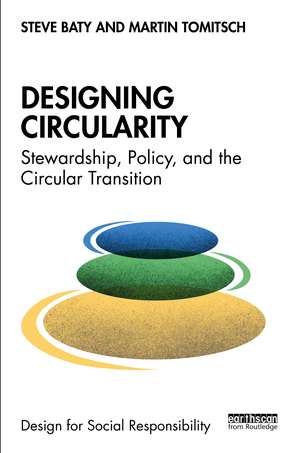
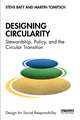
Designing Circularity: Stewardship, Policy, and the Circular Transition: Design for Social Responsibility
Autor Steve Baty, Martin Tomitschen Limba Engleză Hardback – 22 feb 2027
At the centre of the book is a triple-layered systemic design framework for coordinating circular initiatives across socio-technical and policy systems, organisational business and service models, and products and assets. Drawing on research, practitioner insights, and real-world examples, the book shows how governments, businesses, not-for-profit organisations, and designers can work across these layers to reshape the conditions that influence production, consumption, and resource use.
Through the lens of material intensity, Designing Circularity challenges readers to consider not only how products are made, but how systems are organised to meet human needs. It examines how effectively economies and sectors meet those needs in relation to the materials and energy they use, and how shared forms of provision can reduce dependence on materially intensive patterns of individual consumption. Written for researchers, practitioners, designers, industry leaders, and policymakers, the book offers a practical pathway for applying systems stewardship to create collective abundance within ecological limits.
The Introduction and Chapters 1 and 3 of this book are freely available as a downloadable Open Access PDF at http://www.taylorfrancis.com under a Creative Commons Attribution-Non Commercial-No Derivatives (CC BY-NC-ND) 4.0 International license.
Din seria Design for Social Responsibility
-
 Preț: 381.56 lei
 -
 Preț: 354.90 lei
 -
 Preț: 351.06 lei
 -
 Preț: 333.18 lei
 -
 Preț: 391.90 lei
 -
 Preț: 426.45 lei
 -
 Preț: 344.54 lei
 -
 Preț: 409.59 lei
 -
 Preț: 331.24 lei
 -
 Preț: 329.84 lei
 -
 Preț: 341.80 lei
 - 20%
 Preț: 327.73 lei
 - 10%
 Preț: 346.64 lei
 - 25%
 Preț: 1092.92 lei
 - 26%
 Preț: 392.34 lei
 - 25%
 Preț: 1099.20 lei
 - 21%
 Preț: 419.16 lei
 - nou
 Preț: 291.38 lei
Preț: 1127.84 lei
Preț vechi: 1484.64 lei
-24% Precomandă
Puncte Express: 1692
Carte nepublicată încă
Livrare prin curier în România Precomanda se expediază când titlul devine disponibil.
Transport gratuit pentru acest produs Plată online sau ramburs, în funcție de opțiunile comenzii.
Retur gratuit în 14 zile Comandă securizată și suport în română.
Doresc să fiu notificat când acest titlu va fi disponibil:
Se trimite...
Specificații
ISBN-13: 9781041306627
ISBN-10: 1041306628
Pagini: 212
Ilustrații: 78
Dimensiuni: 156 x 234 mm
Ediția:1
Editura: Taylor & Francis
Colecția Routledge
Seria Design for Social Responsibility
Locul publicării:Oxford, United Kingdom
ISBN-10: 1041306628
Pagini: 212
Ilustrații: 78
Dimensiuni: 156 x 234 mm
Ediția:1
Editura: Taylor & Francis
Colecția Routledge
Seria Design for Social Responsibility
Locul publicării:Oxford, United Kingdom
Public țintă
Postgraduate, Professional Practice & Development, and Undergraduate AdvancedNotă biografică
Steve Baty is founder of Meld Collective and UX Australia, Director at the Product Stewardship Centre of Excellence, was inaugural CEO of the Australian Design Council, and co-founder of Meld Studios, winners of the 2022 Good Design Team of the Year. His work focuses on the application of strategic and systems design to complex organisational, service, and infrastructure challenges. He has led design research and strategy initiatives across government, transport, and industry sectors, including the customer experience design of Sydney's metro rail network. He is co-author of Designing Tomorrow.
Martin Tomitsch is Professor and Head of the Transdisciplinary School at the University of Technology Sydney. His research investigates how new technologies will shape people’s lives in cities and explores methods and processes for responsible innovation. He has published over 150 academic articles and seven books, including Making Cities Smarter, Design Think Make Break Repeat, and Designing Tomorrow. He is a founding member of several international design and research networks, including the Media Architecture Institute and the Life-centered Design Collective.
Martin Tomitsch is Professor and Head of the Transdisciplinary School at the University of Technology Sydney. His research investigates how new technologies will shape people’s lives in cities and explores methods and processes for responsible innovation. He has published over 150 academic articles and seven books, including Making Cities Smarter, Design Think Make Break Repeat, and Designing Tomorrow. He is a founding member of several international design and research networks, including the Media Architecture Institute and the Life-centered Design Collective.
Cuprins
Introduction: Too much stuff – the symptoms of material consumption in developed nations PART I: Framing the problem 1. Lessons in history – consumerism, Friedman Doctrine, neoliberalism, and democratic socialism 2. Fundamental human needs – how resource-intensive systems shape everyday life 3. The design-policy nexus – how design practice influences material intensity at different levels of decision-making and the role of circularity PART II: Socio-technical and policy systems 4. The tragedy of the commons – designing for collective abundance through systems stewardship 5. Systems approaches to addressing human needs – designing inherently low-intensity solutions at a systemic level 6. Levers of government – changing systems boundaries, costing externalities, and shaping markets PART III: Business and service models 7. The purpose of business – an end to the Friedman doctrine 8. Designing organisational impact – embedding societal and planetary impact into organisational strategy 9. Rethinking business models – decoupling value generation from resource use PART IV: Product-level circularity and stewardship 10. Durability and repairability – designing things that last and can be repaired 11. Disassembly – designing products, buildings, and components that can be taken apart 12. Material selection – designing materials for longevity, recovery, and circulation PART V: Defining success 13. Metrics and ecological outcomes – measuring circularity across products, organisations, and systems 14. Visions of a circular future – an optimistic outlook
Descriere
This book shows how design decisions can reduce material intensity and support a transition to a regenerative future. The authors explore a three-layered systemic design framework through practitioner insights and real-world examples, illustrating ways to reshape the conditions that influence production, consumption, and resource use.