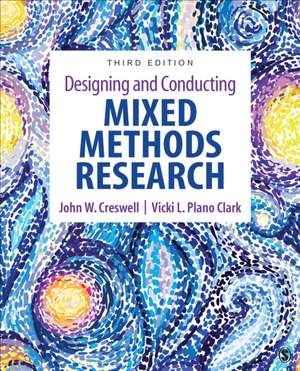
Designing and Conducting Mixed Methods Research
Autor John W. Creswell, Vicki L. Plano Clarken Limba Engleză Paperback – 22 sep 2017
Remarcăm în această a treia ediție a lucrării Designing and Conducting Mixed Methods Research o rafinare necesară a metodologiei, autorii John W. Creswell și Vicki L. Plano Clark concentrându-se acum pe trei designuri de bază care servesc drept fundație pentru orice demers de cercetare mixtă. Capitolul 4 reprezintă o noutate majoră, extinzând aplicabilitatea acestor modele fundamentale către zone complexe precum studiile de caz, designurile de justiție socială participativă și evaluările de program. Structura cărții urmărește riguros parcursul unui cercetător, de la fundamentele filozofice și istorice din capitolul 2, până la tehnici sofisticate de integrare a datelor. Suntem de părere că progresia logică a conținutului, susținută de exemple actualizate din științele sociale și medicale, facilitează o înțelegere profundă a modului în care teoria se traduce în practică. Notăm cu interes efortul autorilor de a simplifica decizia metodologică prin reducerea tipologiilor la trei modele esențiale, oferind în același timp strategii pentru a face studiile mai „state-of-the-art”. Această abordare este comparabilă cu cea din Foundations of Mixed Methods Research de Abbas Tashakkori în ceea ce privește rigurozitatea academică, dar lucrarea de față se distinge prin accentul pus pe pașii procedurali și pe noul tabel sinoptic final care unifică întregul proces. În contextul operei lui John W. Creswell, acest volum completează perfect textul său clasic Research Design - International Student Edition. Dacă lucrarea menționată anterior oferă o privire de ansamblu asupra celor trei abordări de cercetare (calitativă, cantitativă și mixtă), Designing and Conducting Mixed Methods Research aprofundează specificul metodologiei mixte, fiind instrumentul ideal pentru cei care au depășit etapa de inițiere și au nevoie de un ghid de implementare detaliat.
Preț: 544.68 lei
Preț vechi: 672.44 lei
-19%
Carte disponibilă
Livrare economică 15-29 mai
Specificații
ISBN-10: 1483344371
Pagini: 522
Dimensiuni: 191 x 235 x 29 mm
Greutate: 0.96 kg
Ediția:3. Auflage
Editura: Sage Publications, Inc
Locul publicării:Thousand Oaks, United States
V-ar putea interesa
-
 The Russian Language TodayLarissa Ryazanova-Clarke-15%Preț: 465.96 lei548.18 lei
 -
 Reaching MillennialsDavid StarkPreț: 104.33 lei
 -
 Managing the MillennialsChip EspinozaPreț: 153.18 lei
 -
 Baby Boomers and Generational ConflictJennie BristowPreț: 374.30 lei
 -
 Qualitative Research DesignJoseph A. Maxwell-15%Preț: 468.19 lei550.80 lei
 -
 InterViewsSteinar Kvale-26%Preț: 644.63 lei871.13 lei
 -
 Writing the Literature Review, First Edition: A Practical GuideSara Efrat EfronPreț: 310.46 lei
 -
 iGenJean M. Twenge-23%Preț: 58.93 lei76.22 lei
 -
 -26%Preț: 646.65 lei873.85 lei
 -
 Research Design (International Student Edition)John W. Creswell-8%Preț: 622.67 lei676.81 lei
 -
 Leading Intelligence AnalysisBruce E. Pease-22%Preț: 489.29 lei627.29 lei
 -
 -12%Preț: 30.41 lei34.65 lei
De ce să citești această carte
Această ediție este esențială pentru cercetătorii și studenții la doctorat care doresc să combine datele calitative și cantitative într-un mod riguros. Cititorul câștigă acces la o structură clară, bazată pe trei modele fundamentale, și la exemple practice din diverse discipline. Este recomandată deoarece transformă o metodologie complexă într-un proces pas cu pas, facilitând publicarea unor studii academice de înalt nivel.
Despre autor
John W. Creswell este profesor de psihologie educațională la Teachers College, University of Nebraska-Lincoln, unde coordonează programe de specializare în metode cantitative și calitative. Expertiza sa vastă în designul cercetării și leadership academic este recunoscută la nivel internațional prin numeroasele sale publicații de referință. Alături de Vicki L. Plano Clark, acesta a pionierat standardizarea cercetării mixte, integrând perspectivele filozofice cu aplicațiile practice în științele sociale și comportamentale. Lucrările sale sunt fundamentale pentru formarea academică a cercetătorilor din întreaga lume.
Descriere scurtă
Recenzii
“Creswell and Plano Clark have captured recent changes within mixed methods research, and these are reflected in this dynamic, salient book!”
“An excellent guide for the design and conduct of mixed methods research!”
“Readers of the book will understand the expanding breadth of multiple methods, the value of complex methods for sophisticated analysis of problems, and how to use and evaluate mixed methods in research.”
“This updated edition provides thoughtful consideration to how the field of mixed methods research has changed, including how the authors' own definitions and typologies have refined. It also provides a discussion of a diverse array of empirical studies from prominent and emerging mixed methods scholars, highlighting the strength and potential of this field for social and behavioral sciences.”
“Creswell and Plano Clark do excellent work in showing the evolution of mixed-methods research. One of the highlights of this edition is the addition of scaffolds that guide writing sections of a mixed-methods study.”
“Narrowing down the research methods to three primary types and then providing application methods and basic step-by-step instructions, along with great resources in the appendix and outside contributions, makes this a must have book in any academic study leading to research development.”
Cuprins
List of Tables
Preface
Purpose of the Book
Audience for the Book
Book Features
New Features Added to the Third Edition
Acknowledgments
About the Authors
Chapter 1 • The Nature of Mixed Methods Research
Defining Mixed Methods Research
Examples of Mixed Methods Studies
What Research Problems Require Mixed Methods?
What Are the Advantages of Using Mixed Methods?
What Are the Challenges in Using Mixed Methods?
Summary
Activities
Additional Resources to Examine
Chapter 2 • The Foundations of Mixed Methods Research
Historical Foundations
Philosophical Foundations
Theoretical Foundations
Summary
Activities
Additional Resources to Examine
Chapter 3 • Core Mixed Methods Designs
Key Concepts That Inform Mixed Methods Designs
The Three Core Mixed Methods Designs
Additional Considerations in Choosing a Core Design
Describing a Design in a Written Report
Summary
Activities
Additional Resources to Examine
Chapter 4 • Complex Applications of Core Mixed Methods Designs
Intersecting Core Mixed Methods Designs With Other Research Approaches or Frameworks
Four Prominent Types of Complex Mixed Methods Designs
Drawing Diagrams of Complex Applications
Summary
Activities
Additional Resources to Examine
Chapter 5 • Introducing a Mixed Methods Study
Writing a Mixed Methods Title
Stating the Research Problem in the Introduction
Developing the Purpose Statement
Writing Research Questions and Hypotheses
Summary
Activities
Additional Resources to Examine
Chapter 6 • Collecting Data in Mixed Methods Research
Procedures in Collecting Qualitative and Quantitative Data
General Considerations for Data Collection in Mixed Methods
Data Collection Within the Mixed Methods Designs
Summary
Activities
Additional Resources to Examine
Chapter 7 • Analyzing and Interpreting Data in Mixed Methods Research
Procedures in Quantitative and Qualitative Data Analysis and Interpretation
Mixed Methods Data Analysis and Interpretation
Integrated Data Analysis and Interpretation Within the Mixed Methods Designs
Validity and Mixed Methods Designs
Software Applications and Mixed Methods Data Analysis
Summary
Activities
Additional Resources to Examine
Chapter 8 • Writing and Evaluating Mixed Methods Research
General Guidelines for Writing
Relate the Mixed Methods Structure to the Type of Writing
Evaluating a Mixed Methods Study
Summary
Activities
Additional Resources to Examine
Chapter 9 • Advances in Mixed Methods Research
Advances in Mining Data
Advances in the Insight Gained Through the Value of Mixed Methods Research
Advances in Mixed Methods Designs
Advances in Representations of Design Procedures
Advances in Integration
Advances in Creating Mixed Methods Questions and Study Aims
Advances in Representing Integration Through Joint Displays
Advances in Mixed Methods Validity
Advances in Understanding Skills Required for Mixed Methods
Advances in Publishing Mixed Methods Manuscripts
Summary
Activities
Additional Resources to Examine
Appendix A: Unwritten Rules of Talking to Doctors About Depression: Integrating Qualitative and Quantitative Methods
Appendix B: Students’ Persistence in a Distributed Doctoral Program in Educational Leadership in Higher Education: A Mixed Methods Study
Appendix C: The Development of Client Violence Questionnaire (CVQ)
Appendix D: Evaluation of the Effectiveness of Robotic Gait Training and Gait-Focused Physical Therapy Programs for Children and Youth With Cerebral Palsy: A Mixed Methods RCT
Appendix E: Reconciling Data From Different Sources: Practical Realities of Using Mixed Methods to Identify Effective High School Practices
Appendix F: Understanding Transitions in Care From Hospital to Homeless Shelter: A Mixed-Methods, Community-Based Participatory Approach
Appendix G: Mixed Methods in Intervention Research: Theory to Adaptation
Glossary
References
Index