
Design Thinking Research: Understanding Innovation
Editat de Larry Leifer, Hasso Plattner, Christoph Meinelen Limba Engleză Hardback – 3 sep 2013
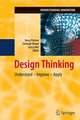
The authors offer readers a closer look at Design Thinking with its processes of innovations and methods. The contents of the articles range from how to design ideas, methods, and technologies via creativity experiments and wicked problem solutions, to creative collaboration in the real world and the connectivity of designers and engineers. But the topics go beyond this in their detailed exploration of design thinking and its use in IT systems engineering fields and even from a management perspective.
The authors show how these methods and strategies work in companies, introduce new technologies and their functions and demonstrate how Design Thinking can influence as diverse a topic area as marriage. Furthermore, we see how special design thinking use functions in solving wicked problems in complex fields.
Thinking and creating innovations are basically and inherently human – so is Design Thinking. Due to this, Design Thinking is not only a factual matter or a result of special courses nor of being gifted or trained: it’s a way of dealing with our environment and improving techniques, technologies and life.



Preț: 1152.40 lei
Preț vechi: 1405.37 lei
-18%
Puncte Express: 1729
Carte tipărită la comandă
Livrare economică 04-18 decembrie
Livrare prin curier în România Termenul estimat este afișat lângă disponibilitate.
Transport gratuit pentru acest produs Plată online sau ramburs, în funcție de opțiunile comenzii.
Retur gratuit în 14 zile Comandă securizată și suport în română.
Specificații
ISBN-13: 9783319013022
ISBN-10: 3319013025
Pagini: 260
Ilustrații: VIII, 252 p.
Dimensiuni: 160 x 241 x 19 mm
Greutate: 0.51 kg
Ediția:2014
Editura: Springer
Colecția Understanding Innovation
Seria Understanding Innovation
Locul publicării:Cham, Switzerland
ISBN-10: 3319013025
Pagini: 260
Ilustrații: VIII, 252 p.
Dimensiuni: 160 x 241 x 19 mm
Greutate: 0.51 kg
Ediția:2014
Editura: Springer
Colecția Understanding Innovation
Seria Understanding Innovation
Locul publicării:Cham, Switzerland
V-ar putea interesa
-
 Broadcasting in the 21st CenturyRichard RudinPreț: 256.34 lei
 -
 Creating Preschool TelevisionJ. SteemersPreț: 384.57 lei
 -
 Basic Radio JournalismPaul ChantlerPreț: 394.29 lei
 -
 Branding TV: Principles and PracticesWalter McDowell-15%Preț: 468.70 lei551.41 lei
 -
 Preț: 394.17 lei
 -
 -20%Preț: 264.37 lei330.46 lei
 -
 International Communication: A ReaderDaya Kishan Thussu-15%Preț: 475.08 lei558.92 lei
 -
 Public Sector Records Management: A Practical GuideKelvin Smith-18%Preț: 1128.65 lei1376.40 lei
 -
 The Internet and the Mass MediaLucy Küng-18%Preț: 692.76 lei844.83 lei
 -
 Arab Television TodayNaomi Sakr-26%Preț: 164.17 lei222.87 lei
 -
 Web Services: Concepts, Architectures and ApplicationsGustavo Alonso-20%Preț: 493.00 lei616.24 lei
Public țintă
ResearchCuprins
All Design Activity is Ultimately Social in Nature.- Design Thinkers Must Preserve Ambiguity.- All Design is Re-design.- Make Ideas Tangible.
Recenzii
From the book reviews:
“The book is divided into four parts, each comprising three to five papers related to design thinking. Interestingly, the titles of all parts are full sentences, informing the reader of specific design thinking activities. … I would recommend it to engineers, managers, and designers for afternoon reading, as well as to scientists who want to grasp the virtues of engineering processes, which actual scientific discoveries may lead to.” (Janusz Zalewski, Computing Reviews, July, 2014)
“The book is divided into four parts, each comprising three to five papers related to design thinking. Interestingly, the titles of all parts are full sentences, informing the reader of specific design thinking activities. … I would recommend it to engineers, managers, and designers for afternoon reading, as well as to scientists who want to grasp the virtues of engineering processes, which actual scientific discoveries may lead to.” (Janusz Zalewski, Computing Reviews, July, 2014)
Textul de pe ultima copertă
This book summarizes the results of Design Thinking Research carried out at Stanford University in Palo Alto, California, USA, and Hasso Plattner Institute in Potsdam, Germany.
The authors offer readers a closer look at Design Thinking with its processes of innovations and methods. The contents of the articles range from how to design ideas, methods, and technologies via creativity experiments and wicked problem solutions, to creative collaboration in the real world and the connectivity of designers and engineers. But the topics go beyond this in their detailed exploration of design thinking and its use in IT systems engineering fields and even from a management perspective.
The authors show how these methods and strategies work in companies, introduce new technologies and their functions and demonstrate how Design Thinking can influence as diverse a topic area as marriage. Furthermore, we see how special design thinking use functions in solving wicked problems in complex fields.
Thinking and creating innovations are basically and inherently human – so is Design Thinking. Due to this, Design Thinking is not only a factual matter or a result of special courses nor of being gifted or trained: it’s a way of dealing with our environment and improving techniques, technologies and life.
The authors offer readers a closer look at Design Thinking with its processes of innovations and methods. The contents of the articles range from how to design ideas, methods, and technologies via creativity experiments and wicked problem solutions, to creative collaboration in the real world and the connectivity of designers and engineers. But the topics go beyond this in their detailed exploration of design thinking and its use in IT systems engineering fields and even from a management perspective.
The authors show how these methods and strategies work in companies, introduce new technologies and their functions and demonstrate how Design Thinking can influence as diverse a topic area as marriage. Furthermore, we see how special design thinking use functions in solving wicked problems in complex fields.
Thinking and creating innovations are basically and inherently human – so is Design Thinking. Due to this, Design Thinking is not only a factual matter or a result of special courses nor of being gifted or trained: it’s a way of dealing with our environment and improving techniques, technologies and life.
Caracteristici
Based on scientific evidence from the HPI Stanford Design Thinking Research Program Covers more than just best practice in design thinking and innovation Points out how design thinking can be used to innovate IT development Includes supplementary material: sn.pub/extras