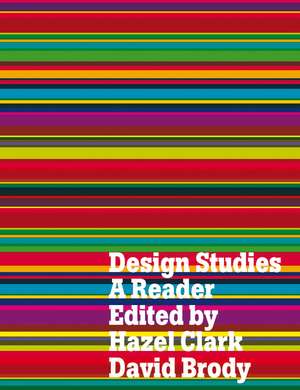
Design Studies: A Reader
Editat de Dr Hazel Clark, David Brodyen Limba Engleză Hardback – mai 2009
Reflecting the diverse range of perspectives on design, the reader brings together over seventy key texts. The essays are presented in themed sections covering history, methods, theory, visuality, identity, consumption, labor, industrialization, new technology, sustainability, and globalization. Each section is separately introduced and each concludes with a guide to further reading. In addition, a final section of specially commissioned essays analyzes ten seminal designs of the twentieth century, from Helvetica to the cell phone.
Bringing together the best classic and contemporary writing, Design Studies: A Reader will be invaluable to all students of Design as well as to students of Architecture, Art, Material Culture, and Sociology.
Authors include: Theodor Adorno, Arjun Appadurai, Reyner Banham, Jean Baudrillard, Zygmunt Bauman, Pierre Bourdieu, Cheryl Buckley, Michel de Certeau, Margaret Crawford, Arthur C Danto, Adrian Forty, Michel Foucault, Buckminster Fuller, Paul du Gay, Erving Goffman, Donna Haraway, Dick Hebdige, John Chris Jones, Guy Julier, Naomi Klein, Ezio Manzini, Victor Margolin, Karl Marx, Daniel Miller, Victor Papanek, Nikolaus Pevsner, John Styles, and John Walker.
Preț: 849.92 lei
Preț vechi: 988.28 lei
-14%
Puncte Express: 1275
Carte tipărită la comandă
Livrare economică 28 noiembrie-12 decembrie
Livrare prin curier în România Termenul estimat este afișat lângă disponibilitate.
Transport gratuit pentru acest produs Plată online sau ramburs, în funcție de opțiunile comenzii.
Retur gratuit în 14 zile Comandă securizată și suport în română.
Specificații
ISBN-13: 9781847882370
ISBN-10: 1847882374
Pagini: 608
Ilustrații: 50 b&w illustrations
Dimensiuni: 189 x 244 x 46 mm
Greutate: 1.29 kg
Ediția:English.
Editura: Bloomsbury Publishing
Colecția Berg Publishers
Locul publicării:London, United Kingdom
ISBN-10: 1847882374
Pagini: 608
Ilustrații: 50 b&w illustrations
Dimensiuni: 189 x 244 x 46 mm
Greutate: 1.29 kg
Ediția:English.
Editura: Bloomsbury Publishing
Colecția Berg Publishers
Locul publicării:London, United Kingdom
V-ar putea interesa
-
 Design: A Very Short IntroductionJohn Heskett-19%Preț: 57.52 lei71.35 lei
 -
 -13%Preț: 134.60 lei154.31 lei
 -
 -8%Preț: 473.43 lei514.60 lei
 -
 Design and Ethics: Reflections on PracticeEmma FeltonPreț: 387.51 lei
 -
 Design: The Whole StoryElizabeth Wilhide-18%Preț: 188.13 lei230.28 lei
 -
 Notes on the Synthesis of FormChristopher AlexanderPreț: 235.55 lei
 -
 Preț: 364.67 lei
 -
 The Power of Design and Convergence of AITai Lee Siang-20%Preț: 419.95 lei524.93 lei
 -
 Preț: 418.59 lei
 -
 Ethics in Design and Communication: Critical PerspectivesLaura Scherling-19%Preț: 191.20 lei235.03 lei
 -
 The Design History ReaderGrace Lees-Maffei-20%Preț: 251.15 lei315.65 lei
 -
 -21%Preț: 267.18 lei336.77 lei
 -
 On Design: Theory, History, Education and PracticeTevfik Balcioglu-25%Preț: 175.76 lei234.40 lei
 -
 -15%Preț: 220.83 lei258.82 lei
 -
 -21%Preț: 306.34 lei388.73 lei
 -
 A Studious Use: Designing From The UndercommonsGiovanni Marmont-18%Preț: 135.71 lei166.13 lei
 -
 What It Means to Be a Designer TodayJarrett Fuller-15%Preț: 192.07 lei225.34 lei
 -
 Preț: 274.34 lei
 -
 Design. Think. Make. Break. Repeat.: Revised editionMartin Tomitsch-22%Preț: 178.54 lei227.56 lei
 -
 Design History ReaderKristen Coogan-22%Preț: 177.96 lei228.25 lei
Cuprins
General Introduction, Hazel Clark and David Brody
SECTION I: HISTORY OF DESIGN
Section Introduction
I.1: DESIGN HISTORIES
Part Introduction
1. Nikolaus Pevsner, Pioneers of Modern Design
2. Adrian Forty, Design, Designers and the Literature of Design
3. Matthew Turner, Early Modern Design in Hong Kong
4. Lucila Fernández Uriate, Modernity and Postmodernity from Cuba
I.2: DESIGN HISTORY AS A DISCIPLINE
Part Introduction
5. Victor Margolin, Design History and Design Studies
6. John Walker, Defining the Object of Study
7. Judy Attfield, FORM/female FOLLOWS FUNCTION/male
8. Denise Whitehouse, The State of Design History as a Discipline
Annotated Guide to Further Reading
SECTION II: DESIGN THINKING
Section Introduction
II.1: DESIGN PHILOSOPHIES AND THEORIES
Part Introduction
9. Buckminster Fuller, Speculative Prehistory of Humanity
10. John Chris Jones, What is Designing?
11. Louis Bucciarelli, Designing Engineers
12. Henry Petroski, Success and Failure in Design
13. Richard Buchanan, Wicked Problems in Design Thinking
II.2: DESIGN RESEARCH
Part Introduction
14. Herbert Simon, Understanding the Natural and Artificial Worlds
15. Donald Schön, Designing; Rules, Types and Worlds
16. Susan Squires, Discovery Research
II: 3 DESIGN COMMUNICATIONS
Part Introduction
17. Eric van Schaak, The Division of Pictorial Publicity in World War I
18. D.J Huppatz, Globalizing Corporate Identity in Hong Kong
19. Shirley Teresa Wajda, Kmartha
Annotated Guide to Further Reading
SECTION III: THEORIZING DESIGN AND
VISUALITY
Section Introduction
III.1: AESTHETICS
Part Introduction
20. Arthur C. Danto, Aesthetics and the Work of Art
21. Jean Baudrillard, Design and Environment
22. Reyner Banham, Taking it with You
III.2: ETHICS
Part Introduction
23. Zygmunt Bauman, In the Beginning was Design
24. Susan Szenasy, Ethical Design Education
25. AIGA/Rick Poyner, First Things First 2000
26. Clive Dilnot, Ethics in Design: 10 Questions
III.3: POLITICS
Part Introduction
27. Karl Marx, The Fetishism of Commodities and the Secret Thereof
28. Pierre Bourdieu, The Aesthetic Sense and the Sense of Distinction
29. Naomi Klein, No Logo
30. Dick Hebdige, Subculture and Style
31. John Stones, Incendiary Devices
32. Gui Bonsiepe, Design and Democracy
III.4 MATERIAL CULTURE AND SOCIAL INTERACTIONS
Part Introduction
33. Jules Prown, Mind in Matter
34. Daniel Miller, The Artefact as Manufactured Object
35. Michel Foucault, Panopticism
36. Michel de Certeau, Walking in the City
37. Erving Goffman, The Presentation of Self in Everyday Life
Annotated Guide to Further Reading
SECTION IV: IDENTITY AND CONSUMPTION
Section Introduction
IV.1: VIRTUAL IDENTITY AND DESIGN
Part Introduction
38. Donna Haraway, A Cyborg Manifesto
39. Katie Salen and Eric Zimmerman, Introducing Cybernetic Systems
40. Justin Clark, Get a Life
41. Gavin O'Malley, American Apparel
IV.2: GENDER AND DESIGN
Part Introduction
42. Cheryl Buckley, Made in Patriarchy
43. Barbara Ehrenreich and Annette Fuentes, Life on the Global Assembly
Line
44. Hazel ClarkThe Difference of Female Design
IV.3: CONSUMPTION
Part Introduction
45. Mary Douglas and Baron Isherwood,Technology and Consumption
46. Daniel Harris, Quaintness
47. Sarah Lichtman, Do-It-Yourself Security
48. W.F. Haug, Critique of Commodity Aesthetics
49. Heike Jenß, Fashioning Uniqueness: Mass-Customization and
Commodization of Identity
Annotated Guide to Further Reading
SECTION V: LABOR, INDUSTRIALIZATION AND
NEW TECHNOLOGY
Section Introduction
V.1: LABOR AND THE PRODUCTION OF DESIGN
Part Introduction
50. John Styles, Manufacturing Consumption and Design
51. Paul du Gay, et al, The Sony Walkman
52. Stuart Walker, Integration of Scale
V.2: INDUSTRIALIZATION AND POST INDUSTRIALIZATION
Part Introduction
53. David Brett, Drawing and the Ideology of Industrialization
54. Margaret Crawford, The 'New' Company Town
55. Frederick Winslow Taylor, The Principles of Scientific Management
56. Abraham Moles, Design and Immateriality
V.3: NEW DESIGN AND NEW TECHNOLOGIES
Part Introduction
57. Bradley Quinn, Hussein Chalayan, Fashion and Technology
58. Donald Norman, What's Wrong with the PC?
59. Vicente Rafael, The Cell Phone and the Crowd
60. Theodor Adorno, Do Not Knock
Annotated Guide to Further Reading
SECTION VI: DESIGN AND GLOBAL ISSUES
Section Introduction
VI.1: GLOBALIZATION
Part Introduction
61. Arjun Appadurai, Modernity at Large
62. Hugh Aldersey-Williams, Globalism, Nationalism, and Design
63. Guy Julier, Responses to Globalisation
VI.2: EQUALITY AND SOCIAL JUSTICE
Part Introduction
64. Kate Stohr, Self-Help and Sites-and Services Programs
65. John Hockenberry, The Re-Education of Michael Graves
66. Ezio Manzini, A Cosmopolitan Localism
67. Earl Tai, Design Justice
VI.3: SUSTAINABILITY
Part Introduction
68. William McDonough and Michael Braungart, A Question of Design
69. Victor Papanek, Designing for a Safe Future
70. Trish Lorenz, British Designers Accused of Creating Throw-Away
Culture
Annotated Guide to Further Reading
SECTION VII: DESIGN THINGS
Section Introduction
71.Wava Carpenter, The Eames Lounge: The Difference between a Design
Icon and Mere Furniture
72.Dipti Bhagat, The Tube Map (The London Underground Map)
73.Susan Yelavich, Swatch
74.Catherine Walsh, Architecture and Cultural Identity: The Case of the
Petronas Towers in Kuala Lumpur
75.R. Roger Remington, Helvetica: Love it or Leave it
76.Shirley Teresa Wajda, The Architect and the Teakettle
77.Greg Votolato, Bullets and Beyond (The Shinkanzen)
78.Alison Gill, Sneakers
79.Bess Williamson, The Bicycle: Considering Design in Use
80.Gerard Goggin, Cell Phone
Annotated Guide to Further Reading
Bibliography
SECTION I: HISTORY OF DESIGN
Section Introduction
I.1: DESIGN HISTORIES
Part Introduction
1. Nikolaus Pevsner, Pioneers of Modern Design
2. Adrian Forty, Design, Designers and the Literature of Design
3. Matthew Turner, Early Modern Design in Hong Kong
4. Lucila Fernández Uriate, Modernity and Postmodernity from Cuba
I.2: DESIGN HISTORY AS A DISCIPLINE
Part Introduction
5. Victor Margolin, Design History and Design Studies
6. John Walker, Defining the Object of Study
7. Judy Attfield, FORM/female FOLLOWS FUNCTION/male
8. Denise Whitehouse, The State of Design History as a Discipline
Annotated Guide to Further Reading
SECTION II: DESIGN THINKING
Section Introduction
II.1: DESIGN PHILOSOPHIES AND THEORIES
Part Introduction
9. Buckminster Fuller, Speculative Prehistory of Humanity
10. John Chris Jones, What is Designing?
11. Louis Bucciarelli, Designing Engineers
12. Henry Petroski, Success and Failure in Design
13. Richard Buchanan, Wicked Problems in Design Thinking
II.2: DESIGN RESEARCH
Part Introduction
14. Herbert Simon, Understanding the Natural and Artificial Worlds
15. Donald Schön, Designing; Rules, Types and Worlds
16. Susan Squires, Discovery Research
II: 3 DESIGN COMMUNICATIONS
Part Introduction
17. Eric van Schaak, The Division of Pictorial Publicity in World War I
18. D.J Huppatz, Globalizing Corporate Identity in Hong Kong
19. Shirley Teresa Wajda, Kmartha
Annotated Guide to Further Reading
SECTION III: THEORIZING DESIGN AND
VISUALITY
Section Introduction
III.1: AESTHETICS
Part Introduction
20. Arthur C. Danto, Aesthetics and the Work of Art
21. Jean Baudrillard, Design and Environment
22. Reyner Banham, Taking it with You
III.2: ETHICS
Part Introduction
23. Zygmunt Bauman, In the Beginning was Design
24. Susan Szenasy, Ethical Design Education
25. AIGA/Rick Poyner, First Things First 2000
26. Clive Dilnot, Ethics in Design: 10 Questions
III.3: POLITICS
Part Introduction
27. Karl Marx, The Fetishism of Commodities and the Secret Thereof
28. Pierre Bourdieu, The Aesthetic Sense and the Sense of Distinction
29. Naomi Klein, No Logo
30. Dick Hebdige, Subculture and Style
31. John Stones, Incendiary Devices
32. Gui Bonsiepe, Design and Democracy
III.4 MATERIAL CULTURE AND SOCIAL INTERACTIONS
Part Introduction
33. Jules Prown, Mind in Matter
34. Daniel Miller, The Artefact as Manufactured Object
35. Michel Foucault, Panopticism
36. Michel de Certeau, Walking in the City
37. Erving Goffman, The Presentation of Self in Everyday Life
Annotated Guide to Further Reading
SECTION IV: IDENTITY AND CONSUMPTION
Section Introduction
IV.1: VIRTUAL IDENTITY AND DESIGN
Part Introduction
38. Donna Haraway, A Cyborg Manifesto
39. Katie Salen and Eric Zimmerman, Introducing Cybernetic Systems
40. Justin Clark, Get a Life
41. Gavin O'Malley, American Apparel
IV.2: GENDER AND DESIGN
Part Introduction
42. Cheryl Buckley, Made in Patriarchy
43. Barbara Ehrenreich and Annette Fuentes, Life on the Global Assembly
Line
44. Hazel ClarkThe Difference of Female Design
IV.3: CONSUMPTION
Part Introduction
45. Mary Douglas and Baron Isherwood,Technology and Consumption
46. Daniel Harris, Quaintness
47. Sarah Lichtman, Do-It-Yourself Security
48. W.F. Haug, Critique of Commodity Aesthetics
49. Heike Jenß, Fashioning Uniqueness: Mass-Customization and
Commodization of Identity
Annotated Guide to Further Reading
SECTION V: LABOR, INDUSTRIALIZATION AND
NEW TECHNOLOGY
Section Introduction
V.1: LABOR AND THE PRODUCTION OF DESIGN
Part Introduction
50. John Styles, Manufacturing Consumption and Design
51. Paul du Gay, et al, The Sony Walkman
52. Stuart Walker, Integration of Scale
V.2: INDUSTRIALIZATION AND POST INDUSTRIALIZATION
Part Introduction
53. David Brett, Drawing and the Ideology of Industrialization
54. Margaret Crawford, The 'New' Company Town
55. Frederick Winslow Taylor, The Principles of Scientific Management
56. Abraham Moles, Design and Immateriality
V.3: NEW DESIGN AND NEW TECHNOLOGIES
Part Introduction
57. Bradley Quinn, Hussein Chalayan, Fashion and Technology
58. Donald Norman, What's Wrong with the PC?
59. Vicente Rafael, The Cell Phone and the Crowd
60. Theodor Adorno, Do Not Knock
Annotated Guide to Further Reading
SECTION VI: DESIGN AND GLOBAL ISSUES
Section Introduction
VI.1: GLOBALIZATION
Part Introduction
61. Arjun Appadurai, Modernity at Large
62. Hugh Aldersey-Williams, Globalism, Nationalism, and Design
63. Guy Julier, Responses to Globalisation
VI.2: EQUALITY AND SOCIAL JUSTICE
Part Introduction
64. Kate Stohr, Self-Help and Sites-and Services Programs
65. John Hockenberry, The Re-Education of Michael Graves
66. Ezio Manzini, A Cosmopolitan Localism
67. Earl Tai, Design Justice
VI.3: SUSTAINABILITY
Part Introduction
68. William McDonough and Michael Braungart, A Question of Design
69. Victor Papanek, Designing for a Safe Future
70. Trish Lorenz, British Designers Accused of Creating Throw-Away
Culture
Annotated Guide to Further Reading
SECTION VII: DESIGN THINGS
Section Introduction
71.Wava Carpenter, The Eames Lounge: The Difference between a Design
Icon and Mere Furniture
72.Dipti Bhagat, The Tube Map (The London Underground Map)
73.Susan Yelavich, Swatch
74.Catherine Walsh, Architecture and Cultural Identity: The Case of the
Petronas Towers in Kuala Lumpur
75.R. Roger Remington, Helvetica: Love it or Leave it
76.Shirley Teresa Wajda, The Architect and the Teakettle
77.Greg Votolato, Bullets and Beyond (The Shinkanzen)
78.Alison Gill, Sneakers
79.Bess Williamson, The Bicycle: Considering Design in Use
80.Gerard Goggin, Cell Phone
Annotated Guide to Further Reading
Bibliography
Recenzii
Incredibly inclusive, this is essential reading for students and teachers of Design Studies in any context. A superlative collection of authoritative contributions from many of the most influential writers on design, past and present.
The Reader combines new interpretations with influential texts that have shaped Design thinking over the last thirty years. It shows how Design is becoming more complex and how the emerging discipline of Design Studies has risen to this challenge. It will be an essential resource for students.
A critical snapshot of what's vital now in global comparative critical thinking on Design. The clearly structured and framed sets of key essays disclose the full reach and power of the myriad acts of designing that create our realities and, increasingly, narrow our future options.
The Reader will become a standard reference for the subject. It establishes the field for all those interested in Design and its impact on the contemporary world. The Reader offers an informed overview of ways of engaging with the central themes of Design such as ethics, globalization, identity and gender.
An extraordinarily valuable resource for students in all areas of Design. It opens up endless fields of inquiry and also affirms 'Design Studies' as the only theoretical framework which encompasses all the richness and multiplicity of Design both conceptually and globally.
A wonderful and richly engaging book that would be invaluable to any student both at undergraduate and postgraduate levels of study to draw upon as a one-stop companion and reliable point of reference.
A book that works for students or anyone else with the slightest interest in design.
As a design educator, I've been waiting for a smart compilation of design essays for my graduate 3D design students. Until now, I've used my own mix of 'greatest hits' essays to inform our reading seminars. This year I began using this compilation with my graduate students. I like the way the book is structured by contemporary topics. The content is smart, contemporary and concise - excerpting the most relevant reading from each essay. I'd recommend this book to any student with an interest in the intellectual-big-picture of design.
If you're looking to do a little self-education this fall, this just might be the book for you.
Provides a great deal of food for thought for beginning design students from numerous subdisciplines and is also a good refresher for more advanced scholars.
In totality [Design Studies is] more than just a teaching or study resource. As [it] advocate[s] that the production, consumption and mediation of designed objects and images affect everyone, [it] will be of interest to both informed and general readerships... [A great strength of Design Studies is] the effective demonstration that design analysis and history is not an elitist, purely academic pursuit, but essential to consideration of society and its cultural expressions in the very broadest sense.
The Reader combines new interpretations with influential texts that have shaped Design thinking over the last thirty years. It shows how Design is becoming more complex and how the emerging discipline of Design Studies has risen to this challenge. It will be an essential resource for students.
A critical snapshot of what's vital now in global comparative critical thinking on Design. The clearly structured and framed sets of key essays disclose the full reach and power of the myriad acts of designing that create our realities and, increasingly, narrow our future options.
The Reader will become a standard reference for the subject. It establishes the field for all those interested in Design and its impact on the contemporary world. The Reader offers an informed overview of ways of engaging with the central themes of Design such as ethics, globalization, identity and gender.
An extraordinarily valuable resource for students in all areas of Design. It opens up endless fields of inquiry and also affirms 'Design Studies' as the only theoretical framework which encompasses all the richness and multiplicity of Design both conceptually and globally.
A wonderful and richly engaging book that would be invaluable to any student both at undergraduate and postgraduate levels of study to draw upon as a one-stop companion and reliable point of reference.
A book that works for students or anyone else with the slightest interest in design.
As a design educator, I've been waiting for a smart compilation of design essays for my graduate 3D design students. Until now, I've used my own mix of 'greatest hits' essays to inform our reading seminars. This year I began using this compilation with my graduate students. I like the way the book is structured by contemporary topics. The content is smart, contemporary and concise - excerpting the most relevant reading from each essay. I'd recommend this book to any student with an interest in the intellectual-big-picture of design.
If you're looking to do a little self-education this fall, this just might be the book for you.
Provides a great deal of food for thought for beginning design students from numerous subdisciplines and is also a good refresher for more advanced scholars.
In totality [Design Studies is] more than just a teaching or study resource. As [it] advocate[s] that the production, consumption and mediation of designed objects and images affect everyone, [it] will be of interest to both informed and general readerships... [A great strength of Design Studies is] the effective demonstration that design analysis and history is not an elitist, purely academic pursuit, but essential to consideration of society and its cultural expressions in the very broadest sense.