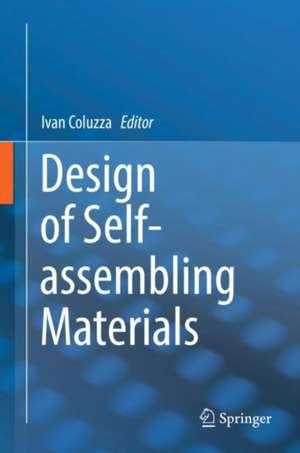
Design of Self-Assembling Materials
Editat de Ivan Coluzzaen Limba Engleză Hardback – 6 apr 2018
Notăm cu interes apariția volumului Design of Self-Assembling Materials, o lucrare ce rafinează metodologia de proiectare a sistemelor complexe prin prisma dinamicii moleculare și a modelării avansate. Găsim în această carte o analiză tehnică riguroasă a modului în care proteinele, fragmentele de ADN și nanoparticulele pot fi orchestrate în structuri artificiale funcționale. Abordarea nu este doar teoretică; accentul cade pe arhitectura sistemelor și pe design patterns aplicabile în nanotehnologie, oferind cercetătorilor instrumentele necesare pentru a manipula interacțiunile la nivel mezoscopic. Structura volumului reflectă o progresie logică, de la modelarea multiscalară a nanocompozitelor polimerice în regim de densitate semi-diluată, până la studiul experimental al sistemelor caracterizate prin interacțiuni direcționale. Un capitol esențial este dedicat modelării interacțiunilor dintre coloizii încărcați eterogen, o componentă critică pentru dezvoltarea materialelor care răspund la stimuli externi. Dacă Self-Assembling Systems de Li-Tang Yan v-a oferit cadrul teoretic și conceptele fundamentale de simulare, această carte oferă instrumentele practice și studiile de caz necesare pentru implementarea acestor modele în designul de materiale noi. Credem că valoarea adăugată a acestei lucrări rezidă în capacitatea de a unifica biologia cu fizica materialelor sub o umbrelă computațională comună. Tonul este unul strict academic și tehnic, evitând speculațiile și concentrându-se pe acuratețea modelelor de folding proteic și pe eficacitatea sistemelor de auto-asamblare artificială. Este o resursă indispensabilă pentru cei care navighează la intersecția dintre biotehnologie și ingineria materialelor, oferind o perspectivă clară asupra stadiului actual al tehnologiei în 2017.
Preț: 400.30 lei
Carte disponibilă
Livrare economică 06-20 noiembrie
Specificații
ISBN-10: 3319715763
Pagini: 144
Ilustrații: IX, 132 p. 26 illus., 25 illus. in color.
Dimensiuni: 160 x 241 x 14 mm
Greutate: 0.36 kg
Ediția:1st ed. 2017
Editura: Springer
Locul publicării:Cham, Switzerland
V-ar putea interesa
-
 Multiscale Modelling of PolymersDoros N. Theodorou-23%Preț: 580.56 lei749.36 lei
 -
 Notes on the Synthesis of FormChristopher AlexanderPreț: 235.55 lei
 -
 Things Fall TogetherSkylar TibbitsPreț: 154.05 lei
 -
 Soft Matter - Concepts, Phenomena, and ApplicationsVincenzo Vitelli-16%Preț: 619.99 lei738.08 lei
 -
 BionanodesignMaxim Ryadnov-14%Preț: 783.93 lei911.54 lei
 -
 Preț: 393.50 lei
 -
 Design-Tech: Building Science for ArchitectsJason Alread-8%Preț: 496.29 lei539.45 leiRecomandat
 -
 Preț: 359.34 lei
 -
 Self-Assembling SystemsLi-Tang Yan-23%Preț: 910.48 lei1182.44 lei
 -
 Computational Materials & Biological SciencesKholmirzo T Kholmurodov-27%Preț: 1271.76 lei1734.74 lei
 -
 -31%Preț: 95.45 lei137.35 lei
 -
 NanochemistryGeoffrey A Ozin-14%Preț: 388.63 lei453.06 lei
 -
 -14%Preț: 1400.14 lei1628.07 lei
 -
 A Concise Introduction to Polymer PhysicsReinhard Hentschke-11%Preț: 428.27 lei481.21 lei
 -
 Protein-based Engineered NanostructuresAitziber L. Cortajarena-18%Preț: 991.80 lei1209.51 lei
 -
 -14%Preț: 2350.46 lei2733.09 lei
 -
 Chemical Physics of Polymer NanocompositesVera V. Myasoedova-14%Preț: 2251.88 lei2618.47 lei
 -
 Peptide Self-Assembly and EngineeringXuehai Yan-14%Preț: 1650.47 lei1919.16 lei
 -
 Biomimetic NanomaterialsZhicheng Zhang-23%Preț: 843.39 lei1095.30 lei
De ce să citești această carte
Recomandăm această carte cercetătorilor și studenților la master sau doctorat care doresc să treacă de la înțelegerea fenomenelor naturale de auto-asamblare la proiectarea activă a sistemelor nanotehnologice. Cititorul câștigă acces la metodologii specifice de modelare multiscalară și algoritmi computaționali pentru materiale bio-hibride, esențiale în dezvoltarea de senzori, medicamente inteligente sau noi materiale cu proprietăți programabile.
Despre autor
Ivan Coluzza este editorul acestui volum și un cercetător recunoscut în domeniul fizicii computationale și al biopolimerilor. Activitatea sa se concentrează pe mecanismele de folding ale proteinelor și pe designul de materiale biomimetice. În calitate de editor pentru Springer, Coluzza a facilitat colaborarea între experți din discipline variate, reușind să sintetizeze în cele 144 de pagini ale cărții cele mai recente avansuri în modelarea interacțiunilor moleculare și a sistemelor de auto-asamblare.
Descriere scurtă
Cuprins
Notă biografică
He graduated in Physics at the University ``La Sapienza'' in Rome and got his PhD in Physics at the University of Amsterdam. Dr Coluzza worked as a post-doctoral researcher at the University of Cambridge and at the National Institute for Medical Research in London, and recently he held the position of University Assistant at the University of Vienna. During his research career, he had the opportunity to work with worldwide leading scientists in Biophysics, Soft Matter and Statistical Mechanics.
Currently, he holds an Ikerbasque Professorship at the CIC biomaGUNE research centre in San Sebastian (Spain) and head of Computational Biophysics group. The research conducted by the Computational Biophysics Group will focus on two main highly connected research lines: on the one side, the team will work at developing protein models with significant applications in protein engineering and drug design (Bio Velcro). While on the other side we will learn from proteins to develop artificial polymers, biomimetic molecules that can imitate their behaviour (Bionic Proteins). Concerning the Bio Velcro project (the computational design of highly selective tumour targeting nanoparticles), Dr Coluzza’s group has introduced a novel computational methodology capable of quantitatively describing the relation between protein sequence and protein folding. By applying such method, the group proposes to computationally optimise artificial proteins to achieve multivalent binding of drug-delivery vehicles to cancer cells.
The Bionic Proteins research project (theory and simulations of modular bionic proteins) aims at defining a novel theoretical framework within which the group will be able to design new experimentally realisable materials with tuneable self-assembling properties.